|
I saw Emerald Fennell’s “Wuthering Heights” — quotation marks intentional and, it turns out, crucial — and therefore my Instagram algorithm is now filled with many, many takes because I posted a single story saying I liked this zany fanfic based (very, very loosely) on Emily Brontë’s 1847 classic.
Right from the trailer, the Charli XCX soundtrack and the casting — Margot Robbie as Cathy and Jacob Elordi as Heathcliff — it was clear this movie was going to be a problem. And I absolutely agree with some of the criticism: I do not defend the casting choices, for example. While I’m cool with Cathy being played by a grown woman, I am in full agreement that Heathcliff should have been played by an actor of colour.
What I don’t quite understand are the people who were expecting, like, a six-part BBC miniseries from the lady who made Saltburn. This is “Wuthering Heights” by the lady who made Saltburn. It’s precisely what I expected. Actually, I think she pulled her punches a bit. It could have been weirder and hornier.
Advertisement

It is a sumptuous, visual spectacle laced with much viscous — and, frankly, vaginal — imagery. It is not subtle. It is not period. It is absolutely not faithful. It’s like if a teenage girl’s bedroom collage were a movie (complimentary). It’s pure fanfic. It’s Brat Summer: The Moors edition. It’s the pure id of desire. It’s also very, very sad.
Fennell herself has said that this is an interpretation of the novel as she read it at 14. And, as it does for a lot of people, it reminds me a lot of Sofia Coppola’s Marie Antoinette from 2006. It is, in online parlance, “a vibe.”

Margot Robbie, left, and Jacob Elordi in a scene from “Wuthering Heights.” (Warner Bros. Pictures / The Associated Press)
And honestly, I’m not mad about it. But all the gnashing on the internet has forced me to defend a movie to which I would have given three stars.
I have no allegiance to the source material, which I’m pretty sure makes me the intended audience for this film. “Wuthering Heights” is for people who are ambivalent about the book, have never read the book, didn’t like the book, forgot they read the book or didn’t finish reading the book. It’s not for WH fans, purists or English Lit majors. Don’t even do it to yourselves.
Wuthering Heights has been adapted many, many times — including, beautifully, in song by Kate Bush — so it’s also a bit curious to me why this adaptation has been such a lightning rod.
I have two theories: one, I think people have strong negative opinions about its director who they see as privileged and chronically off-key when it comes to stories that contend with class; and two, I think people firmly made up their minds about it before they saw it and I think this because everyone keeps accusing Fennell of turning this beloved piece of gothic lit a “horned-up bodice ripper” even though all the sex scenes are fully clothed.
Also, I am pretty sure the marketing of “Wuthering Heights” as “the greatest love story of all time” is tongue firmly in cheek. As in the book, the relationships are toxic and you’ll hate everyone in this movie.
I keep encountering (not incorrect) criticism that this rich text has been taken and dumbed down; there is a lot that has been left out, including the second half of the book, and that has left people wanting. I saw one critic call it anti-intellectual.
A few things: yes, I would agree that modern scripts are, in general, being oversimplified; there’s a reason streaming shows have so much exposition now: everyone is also on their phones. When you encounter that in a movie theatre, where you can’t (or shouldn’t) be on your phone, it’s jarring. People are now bemoaning vibes-based content even though they essentially asked for it via their viewing and media consumption habits. We can watch hard things.
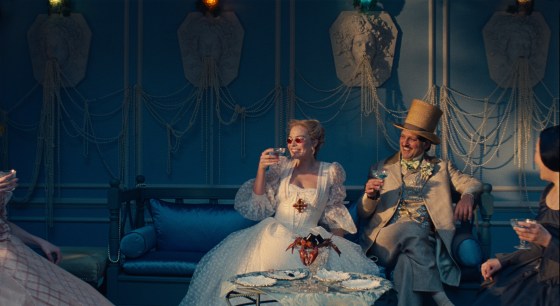
Margot Robbie and Shazad Latif in a scene from “Wuthering Heights.” (Warner Bros. Pictures / The Associated Press)
But I also think that creating a specific vibe, or creating an indelible image that is unsettling or disturbing and will stick in people’s minds forever, or creating something that is a feast to watch, is actually incredibly difficult to do, and it’s discussed as though it’s easy and unimportant. Style and substance are often regarded as opposites even though, sometimes, it’s the style that gives something substance.
Take Alfred Hitchcock or David Lynch or any other director who has such a strong and singular sense of style that it becomes a genre unto itself and they get a -ian suffix attached to their name. Script and plot are only two ways to tell a story; film is a visual medium. And, love her or hate her style, Fennell knows how to create a visual.
But even if you believe, as I’ve seen repeated over the past few days, that “Wuthering Heights” is a beautiful cake that turns out to be mostly buttercream, have you never run an index finger through an inch of frosting and plopped it in your mouth? Have you never binged on too much of something? Have you never enjoyed something you know is kinda bad for you?
And, if nothing else, Fennell’s fever dream is inspiring people to go see a movie in the actual theatre and read (and discuss) a 179-year-old novel.
|