|
Princess Auto has grown into one of Winnipeg’s pre-eminent retailers, but when you walk through the doors you might be tempted to ask, “Where are the autos?”
Instead, you’re greeted by a vast array of hydraulic components, tools, welders, trailer accessories, electrical bits and a large surplus section that’s perfect for replacing that umpteenth Lightning or USB-C cable that just broke.
The story of Princess Auto is a fascinating tale, well-told by my friend and former colleague, Bill Redekop. It began small, as many rags-to-riches stories do, with a wrecking business located on Princess Street in 1933.
Advertisement

Redekop’s book, written with the founder’s son, Bob Tallman, tells the story of triumph and tribulations — what worked and what didn’t — in growing the company to what it is today. The Princess Auto Story was launched Friday at the company’s flagship store next to its headquarters on Panet Road.
“This is a different kind of business book,” Redekop says in his Facebook post. “Few companies would be so open about how they did it, what they did right, what they did wrong, what was disastrous, what was a hit.
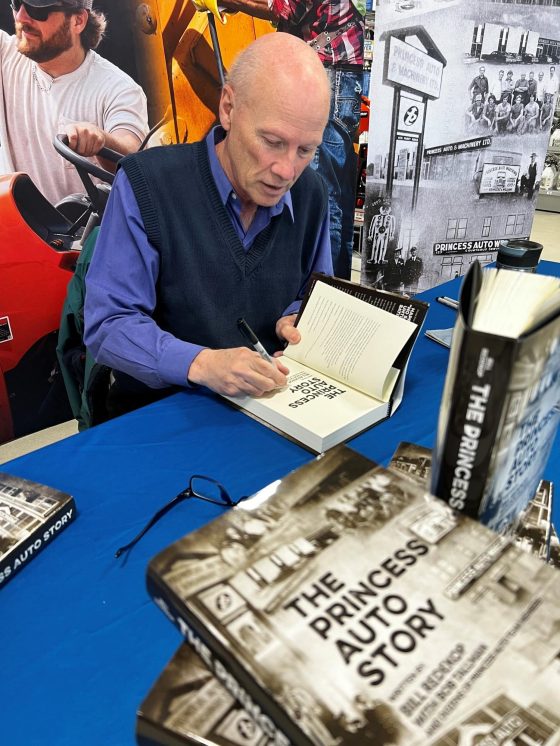
The Princess Auto Story was launched Friday at the company’s flagship store next to its headquarters on Panet Road.
“This is not a PR exercise.”
In 1942, Harvey Tallman bought the company and started its evolution. He began selling automotive parts to customers at the original location. By the 1950s, he was buying parts from the U.S. and cars from across western Canada. As part of the evolution, he travelled far and wide to find products needed by farmers. Many of those products were war surplus.
It all led to the creation of the first Princess Auto Catalogue, a tradition that continues today.
How successful is Princess Auto? Consider that Princess Auto just took over naming rights to the Winnipeg Blue Bombers stadium, rights formerly owned by IG, one of Canada’s largest investment firms. Princess Auto Stadium will greet its first Bombers fans June 6, when the Blue and Gold face the Montreal Alouettes in an exhibition game.
Today, Princess Auto is in the capable hands of Bob’s sons, Matthew and Marc, and operates 50 stores across Canada, with more set to open this year, according to the company’s website.
The book retails for $24.95 and is available at Princess Auto, of course. All proceeds go toward the Princess Auto Foundation, which provides financial assistance to pre-employment skilled trades and technology students at Canadian colleges.
There’s one quote from the book I’d like to share. It’s Bob Tallman speaking about how he values employees, and how good pay, good benefits and staff autonomy make for a better bottom line. “I want to go home and sleep at night. I didn’t want to have to worry about every relationship, every interaction and I believe that the people who work on the floor, the people who work in the distribution centre, the people who worked the factory when we had it, they know way better than I do about what to do. And as long as you give people the leeway and there’s no punitive action if they make a mistake, they’ll do a bang-up job.”
If you’ve never soiled your hands with axle grease or burnt holes in your overalls from welding or needed to get your skid steer working pronto, there’s a good chance you’ve never set foot inside a Princess Auto. If you have, then you likely know why it’s a hang-out for some of Canada’s hardest-working people.
Redekop, a master storyteller who covered rural stories across Manitoba, retired from the Free Press in 2019 and took on the role of freelance writer. His books include Made in Manitoba: Best of the Open Road Stories, Don’t Fence Me In: True Stories About Rural Manitoba and Lake Agassiz: The Rise and Demise of the World’s Greatest Lake.
Last week, I told you about the 2024 Hyundai Santa Fe, the all-new fifth-generation iteration of one of the Korean company’s most popular vehicles. In Friday’s review, I explain why it’s bigger, bolder and better than ever.
|