|
“Maybe we were all naive for believing that popular artists were worth looking at seriously, critically?”
— film director Kevin Macdonald
The release of Michael, a biopic of pop music’s late (but still maybe reigning) king, I’m reminded just how much of the history of famous people is controlled by their estates and their lawyers.
Advertisement

The Macro
The Rotten Tomatoes verdict following the first weekend of release for Michael — the Michael Jackson biopic — pretty much told the story. Or, at least, the story I’ll try to tell today.
Critics on average gave Michael a big thumbs down, with an aggregate score of just 38 per cent. I don’t expect everyone puts as much faith in Rotten Tomatoes as I do, but in my experience, a 38-per-cent aggregate critics score is a good reason not to see a movie.
On the flip side of the coin, more than 10,000 viewers logged their reviews. Not surprisingly, it got an overwhelming score of 97 per cent, which is “verified hot” on RT’s scale of reviews.
This is not a precedent-setting phenomenon. True fans of artists — musicians, painters/sculptors, authors, movie stars — always tend to find more value in a biopic project than casual or non-fans. Even when the movie represents a completely misleading, sanitized image of the featured artist.
All over the globe, critics panned Michael as a cowardly and misrepresentative portrait of one of the most popular, and most controversial, musical stars of all time. This take on the film is virtually the same: a dull, superficial narrative that completely skips the more controversial aspects of his life — drug abuse, extreme plastic surgery, allegations of pedophilia — that most fans and non-fans would accept as indelible parts of the singer’s legacy.
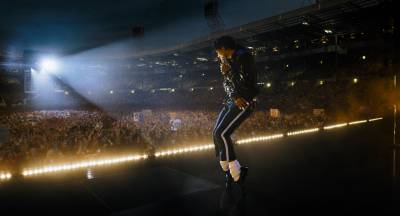
On the other hand, those concert scenes were scintillating.
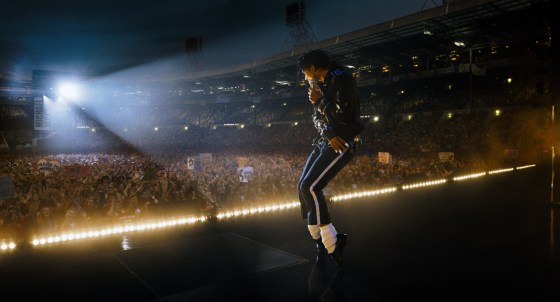
Jaafar Jackson as Michael Jackson in a scene from “Michael.” (Lionsgate via The Associated Press)
Biopics are as they have always been; dramatizations that skew heavily toward a sympathetic look at featured artist. In most instances, these biopics are created with the full participation of, and control from, the artist themselves or their estates. The biopics about Ray Charles, Elton John, Bruce Springsteen, Bob Dylan — just to mention a few more recent projects — were either produced by the subject artist, or involved some level of control by the artist’s estate.
Fortunately, in some instances, documentary films or series have served as a counterbalance to the sanitized narrative offered by dramatized feature film biopics. This was certainly the case with Back to Black, the much-criticized feature 2024 biopic of pop star Amy Winehouse. Like Michael, Back to Black was soundly denounced as a sanitized retelling of Winehouse’s tragic story. The dishonesty in the feature film was largely exposed by Amy, a remarkable and remarkably sad documentary released almost 10 years earlier (in 2015) by director Asif Kapadia that pulled no punches.
Unfortunately, this counterbalance provided by true documentary storytelling is increasingly under attack. I recently listened to an episode of Pablo Torre Finds Out, a really cool (IMHO) podcast hosted by investigative journalist Pablo Torre, who has written or contributed to a broad range of the best traditional media outlets.
The episode involved a detailed conversation with documentary director Ezra Edelman, one of the world’s best documentarians and Academy Award winner in 2017 for O.J: Made in America, an eight-hour documentary series that laid bare the life and times of disgraced football superstar O.J. Simpson.
Edelman worked for years to produce the definitive documentary The Book of Prince, a deeply intimate examination of the life and times of Prince, the Minneapolis-born music superstar who died tragically of a drug overdose in 2016. Remarkably, Edelman had already finished his multi-part series — which was commissioned by Netflix — when the streaming service gave in to concerns from Prince’s estate and decided not to air it in any form.

Prince performs in 1985 at the Forum in Inglewood, Calif. The musician died in 2016. (Liu Heung Shing / The Associauted Press files)
Netflix claimed that it “had come to a mutual agreement” with the Prince estate “that will allow the estate to develop and produce a new documentary featuring exclusive content from Prince’s archive.”
I encourage you to listen to the podcast interview with Edelman, the first long-form interview the director has provided since his project was spiked. It’s also very interesting context that Torres, who admits to being a friend of Edelman, got to watch the entire series.
I don’t want to belabour the obvious issues here, namely that this is a struggle between a corporate entity set up to continue profiting from the work of a deceased artist and the journalists or documentarians who feel compelled to give you the truth about those artists.
I’m a huge fan of Prince, even though I know he was emotionally and physically abusive to some of the people who were closest to him. I couldn’t care less about his substance abuse, particularly given that it’s part of the rock-and-roll lifestyle that somehow musicians continue to embrace. I would “Die 4 U” to see Edelman’s project, given that there is nothing in there that is going to stop me from celebrating Prince’s life and music.
Some of the stuff he did may be, for some people, a good reason to cancel him. I’m not one of them.
But I certainly won’t be consuming the new and approved documentary the Prince estate is working on now.
|