|
Don’t spend it all in one place.
That’s my advice for anyone figuring out what to do with the roughly $8.33 the Manitoba government expects the typical family to save each month when its expanded PST exemption kicks in July 1.
Look, I get it: the economic levers available to a provincial government on food prices are even fewer than those available to a federal government. The big driver of food prices right now is energy — the fuel to harvest crops, the fuel to process foods, the fuel to transport food. That’s a global economic issue beyond the reach of any one government.
Advertisement
(Except, perhaps, the government that launched a war of choice that’s driven up fuel prices, but I digress…)
Most of the food we buy is already PST-exempt. The expansion covers previously taxed items such as potato chips, carbonated drinks, bakery items and ready-to-eat prepared foods such as sandwiches, salads and soups, but only from grocery and convenience stores (more on that in a moment).
Essentially, it’s costing provincial coffers $24 million so that I can save 32 cents on a bag of Old Dutch. Be still my beating heart.
The exemption is flawed on so many levels. First, it undoes the reason for exempting whole foods in the first place, to be an incentive for people to stock up on nutritious meal components they prepare themselves, rather than empty-calorie snack foods and overly processed products.
It’s also patently unfair to restaurants. Look at it this way: if, after July 1, I buy a $10 sandwich from, say, Bagelsmith, I pay PST. If I buy an identical sandwich from Sobey’s or 7-Eleven (if I can even find a Sev these days), I don’t. To be sure, the exemption is for ready-made, grab-n-go foods sold through the grocery store cashier; anything made to order isn’t covered.
For an even more perverse example, if Bagelsmith strikes a deal to put its sandwiches into Save-On-Foods, the sandwiches sold at Save-On are exempt, the same sandwiches off the shelf at Bagelsmith are not.
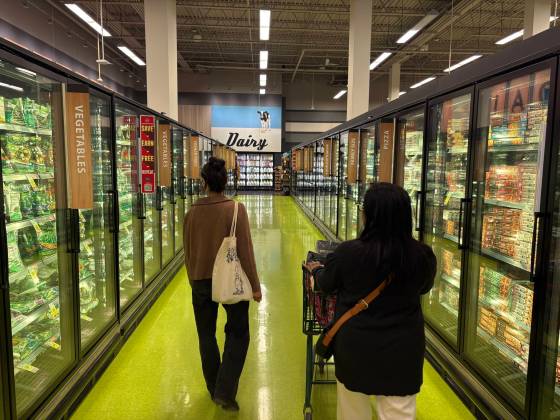
Customers shop at Save-on-Foods. (Conrad Sweatman / Free Press)
Shaun Jeffrey has given up trying to make sense of it all. Jeffrey, the CEO of the Manitoba Restaurant and Foodservices Association, says his group’s pitch for the same carve-out granted to grocery and convenience stores has been entirely disregarded.
“All we asked for was apples-to-apples, cost-to-cost, a fixed dollar amount, $10.99 or less, take-out only, no drive-thru, no in-house,” he said. “They’re just not interested in listening.”
Several times during our interview, Jeffrey paused, clearly exasperated. The industry isn’t asking for all of restaurant menus to be exempt, just those pieces in direct competition with exempted items at retailers. He’s particularly frustrated that the changes help 9-5 Manitobans, but, since stores are only open so late, shuts out Manitobans who end work late.
Kris Barnier, vice-president, central Canada, of Restaurants Canada, the national counterpart to Jeffrey’s association, says restaurants outstrip grocery stores in local employment by a factor of three. For every $1 million in sales, a restaurant employs 12 people while a grocery store employs four.
“It is our position that it is ridiculous and unfair to tax food items in some environments while exempting the same items when sold in others,” Barnier says in an email. “We believe the approach the government is taking is horrifically unfair to restaurant businesses, their employees and patrons.”
Jeffrey says the restaurant industry generally involves more local ownership than national and multinational retailers, so promising to make life better for Manitobans by making life worse for some Manitobans doesn’t make sense. For now, the restaurant industry is waiting to see how it all shakes out after July 1, when it can determine strategies to mitigate the effects, Jeffrey said.
The provincial government responded to a request to make sense of the dichotomy by providing a fact sheet essentially confirming the dichotomy. A repeated request for an explanation did not elicit a response.
Measures to combat inflation are welcome, but they should be reasonable and fair to all Manitobans. And should have a meaningful effect beyond a measly $100 a year.
|