|
“Our most powerful response to the horror in Israel and Palestine is to refuse to surrender our humanity.”
— author and filmmaker Valerie Kaur
Two stories of Winnipeg potential hate crimes in one weekend demonstrates the deep divisions that have gripped the world.
Advertisement

The Macro
It’s hardly surprising the Winnipeg Police Service linked the two potential hate crimes.
“‘An alarming and escalating trend’: Jewish community calls out hate after synagogue targeted,” read the headline of a worrisome story about an attack on the Congregation Shaarey Zedek in the early hours of Friday morning that left the building defaced with antisemitic graffiti.
In the early hours of Sunday morning, the front windows of the Habibiz Café on Portage Avenue were smashed and a threatening note was left behind. “Leave our country terrorist. F— off.”
Insp. Jennifer McKinnon from the WPS’s major crimes unit did not mince her words. “These incidents affect all of us and have a detrimental impact on our entire community.”
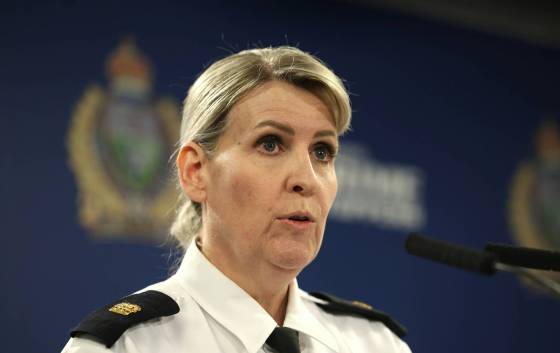
Winnipeg Police Service Insp. Jen McKinnon (Ruth Bonneville / Free Press)
Café owner Ali Zeid, who is of Palestinian descent but was born in Winnipeg, said he was equal parts sad and angry about the attack and threatening message. “It’s hate,” he said. “It doesn’t matter who it is. It’s just somebody hating on somebody.”
Gustavo Zentner, vice-president of the Centre for Israel and Jewish Affairs, told the Free Press the attack on the synagogue is part of a worrisome trend. “The problem with this is that once (antisemitism) gets normalized, it’s very difficult for society to uproot it, to take a stand against it, and to protect its own citizens,” Zentner said.
Those two comments have a common link. As Zentner said, hate, once normalized, becomes part of our identity. And as Zeid noted, hate is hate no matter the political or religious cause.
Unfortunately, the common experience suffered by people of all faiths, races, cultures or political beliefs when they are the target of hate is being lost in a conflict that is deepening divisions around the world. And not just between people with a direct stake in the conflict in Gaza.
It is pro forma right now for younger people around the world to stake out a rigid position on the Gaza conflict even if they do not lay claim to a racial or religious connection.
In December, I attended a concert in Dublin by the west Belfast rap group Kneecap. One of the group’s members, Mo Chara, was charged by the U.K. government in November 2024 for displaying a Hezbollah flag at a concert in London. Chara claimed the flag had been thrown on stage and disavowed any support for Hezbollah. The charges were later dropped but the impact of that incident — on both the music and the way the group has been viewed around the world — has been profound. Kneecap and their fans do not think the plight of Palestine is a cause. They believe it is the only cause in the world today.
Kneecap, and most of their fans, are unabashedly pro-Palestinian and view the conflict in Gaza as a genocide perpetrated by Israel. This posture has drawn the ire of other nations including Canada, which banned the group from entering the country last fall for a tour claiming the group was promoting terrorism and violence.
Kneecap is not promoting terrorism; the group has taken sides over the remorseless Israeli military attacks in Gaza without acknowledging the atrocities committed by Hamas on Oct. 7, 2023. Does Kneecap’s decision to only acknowledge one side in the conflict justify their banishment from Canada? Absolutely not. But they do embody the tribalization that affects both sides in this conflict.

Liam Óg Ó hAnnaidh, a.k.a. Mo Chara, centre, a member of the Irish-language band Kneecap, leaves Woolwich Crown Court in London in September 2025. (Joanna Chan / The Associated Press files)
Currently, you must be “for” one side without exception and thus, completely “against” the other. This is the overarching context for the global public-relations campaigns that joust with each other to claim some sort of moral high ground in a conflict that is short of morals.
Every day my inbox is flooded with dispatches from Honest Reporting Canada, which describes itself as an “independent grass-roots organization promoting fairness and accuracy in Canadian media coverage of Israel, the Middle East and matters affecting Canada’s Jewish community.” However, it also claims as part of its mission efforts to “challenge anti-Jewish rhetoric, particularly when antisemitism hides behind a mask of anti-Israel criticism.”
HRC is a lot of things, but independent isn’t one of them. That is not to say it is an illegitimate source of commentary. Rather, HRC is symbolic of the “must be for us or you’re against us” mentality. And while it claims to be searching for antisemitism lurking behind criticism of Israel, its dispatches largely denounce all anti-Israel criticism.
What appears to be lost by both pro-Palestinian and pro-Israeli forces is this unambiguous fact: both Hamas and Israel are to some extent motivated by genocidal agendas. Direct quotes from Hamas leadership and Israeli Prime Minister Benjamin Netanyahu make it clear that eradication of the other side is now the prime objective.
Not all pro-Israeli supporters or pro-Palestinian supporters believe genocide is the solution to conflict in this region. However, strident supporters of both sides cannot ignore the genocidal intentions that are present.
For a final thought, I will go back to author and filmmaker Valerie Kaur, whose 2023 essay provided the opening quote for this newsletter. Although there are many quotable parts, I was haunted by this one line that advocates for a triumph of empathy over division.
“I don’t know the solution to the conflict in Israel and Palestine, but I do know the starting point: To grieve ‘their’ children as our children.”
Amen.
|