How could tariffs impact the cost of plants? In a word: inputs
It’s not only gardeners who are wondering about the effect of tariffs on the cost of everything from plants to seeds, tools, fertilizers and pots. The entire ornamental horticulture industry is asking the same question. Origin of inputs is a key factor.
Let’s start with the example of peat-based potting mixes, which are found at local outlets. I have heard the comment expressed by several gardeners that at least peat-based potting mix is Canadian-made. So, no worries, right?
Indeed, the peat in potting mix is primarily sourced from Canadian-owned peat bogs, however, the raw materials such as perlite and vermiculite, which are used as inputs for many potting mixes, are often sourced from other countries. As well, the raw materials for wetting agents, which are often pre-mixed into potting mixes, are also imported.
Source of origin, therefore, is the operative phrase. If there are tariffs on imported components and raw materials — inputs as they are called — that are needed for certain products, the cost could be passed onto consumers.
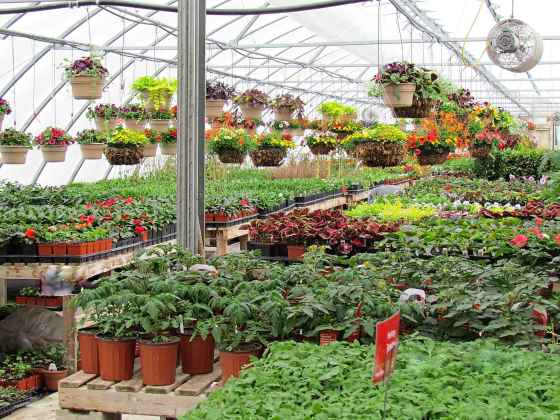
Will plants cost more this year? (Colleen Zacharias photo)
Then there is the example of blueberries grown in British Columbia. An article earlier this year in the Globe and Mail gave the example of how fresh blueberries grown and sold in B.C. could be impacted by tariffs.
Blueberry farmers in B.C. source blueberry bushes from nurseries in Oregon to replace aging plants. Currently, a third of the province’s blueberry acreage requires new shrubs. Shipments of fresh bushes are expected this spring. If counter tariffs by Canada come into effect before the shipment, blueberry growers will pay more for the bushes and consumers will pay more for the blueberries.
What about the prices of plants that we will see this spring at garden centres? Gardeners can make do without some things but not plants.
To get an idea of what gardeners might expect this year, I reached out to Bernie Whetter, owner of The Green Spot Home & Garden located in Brandon.
“We booked our orders last fall,” says Whetter. “We haven’t seen any changes on pricing on the materials we received this year.”
That’s the good news.
Many garden centres receive shipments of plants that are grown in Canadian-owned greenhouses. In some cases, the plant plugs and liners are supplied by American-owned companies.
“I’m assuming if the background materials (inputs such as plugs and liners) had to come from the U.S. to Canada, that would have been done before tariffs,” says Whetter. “The greenhouses have been shipping to us since the first of March.
“Now, I don’t know what will happen next year or what impact there will be. This spring we have avoided tariffs just because of timing but there could be an impact on shipments of plants for the fall. So, we could see that then. Also, I’m not sure whether these (plant) materials are exempt from the tariffs – I don’t know that.”
It’s a guessing game for all of us. But we can take heart in knowing that many shipments of plants have already arrived at garden centres in Manitoba before the U.S. tariffs.
Concerns about tariffs are shared by the horticulture industry on both sides of the border. This article in Garden Center Magazine provides more insights on potential impacts.
Winnipeg Gardener will continue to follow this evolving story closely.
Money-saving tips to make your plant investments go further
• Don’t shop too early for plants. The greenhouse environment at your garden centre, with its even distribution of light and controlled temperature and humidity levels, provides the ideal growing conditions for plants. It’s their happy place. You can keep tender annuals at home for a few weeks before it’s time to plant them outdoors, but if your plant purchases become stressed or the roots dry out, you may need to buy new ones.
• Read the plant tag. Plant tags provide the information you need to successfully grow a plant, such as ideal light conditions and moisture requirements, along with mature size and height and zone hardiness. The concept of right plant, right place is key to healthy plants. Winnipeg is Zone 3b. Purchasing plants that are hardy to our climate helps minimize the need to purchase replacement plants.

Read the plant tag (Colleen Zacharias photo)
• Direct seed some of your flowers. Growing annuals from seed costs pennies. If you don’t have the supplies or the space at home or the time to start seeds indoors, there are many types of annual flowers, like cosmos, zinnias, marigolds, morning glory and more that you can direct seed into garden beds once the threat of frost has passed. Follow the directions on the seed packet.
• Shop in your garden. That overgrown daylily, hosta, or perennial geranium you loved once upon a time can be made beautiful again and can be used to fill empty spaces in your garden for free. All you need is a sharp spade or garden fork to make it happen. Start by digging up the entire plant once the ground is warm and workable. Ensure you dig up as much of the root ball as possible. Divide the plant into two or three sections and replant each one immediately. Water thoroughly.
• Garden club plant sales are great places for plant finds. Plants cost less at plant sales, yet the plants usually have an already established root ball, which means they are ready to thrive in your garden once they are transplanted.
• Pledge to baby all your plant purchases. New plants that are neglected during the hot, dry days of summer have a poor chance of thriving or overwintering successfully. Guard against disappointment and extra expense by providing your plants with the TLC they need.
How to keep pansies looking their best
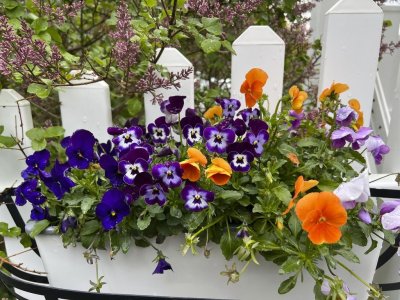
The garden pansy (Viola x wittrockiana) is a favourite cool-season flower for the spring and fall shoulder seasons. Viola is the ancient Latin name for a violet, which may help to explain why pansies are often called violas or violets.
The main difference between the pansy and viola is that pansies have larger flowers. The pansy also has a stockier habit.
To encourage more flowers and keep your pansies looking their best, remove flowers regularly as soon as they start to fade. Pinching back the new growth at the end of stems just above a leaf node (where the leaf joins the stem) will help to prevent your pansies from becoming leggy.
Pansies can tolerate a light frost, but move them back indoors or into a shed or garage if freezing weather is in the forecast.
To keep your pansies growing into the summer months so that they come back into full flower in the cooler temperatures of fall, plant them in a location that receives full morning sun and part shade in the afternoon. Avoid over-watering or splashing water on the leaves to prevent mildew.
Look for the Cool Wave Spreading Pansy series, a fast-growing, long-lasting, vigorous trailing pansy. Ideal for hanging baskets or patio planters, Cool Wave pansies have the most prostrate habit of any spreading pansies and can also be used as a groundcover.
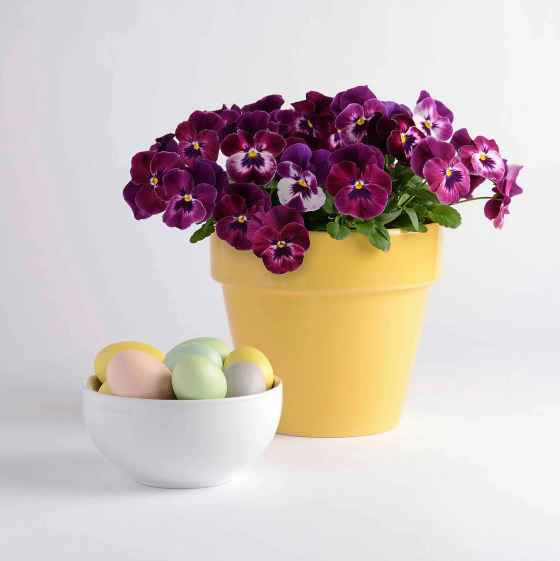
Cool Wave Raspberry Spreading Pansy (Ball Horticultural)
There are 18 different colours in the Cool Wave series! Cool Wave pansies look beautiful on their own or create a mixed container to display at your front door.
St. Mary’s Nursery is carrying Cool Wave Purple Spreading Pansy and Cool Wave Raspberry Spreading Pansy this spring. Carla Hrycyna, co-owner, recommends pairing Cool Wave pansy with Tradescantia Nanouk, a unique foliage plant from Dummen Orange that has leaves that are dark green, mint, pink and magenta. Tradescantia Nanouk is excellent for growing indoors or outdoors in a bright or part-shade location.

Tradescantia Nanouk grow indoors or outdoors, and looks great with pansies. (Dummen Orange photo)
Hrycyna suggests adding Asparagus Fuzzy Fern for a soft, draping effect in baskets and containers.
Direct-to-customer plant purchases: your best deal?
In March, Proven Winners, which is owned by two leading U.S. plant propagators, launched a special direct-to-customer plant promotion for Canadian consumers. The promotion is called Superpacks, which consists of a selection of six-packs, each one consisting of six Canadian-grown annuals for delivery directly to your door.
All the plants in the six-packs are grown in western Canada by Canadian-owned and operated companies. Superpacks are not available to ship to Quebec, New Brunswick, Nova Scotia, Prince Edward Island and Newfoundland and Labrador.
Customers can choose from nine combinations of annuals, one of which includes Supertunia Mini Vista Yellow, the Proven Winners 2025 Annual of the Year, along with two other varieties from the super-popular Supertunia Mini Vista Petunia series.

Supertunia Mini Vista Yellow, Proven Winners 2025 Annual of the Year (Proven Winners)
The price for each six-pack is $34.99 Canadian plus tax ($4.20). Shipping is included.
So, that works out to about $5.80 per annual in the six-pack. Also, each plant is in a 3.5-inch container. Typically, annual plants sold at independent garden centres come in 4-inch or 4.5-inch containers. Also, at garden centres, Proven Winners annuals must be sold in Proven Winners-branded containers that are a standard 4.25 inches, which means that the six-pack plants in the promotion are in containers that are a full inch smaller.
It’s not the size that matters. A smaller annual quickly catches up in size to larger annuals just as soon as temperatures warm up outside.
But there are other things worth considering.
The plants ship the week of May 12. These are tender plants, so if temperatures are cool outside or there is any risk of frost, the plants will need to be looked after in a protected, bright location before they can be planted outdoors. That’s doable, right?
For comparison, consider the example of plant prices at a local garden centre (Glenlea Greenhouses).
Glenlea Greenhouses sells annuals in 3.5-inch pots for $5.22. Six plants at $5.22 each adds up to $31.22 plus tax ($3.76) for a total of $35.08 compared to the Proven Winners Superpack six-pack, which costs $39.99 (including tax) for a difference of $4.91. But the more plants you buy, the more the difference adds up.
Bottom line: The Proven Winners Superpack features a curated selection of annual plants and a ready-made recipe. Plus the price is reasonable. The option of pre-ordering and direct-to-customer delivery does have its advantages.
But shopping locally supports local garden centres, the majority of which are family-run businesses.
What are your thoughts on direct-to-customer plant purchases?
This just in: Canadian-owned Bloomin’ Easy Plants has discontinued its direct-to-home live plant sales.
In a recent email in response to my inquiry, Kevin Cramer, director of marketing, said, “We got out of the e-commerce business ourselves to focus on what our team does best, which is marketing, but Bloomin’ Easy is still widely available online through partner sites. We list online retailers that carry Bloomin’ Easy on the find-a-retailer page of our website.”
Celebrate spring with locally grown cut flowers
Would you like to send fresh flowers for Easter or create a beautiful flower arrangement for your table?
Nico Vonderbank owns Twin River Gardens, a Manitoba cut flower farm since 1987, located in La Broquerie. For spring, Vonderbank is growing tulips, the sweet William (Dianthus barbatus), daffodils, ranunculus, anemones, snapdragons – as well as fresh herbs. “All of this will be available for Easter,” says Vonderbank, who also sells dried flowers.
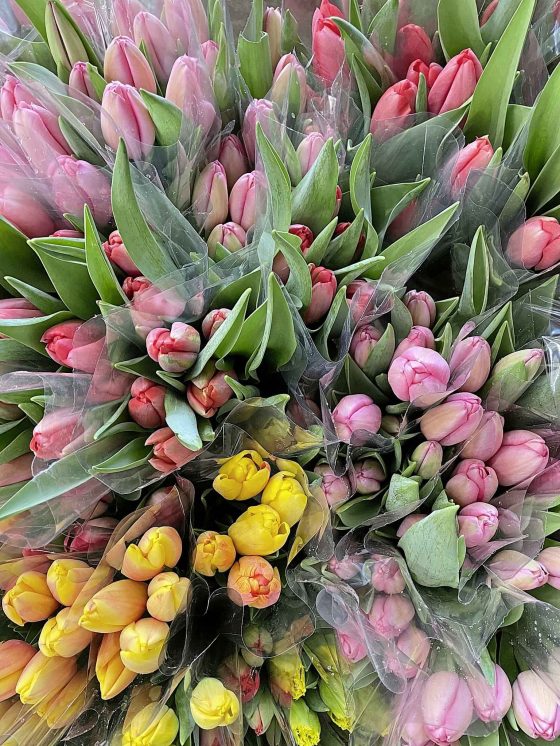
Locally grown fresh cut tulips (Twin River Gardens)
You may remember Vonderbank from Schriemers Market Place, where he was one of the principal growers for 10 years until deciding last year to grow cut flowers full-time.
Vonderbank started growing flowers 40 years ago in the Netherlands. “I was basically born and raised between the tulips and daffodils and spent my youth working at bulb farms,” he says.
Demand for locally grown fresh cut flowers has exploded in recent years, says Vonderbank. “It’s a whole different ball game. There is no comparison to when I first started my greenhouse business.”

Fresh flower bouquets, locally grown flowers (Oak and Lily)
Vonderbank supplies flowers to Petals West, a Winnipeg-based wholesale floral supplier that supplies florists. Local florists such as Oak and Lily Florist Studio, 1724 Corydon Ave., create beautiful bouquets with cut flowers from Twin River Gardens. Vic’s Market, 1049 Pembina Hwy., also carries Vonderbank’s fresh flowers. In May, Vonderbank’s flowers will be available at Jardins St-Léon Gardens, 419 St. Mary’s Rd.
This April, look for Twin River Gardens at the St. Norbert Farmers Market, where Vonderbank will have fresh-cut flowers in abundance.
Sneak preview
Have you always wanted to grow a horse chestnut (Aesculus hippocastanum) tree?
The Selkirk & District Horticultural Society is excited to share that horse chestnut seedlings will be available at its annual plant sale, which will be held on May 30 in Selkirk. Full details of the plant sale will be in the May edition of Winnipeg Gardener.
Fraser Stewart, whose property in St. Clements has many large horse chestnut trees, is currently growing the seedlings for the plant sale. “The horse chestnut tree was selected by Skinner Nursery many years ago. We have many large trees on our property developed from the seed from these beautiful trees,” says Stewart. “The original trees planted in the early 1950’s are still doing well.”

Horse Chestnut seedlings at Selkirk District Hort Society plant sale. (Fraser Stewart photo)
The horse chestnut tree is hardy to Zone 3a and produces large nuts that are not edible. A large deciduous tree, the mature height is 12 metres with a spread of 4 metres. In spring, it produces creamy white flowers, and in fall, the foliage colour is yellow to orange. The horse chestnut does not produce any fluff or catkins. It is in the same plant family as the Ohio Buckeye tree and shares a similarity in the palmately compound leaves, which have five to seven leaflets. As the smooth bark of horse chestnut ages, it develops scaly plates with deep furrows.
In other news, Lois Wales, president of Red River North Tourism, plans to grow patriotic red and white geraniums on her front steps this year. But she has another patriotic garden plan and hopes that gardeners across Manitoba will want to participate. I have the full story in my April 5 column.
Growing new gardeners
Looking for relevant, practical information about gardening in our Zone 3b climate?
Here is a list of resources as well as learning opportunities that are easily accessible for gardeners at any level of experience:
• The University of Saskatchewan offers an online, learn-at-your-own-pace Master Gardener training program that is designed to teach new and experienced gardeners the basics of gardening. To learn more about the program that the USask offers and how to become a Master Gardener, the Manitoba Master Gardener Association offers a training program information video and program information sheet on its website.
• North Dakota State University, a land-grant research university, provides research-based gardening information for northern gardeners.
• Garden clubs and horticultural societies throughout Manitoba offer monthly programming and workshops designed to hone gardening skills. For a list of some of the garden clubs in Manitoba, click here.
• Garden clubs offer diverse volunteer opportunities and the chance to work alongside other gardeners and gain valuable hands-on experience in the how-tos of maintaining food gardens and green spaces.
• The Prairie Garden, published annually in Winnipeg since 1937, features articles on gardening topics from A to Z written by garden experts and horticulturists from across the Prairies. Current and back issues are available here.
Stay up to date with Winnipeg Gardener, which contains a list of programming and volunteer opportunities each month, as well as gardening tips to help you keep your outdoor and indoor plants growing!
Looking for Canadian-grown dipladenia?
Fernlea Flowers is a third-generation family-owned grower since 1939. Based in southern Ontario, Fernlea Flowers supplies annual bedding plants to retail locations across North America.
One of Fernlea Flowers’ most popular brands is Rio Dipladenia.
Dipladenia is sometimes marketed as mandevilla, which gets confusing because while both are in the same family, dipladenia has a much different growth habit. Mandevilla can be a beast of a vining plant, with a height of 304 cm or more. Dipladenia is much more manageable with a compact, bushy form. Both have showy, trumpet-shaped blooms that come in five different colours.

Rio Dipladenia, Canadian grower, coming to a store near you. (Fernlea Flowers)
One of my favourite annuals because of its longevity and superb trouble-free performance in the garden, I buy at least two dozen dipladenia plants every year, which means I need to shop for the best price. Dipladenia plants don’t come cheap. I often find that Rio Dipladenia plants cost less than other types.
Sign up for a fresh shipment alert and you can have the pick of the crop when the shipment arrives. For care information, click here.
I display dipladenia in containers and window-boxes and find that it performs equally well in full sun and part shade. Best of all, Dipladenia is tolerant of spring’s sometimes contrary temperatures, which can be on the cooler side, and Dipladenia is also spectacularly heat-tolerant with only average water needs.
Meet Tiny Monster Garden’s Ryan Gauvin
Ryan Gauvin sources heirloom and experimental vegetable seeds from far-flung cities and farms that he visits. He has lived in several cities in Canada and loves the thrill of exchanging seeds. In March, the Lorette resident was riding his bike through the mountains of southern Mexico, meeting local farmers and talking about seeds.
Gauvin owns Tiny Monster Garden, which offers a wide range of seed varieties from beans to peppers, squash, and tomatoes that are grown without pesticides or synthetic fertilizers on his family-run regenerative quarter-acre (5058 square metre) property in Lorette.

Meet Ryan Gauvin, owner of Tiny Monster Garden in Lorette. (Tiny Monster Garden photo)
I met Gauvin at the March 8 Seedy Saturday event, where we talked about the exotic pole and bush beans that he had on display at his booth.
“The beans I grow are from all different parts of the world,” he said.
“Some of the varieties are Italian, some come from Africa, some from northern Mexico or California. The True Red Cranberry pole bean is one of the oldest known cultivated bean varieties in North America.”
The True Red Cranberry pole bean was originally grown and stewarded by the Abenaki First Nation of the eastern woodlands.
Gauvin said that much of the time, seed varieties from other parts of the world will not thrive in our cold climate.
“But sometimes, you get lucky,” he said. “An edible that grows in a high mountain area like northern Mexico will work fine in Manitoba because the latitude and altitude end up having the same environmental effect. We have such long hot days in the summertime, whereas even though it is a longer growing season in Mexico, the days are shorter because of the proximity to the equator so a lot of things even out.”
Gauvin grows every variety of the seeds that he sells. “That’s how I know they are going to work in Manitoba. I grow far more than I offer because I am always trying new things.”

Varieties of exotic bush beans and pole beans at Tiny Monster Garden in Lorette. (Colleen Zacharias photo)
A fascinating fact about Gauvin: he is an art historian who is originally from Vancouver, where he maintained a large community garden plot while he studied. He holds a BA in geography from Simon Fraser University, an MFA in documentary media from Toronto Metropolitan University, and a PhD in art history from the University of British Columbia.
Gauvin enjoys spending the long Manitoba winters researching and writing on a range of topics, including photography.
Plan to stop by Gauvin’s booth at the 2nd Annual Swallowtail Farmstead Pop-up Seedling Sale & Spring Fest on Saturday, May 24, from 10 a.m. to 2 p.m., where he will be selling seeds for direct-seeded crops.
Gimli gardener grows great quantities of geranium cuttings
The numbers are impressive, even startling — 342 geranium cuttings growing under bright white fluorescent lights in Cheryl Geske’s garage at her lakeside property in Gimli.
Each fall Geske selects the healthiest mother plants from the vast number of geraniums that decorate her spacious property. “Every year I seem to get another (geranium) as a gift, so the party gets even larger,” she says.
The mother plants are overwintered in her heated garage, which is maintained at a consistent temperature of 18 C.
Geske says that she must continuously monitor the older mother plants for insects such as aphids and mealy bugs. If the pest population is serious enough, she sprays the plants completely with soapy water.
Starting in November, Geske propagates new geraniums from stem cuttings, which she grows into larger plants over the winter. “I take cuttings in November and then start to transplant in March,” says Geske.
“My cuttings rarely get any critters,” she says.
To avoid any pest issues, Geske keeps the cuttings separate from the mother plants.
“I start the cuttings in my basement and use heated mats.”
Geske takes care to maintain good ventilation and an even temperature to reduce the risk of fungal infection.
In March — on the 26th to be precise — Geske began transplanting the rooted cuttings into small pots, which she fills with sterile potting mix and a small amount of compost.
The hundreds of transplants are now on shelves under lights in her heated garage.
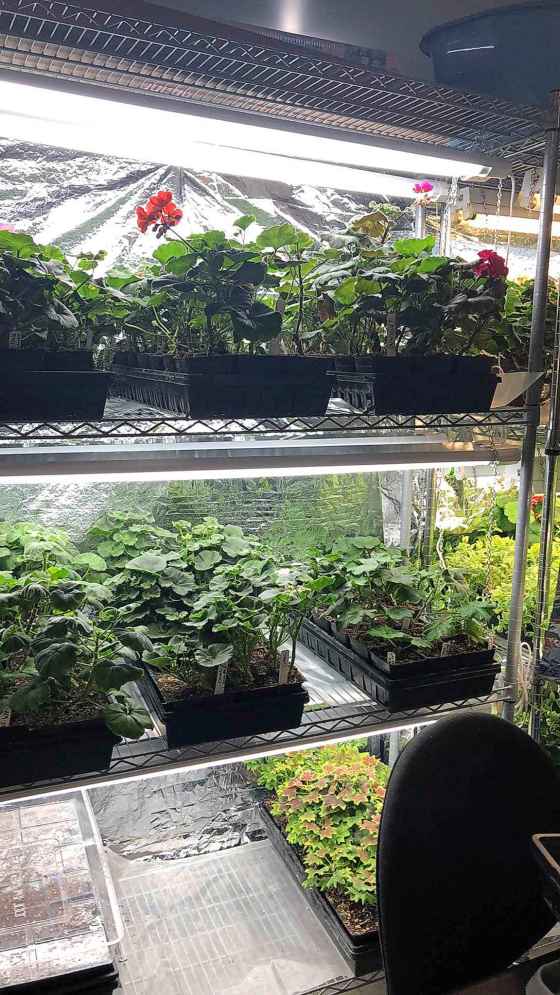
Geranium cuttings growing under fluorescent lights, March 2025. (Cheryl Geske photo)
To assist her in determining the best time for taking cuttings, transplanting, and seeding, Geske follows the recommendations of the Farmers’ Almanac planting calendar, which uses the phases and position of the moon.
Geske waters her seedlings when the top two inches (5.08) of soil feels dry to the touch.
By mid-April, Geske will apply a liquid fertilizer at half-strength. She will encourage bushy growth and side shoots by pinching or cutting back each seedling at the tip and removing flowers as they appear.
What a display Geske’s geraniums will make this summer! Growing your geraniums from cuttings is as cost-effective as it gets, too.
The power of purple
Dr. Rong Cao is a leading Agriculture and Agri-Food Canada (AAFC) researcher and global expert on the health benefits of deeply pigmented fruits and vegetables. His research has found that the dark pigment of edibles such as purple potatoes, blue tomatoes, and black carrots carries anthocyanins, a type of flavonoid that has anti-inflammatory health benefits.
“Since many chronic illnesses are related to gut inflammation, Dr. Rong believes purple potatoes can be an inexpensive way to gain access to the anti-inflammatory health benefits these colourful compounds provide,” said AAFC in a recent email.
Over the years, I’ve come across some stunning examples of purple edibles at local garden centres and in local food gardens. If you are shopping for purple edibles, check out these colourful varieties that are sold locally:
• Sage Garden Greenhouses, 3410 St. Mary’s Rd, has a wide assortment of certified organic seed potatoes in stock right now. One of the varieties is Midnight, a high-yielding potato that is purple on the outside and inside.
• At T&T Seeds, 7724 Roblin Blvd., you will find seed packets for Purple Haze carrot, a tapering purple carrot that grows 25 to 28 cm long! Smooth and purple on the outside, Purple Haze is bright orange on the inside. Best eaten raw as cooking dissolves the purple colour. This unique variety is a 2006 AAS Winner.
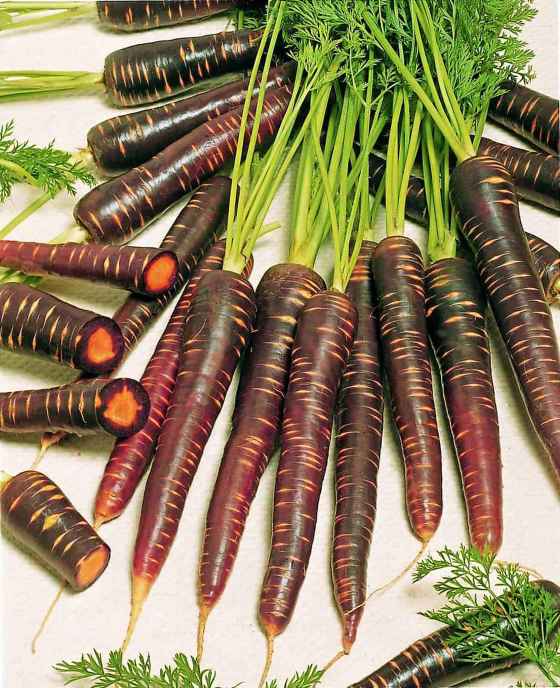
Carrot Purple Haze, at T and T Seeds. (All-America Selections)
• Muddy Waters tomato is one of seed-seller Ryan Gauvin’s top five favourite tomatoes. The owner of Tiny Monster Garden in Lorette, Gauvin says that this black and green indeterminate variety has a tropical fruity flavour.
• Jardins St-Léon Gardens, 419 St. Mary’s Rd., specializes in local food. Opening day is planned for late April. When fresh tomato season begins, Colin Remillard, co-owner, says that they will be offering varieties such as Dancing with Smurfs, a purple-black cherry tomato. “It has been a best seller for many years,” he says.

Purple tomato, Dancing with Smurfs. (Jardins St-Leon Gardens photo)
“Other popular purple tomatoes include Black from Tula, Black Krim, Brandywine Black and the very lovely Carbon tomato. The striped and purple Fred’s Tie Dye is also very eye-catching, and even as a dwarf variety produces quite well in my experience!
“We’ll also be carrying seeds for the wonderful Cosmic Purple carrot and Deep Purple carrot from West Coast Seeds,” says Remillard.
Haskap berries (also known as honeyberries) are a nutritional superfruit. Ideally suited to our soil and growing conditions, the outer layer of the haskap berry is blue and has two to three times the amount of antioxidants as blueberries. Boreal Blizzard, developed at the University of Saskatchewan, has the largest fruit of any haskap cultivar. It is a low maintenance shrub that doesn’t sucker. It grows to a height of 1.5 to 2 meters. Plant Boreal Blizzard with Boreal Beast for cross-pollination.
Share your thoughts on green spaces and natural areas
What matters most to you about public green spaces and natural areas and why? On March 18, the City of Winnipeg launched a new survey that asks Winnipeggers to share their input by April 15.
The City is creating a Greenspace and Natural Corridors Plan Bylaw (Greenspace Plan) and a Biodiversity Policy, which will help the City manage, protect, and restore natural areas while increasing biodiversity within Winnipeg.
The project will be developed in collaboration with First Nations, Metis, and Inuit governments and organizations.
To take the survey and learn more about this initiative, click here.
Calls for volunteers
Henteleff Park is located along the banks of the Red River and Normand Creek in south St. Vital at 1964 St. Mary’s Rd. It has a diverse habitat, including a tall grass prairie restoration, tree-lined trails, a riparian ecosystem, an interpretive centre and a food forest.
Volunteers are needed to help maintain the green spaces at Henteleff Park. Tasks include spring cleanup, planting and watering trees, pulling weeds, trail maintenance, and harvesting fruit.
Please contact Marg Allen, volunteer coordinator, at info@henteleffpark.org.
Sustainable South Osborne Community Co-operative
Sustainable South Osborne Community Co-operative (SSOCC), a fruitful garden space located at 250 Churchill Dr., is planning a spring clean-up of its orchard and garden beds as soon as the weather permits, says Barbara Ediger, garden steward of SSOCC’s raised beds in the river garden.
For more details, click here.
Learn more about plants of the North
Before I tell you about The Boreal Herbal Wild Food and Medicine Plants of the North – A Guide to Harvesting, Preserving and Preparing, an excellent book written by Canadian author Beverley Gray, a boreal herbalist and aromatherapist who lives in Whitehorse, Yukon, let me begin by asking you a question.
Where are your favourite gardening books by Canadian authors published? That’s becoming an essential question.
Ottawa is considering counter-tariffs on books. The problem with this is that nearly 50 per cent of Canadian books are published in the U.S. Take, for example, Growing Under Cover: Techniques for More Productive, Weather-Resistant Pest-Free Vegetable Garden (2020) by best-selling Canadian author Niki Jabbour. The publisher is Storey Publishing, which is in Massachusetts.
The proposal of a 25 per cent tariff on books has serious implications.
As I was rummaging through my collection of gardening books, I pulled The Boreal Herbal off the shelf. An award-winning national bestseller by Beverley Gray, The Boreal Herbal was published in 2011 by Aroma Borealis Press in Whitehorse, Yukon, with the financial assistance of Agriculture and Agri-Food Canada.

The Boreal Herbal, Wild Food and Medicine Plants of the North by Beverley Gray. (Aurora Borealis Press)
This comprehensive 440-page book is an indispensable guide to herbs, berries and trees found in the northern boreal forest. It is a celebration of the richness of plants that grow in Canada’s north as well as a medicine chest packed with instructions on how to gather and preserve wild plants, including detailed recipes.
Gray owns the Aroma Borealis Herb Shop in Whitehorse, Yukon.
Add this quintessential Canadian book (and Whitehorse as a destination!) to your bucket list.
Available for ordering online for $44.95
Mark your calendar
• Discover inspiration for your next project at the 2025 Winnipeg Home + Garden Show, April 3 – 6, at the RBC Convention Centre, 375 York Avenue. Hours are Thursday and Friday, Noon to 9:00 p.m., Saturday 10 a.m. to 9 p.m., and Sunday 10 a.m. to 6 p.m. Featuring vendors, displays, and main stage presentations on planning and designing your garden and landscape. Details and tickets are available at winnipeghomeandgardenshow.com.
• The 38th Annual Gardening Saturday takes place on Apr. 5, 7:45 a.m. to 4:15 p.m., at the Alerus Centre, 1200 42nd St. South, in Grand Forks, ND. The keynote speaker is Michelle Bruhn, regenerative gardener and co-author of Small-Scale Homesteading. Events include morning and afternoon classes, vendors, and a Silent Auction. Gardening Saturday is co-hosted by the Grand Forks Horticultural Society and North Dakota State University Extension. Online registration, class descriptions and additional information can be found at gardeningsaturday.info.
• The Manitoba Giant Growers Association presents the Giant Pumpkin Growers Seminar Saturday, April 5, from 1 p.m. to 3 p.m. at Canalta Selkirk, 1061 Manitoba Ave., Selkirk. Learn the intricacies of growing giant pumpkins and how to compete in weigh-offs. Presentations, question period, free seeds, including seeds from 900+ kg 2000+ lb. pumpkins. Free refreshments and free snacks. Admission is free. Donations are welcome. For more information, contact Art Cameron at artcam@mymts.net.
• Agassiz Garden Club presents De-Mystifying Bonsai with Stu Innes, bonsai expert, on Wednesday, April 9, at 6 p.m. at Lutheran Church of the Cross, 253 McArthur Ave., Lac du Bonnet. Admission is free.
• On April 7, at 7 p.m. at the Canadian Mennonite University South Campus, 600 Shaftesbury, Gardens Manitoba will host Anna Turner, sheep farmer and owner of Long Way Homestead, for a presentation on “Wool in Manitoba: For Gardens and Sustainability.” Doors open at 6:30 p.m. Admission is $5. The evening includes snacks and a seed trade.
• On April 9, from 7 p.m. to 8 p.m., the Winnipeg Public Library offers a free online Zoom event, Birds, Butterflies and Bees in the Garden with Dr. Eva Pip. For more details and to register, please click here.
• Join Marika Olynyk, Curator of Winnipeg’s Living Prairie Museum, for her presentation, Native Pollinators and You, on Thursday, April 10, 6:30 to 8:30 p.m. at McNally Robinson Community Classroom, 1120 Grant Ave. Videos, displays and demonstrations will be included in the presentation along with additional resources for participants. Registration is $25. Click here for more information.
• The Manitoba Regional Lily Society Spring Seminar and Annual General Meeting is on Saturday, April 12. Featuring an exciting lineup of speakers from around Manitoba, the event takes place at the Bourkevale Community Centre, 100 Ferry Rd., from 9 a.m. to 4 p.m. Registration is $35 and includes lunch. Please email Marlene Puls at mmp99m@mymts.net.
• Shelmerdine Garden Centre, 7800 Roblin Blvd., Headingley, hosts a Spring Fling Event on April 12-13. It features greenhouse tours, seminars, live music, food trucks, and more. First come, first served seating! Everyone is welcome. For details, please click here.
• St. Vital Agricultural Society presents a Gardeners Evening on Wednesday, April 16 at St. Mary’s Church, 610 St. Mary’s Rd. It features a plant sale, silent auction, and informative presentations on pollinators and pests, spring garden prep, and composting. There is no fee to attend, but remember to bring cash to purchase plants! Please register by emailing pjmcfarlane@shaw.ca. Visit www.svas@svas.ca.
• Earth Day is April 22. The Forks is celebrating Earth Day by hosting a presentation on April 25, 6 to 8 p.m., by Trina Semenchuk, founder of The Little Greenhouse That Could. Learn the basics of indoor growing, including tips on selecting the right plants, providing the best care, and creating a thriving indoor garden. The presentation will be held on the second floor of the Forks Market. For more details and tickets, please visit The Forks website. Registration is $27.96 on Eventbrite.
• Discover the art of modern homesteading at the Manitoba Homesteading Show & Farmers Market on Saturday, April 26, at Little Britain United Church Hall, 5879 PTH 9, Lockport. Featuring interactive presentations and hands-on experiences. Click here for more information.
• The Manitoba Horticultural Association presents Planting our Future — Garden Party 2025 on Sunday, Apr. 27, 10 a.m. to 5 p.m., at the Meyers Norris Penny Exhibition Building, Island Park, Portage la Prairie. Join us for a fun-filled day of presentations, vendors, and a draw for prizes. Lunch, catered by Bill’s Sticky Finger,s is included. Early bird registration (Apr. 6) is $35 for members and $45 for non-members. For more details, visit mbhorticulture.ca.
• On April 28, the Herb Society of Manitoba welcomes Trina Semenchuk, founder of the Little Greenhouse that Could, for a presentation on vertical gardening at 7 p.m. at Canadian Mennonite University South Campus, 600 Shaftesbury. Admission is $5. Visit herbsocietymb.com.
Thank you, Mr. Tomato
Brian Gory, known affectionately as Mr. Tomato, passed away in March. Many gardeners associate Gory with Kozy-Coats and Sea Magic, two game-changing products used by a generation of gardeners.
Kozy-Coats are re-usable water teepees that can be used in early spring to protect plants from frost and allow at least a one-month head start in the garden. Sea Magic is a dry, soluble seaweed extract for fertilizing indoor and outdoor plants.

Brian Gory, a.k.a. Mr. Tomato, right, in his Winnipeg garden. (Greg Klassen photo)
In 2004, Gory sold his business to HJS Wholesale, a Winnipeg-based business. Today, both products are registered trademarks of Bonadea Gardens.
In his career, Gory wrote for several newspapers, but Greg Klassen remembers him for his ambitious style of gardening and warm hospitality whenever visitors dropped by his eclectic garden on Kilbride Avenue near Rainbow Stage.
Klassen, an avid gardener and the marketing director for the Manitoba Theatre for Young People, says that Gory’s lushly planted garden was his lifelong project. “I think that he was inspired by VanDusen Botanical Garden in Vancouver which is planted with varieties from all over the world. He grew alpine plants and so many other types of plants.
“The one thing that really struck me about his garden is that he just never stopped changing it. Most of us find a style we like and stick with it, but you could walk into his garden one summer and it was completely different than the year before. He would even move the pond.
“Brian was very much into vertical gardening. It was a small yard, and he liked to grow things up. He had that excitement for having the first tomatoes on the block and talked a lot about how to extend the growing season. He loved starting pansies from seed and displaying them outside in April. He helped me renovate and design my garden space and enjoyed doing that for a lot of people.
“He was an absolute gardener.”
Your questions, answered
Have a question for a gardening expert? Reply to this email with your question and we’ll seek answers from some of Manitoba’s most knowledgeable gardeners. If you’re asking about a problem with a plant or pest, please attach a photo to help our experts diagnose the issue.
|