THE MACRO
Shame on you, TSN.
On Monday’s coverage of Euro 2020 — given the “2020” designation because it was supposed to happen last summer and they didn’t want to print new T-shirts — TSN’s panel of experts were called upon to preview a game between Ukraine and Austria.
In that segment, TSN demonstrated extremely poor judgement in discussing the return of Austrian striker Marko Arnautovic. In short, the panel ignored the reason why Arnautovic was suspended.
Following a goal in a June 13 game against North Macedonia, which made it 3-1 Austria, Arnautovic allegedly made racist threats against two of the players on the North Macedonian team.
Not all news organizations bothered to find out what was said but some did report that Arnautovic, who is of Serbian descent, made obscene comments to North Macedonian player Gjanni Alioski, who is of Albanian heritage. The polite translation had Arnautovic threatening to perform a sexual act on the mothers of the Albanian-Macedonian players who were the objects of his derision.
There was little doubt that something awful was said. At one point, Austrian captain David Alba grabbed Arnautovic by the face and tried to stop him from yelling at the Macedonians. UEFA suspended Arnautovic for one game but refused to confirm what was said. A deeper investigation continues.
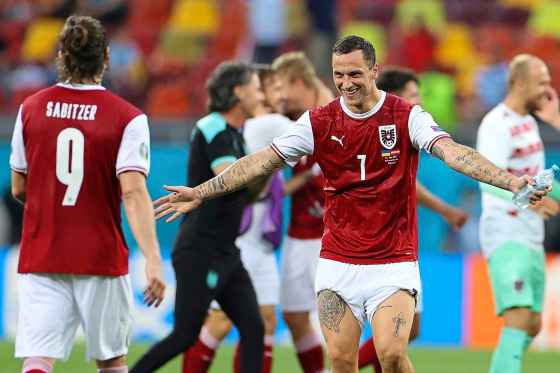
CPAustria’s Marko Arnautovic celebrates after the Euro 2020 soccer championship group C match between Ukraine and Austria at the National Arena stadium in Bucharest. (Marko Djurica / Pool via AP)
Why would a Serbian-Austrian striker lash out at Albanian-Macedonian players? Very quickly, it all goes back to a bloody 1998-1999 conflict between Serbian and Albanian rebel forces in Kosovo, the legacy of which still obviously burns brightly for men whose families were directly affected.
Despite the outrageous nature of Arnautovic’s outburst, it was hard to tell from TSN’s expert panel of soccer analysts — all former professional players — that anything untoward had happened.
In the pre-game analysis of the Ukraine-Austria match, host Luke Wileman acknowledged that Arnautovic was returning “after suspension” but failed to mention why. Even worse, the image that TSN used (but did not acknowledge) as the host gave his pre-game report was a still picture of the start of Arnautovic’s angry and allegedly racist tirade.
Then, former Scottish international soccer player Steven Caldwell went on to offer this assessment of Arnautovic: “He’s a guy who can do something special in a moment, change an entire game,” an effusive Caldwell said. “He’s a magnificent player.”
And that, readers, is an excellent example of how the people who make their living on international soccer would prefer to ignore the ugly politics in their sport.
I’m not saying that Arnautovic should be cancelled from TSN’s coverage. Obviously, he’s an important player for his team, and TSN is providing analysis on every team and every match to feed the appetite of soccer enthusiasts in Canada.
But it really seemed journalistically unethical to exclude the reasons for his suspension. All they had to do was mention that Arnautovic has been accused of racist slurs, denied it and an investigation continues.
Imagine if a politician who took a leave of absence after being accused of sexual misconduct returned to work and beat reporters only acknowledged that he was “returning after a brief break from political duties.” Would that fly?
Lamentably, TSN is only adhering to the rules of engagement seen so often in sports journalism.
WHAT HAPPENS WHEN SPORTS ORGANIZATIONS AND JOURNALISTS IGNORE POLITICS?
Before anyone from TSN or their apologists tries to rationalize what happened, I offer this small note of caution: do not try to argue that football and politics are not fundamentally intertwined. External politics (in the countries that make up the sport) and internal politics (among EUFA, FIFA and other governing bodies) is as much a part of the game as cleats and corner kicks.
And let it be said as well that football has done a pretty magnificent job at ignoring the ugly issues outside the pitch — particularly racism and homophobia — that so often become part of the game.
Kick it Out, was created 25 years ago to track incidents in English football and advise governing organizations on responses to discrimination and racism. Kick it Out reported a 53 per cent increase in racist incidents in the 2019 English Premier League season. That same worrisome trend was seen across the world of soccer in 2019 and beyond.
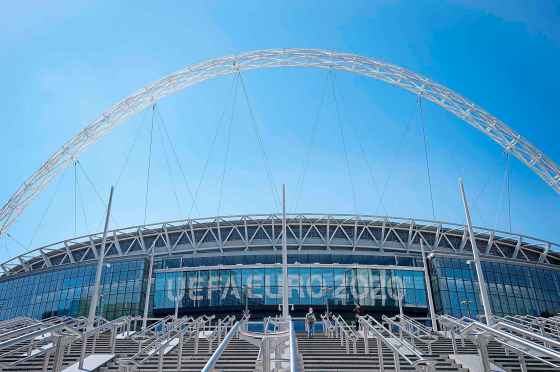
CPThe entrance to Wembley stadium, in London. (Frank Augstein / AP Photo file)
In April, UEFA handed down a 10-game suspension — the minimum penalty available — to Ojdrej Kudela after confirming that he racially abused Glen Kamara, a midfielder for Rangers F.C. of the Scottish premiership, during a Europa League game. UEFA has refused to release the details of its investigation and actually suspended Kamara as well for shoving Kudela after the racist taunts.
Those incidents seem to pale in comparison to what we’ve seen at the Euros. In addition to Arnautovic’s deplorable behaviour, several games have been marred by overtly racist and homophobic incidents.
Prior to a first-round game between Portugal and Hungary in Budapest, black-shirted Hungarian fans — all members of an ultra-nationalist, neo-Nazi movement in Hungary — marched to the stadium with banners taunting players who take a knee before matches as a sign of support for anti-racism.
Inside the stadium, those same fans unfurled a banner with a homophobic message and repeatedly yelled “Cristiano Homosexual” at Portugal’s star striker Cristiano Ronaldo. They also repeatedly demonstrated a Nazi salute during the game.
Ronaldo was hardly the only player to suffer this kind of abuse. A few days later, when Hungary were playing France, the same black-shirted fans hurled racist taunts and made “monkey noises” at superstar striker Kylian Mbappe.
As a side note, UEFA knew full well there was going to be trouble at the Euros in Budapest.
Black-shirted Hungarian soccer fans have attacked visiting players, particularly those of colour, for many years now at sanctioned European competitions. The situation was made a bit more acute when the Hungarian National Assembly passed a law just prior the start of the Euros which bans the sharing of any content about homosexuality or sex reassignment with minors. It has been broadly condemned as an act of state-sponsored homophobia.
WHAT ROLE DO JOURNALISTS (AND ATHLETES) PLAY IN THE ONGOING CAMPAIGN AGAINST RACISM?
As the Black Lives Matter movement showed last summer, there is no credible argument for trying to keep sport and politics apart. That presents special challenges to journalists who have become comfortable focusing their work on the game, while excluding anything else as not worthy of mention.
TSN is hardly the only example of this kind of deliberate indifference. I was pretty alarmed to read a column by Guardian soccer columnist Andy Hunter about the lead-up to the France-Hungary game.
Hunter did mention the incident at the Portugal game and the homophobic banner and the passing of the anti-homosexual content law. One paragraph in between a colourful description of raucous Hungarian fans gathering en masse outside the stadium and another paragraph predicting the weather for the match.
More worrisome was the headline: “Hungary plan to get stadium rocking and make France feel the heat.” It was accompanied by a picture of the black-shirted ultra-nationalists who are responsible for all the hate being spewed at the matches.
This kind of approach is not just unhelpful, it’s actually hurtful.
As noted above, UEFA knew Hungarian ultra-nationalists were going to act out at the matches in Budapest. Despite that, they still awarded Hungary opening-round games and did nothing to stop the black shirts from entering with banners, or control their behaviour before or after games.
And journalists and news organizations, through their inaction, helped to normalize this kind of behaviour by portraying it casually or ignoring it all together.
The politics of international football makes it very unlikely FIFA, UEFA or any of the big domestic leagues will do anything serious to crack down on the rampant racism and homophobia in soccer. Standing up for principles is not good for business.
But that is not an excuse for journalists and news organizations to take the same approach.
We’re supposed to aspire to a higher ideal in everything we report on. We can’t do that if we spend as much time ignoring ugliness as we do reporting on it.
|





.jpg?w=400)