How to keep conifers healthy
Recently I visited Lothar Behnke’s Winnipeg garden.
Behnke operated Behnke Greenhouses — formerly located near Rose Avenue in St. Vital — for 30 years before it closed in the mid-1990s. He also hosted a gardening show on CJOB which ran for many years. His sign off every weekend was, “Plants love people. Start an affair today.”
After living and working in Dallas, Texas, for 21 years, Behnke returned to Winnipeg in 2023. The new garden he has made is filled with numerous conifers brimming with lush, healthy foliage.

Conifers in Lothar Behnke’s Winnipeg garden (Colleen Zacharias)
What’s his secret?
At the time of planting, Behnke adds Pro-Mix.
“Pro-Mix contains a bit of peat moss, which adds organic matter and makes the soil looser,” says Behnke.
“Peat moss has a pH of 4.5. Most of our Manitoba soil has a pH of 7.5 to 8 – so, fairly alkaline – but almost all plant material does best in a soil pH of 6.5,” Behnke added. “Coniferous plants prefer a pH of around 6 because they drop a lot of needles which acidify the soil. By adding peat moss, you bring down the pH naturally to a much more tolerable level for coniferous plant material.”
Behnke also waters his coniferous plants regularly.
“I water only at the drip line (the area around the tree at ground level which is just outside the tips of the branches), not under the tree and never against the trunk,” he says.
The lazy days of summer
💧 Water plants deeply early in the day. Let the water soak slowly into the ground.
Overhead watering mainly reaches the canopy of plants. Instead, use a sprinkler that sits close to the ground to deliver moisture directly to the root zone of plants where it is needed. Allow the water to soak slowly into the ground.
🌳 A slow-release tree watering bag is a quick and easy way to deliver adequate water to a newly planted tree. A reusable watering bag that holds 75.7 litres of water, enough for a deep watering, is available at local Canadian Tire stores for $26.99 plus tax. Remove the bag after watering.

A watering bag allows water to seep slowly into the soil around newly planted trees. (Colleen Zacharias)
🪴 Still have potted plants that need to be planted in the ground? Me, too. Move the pots to a bright, shady spot and don’t allow the soil to dry out. Once temperatures cool down a bit, get them planted!
💩 To avoid fertilizer burn, ornamental perennials, shrubs and trees should not be fertilized when temperatures climb above 25C. Keep in mind, too, fertilizing late in the growing season can result in leafy new growth that does not go dormant in time for winter.
To avoid leaf scorch, take a break from fertilizing container gardens during a heat wave. Mineral salts in synthetic fertilizers only enhance the moisture loss that occurs in hot weather.
🌷 Now is the time to order your fall-planting flower bulbs for your best spring garden!
The hazy days of summer
So far, Manitoba’s 2026 wildfire season is nowhere as severe as the wildfire season in 2025, which ranked as one of the worst in Manitoba’s recorded history.
At the time, gardeners and farmers alike openly wondered if plants and crops were being affected by smoke particles.
There is significant research ongoing in Canada on the impact of wildfire smoke. Researchers at Agriculture and Agri-Food Canada, the University of British Columbia and the University of Saskatchewan are studying the physiological and yield impacts of smoke on plants as well as on biodiversity.
What you can do in the garden to protect plants and pollinators during prolonged smoky periods:
🥀 Protect flowers and edibles from heat and drought stress by watering deeply to maintain consistent soil moisture.Early in the morning, hose down foliage (use the shower setting on your garden hose nozzle) to remove any fine particulate matter that may settle on leaves. Fine ash clogs the stomata (tiny pores) that leaves use to breathe and process carbon dioxide. Fine particulate matter can also reduce the essential process of photosynthesis.
⛔ Avoid using high-nitrogen fertilizers during smoky periods, as it can further stress plants by triggering active growth.
🐝 Provide fresh water for pollinators, which can become disoriented in smoky air. Use a shallow dish about 2 to 3 cm deep with marbles or pebbles for butterflies and bees to land on safely.
😶🌫️ Smoke from wildfires will reduce the air quality. Pay attention to air quality warnings when smoke particles are in your area. For up-to-date data, use the Environment Canada Air Quality Health Index, Manitoba Air Quality Monitoring, or IQAir Winnipeg Map.

During days where air quality is compromised, gardeners can provide fresh water for pollinators, which can become disoriented in smoky air. (Colleen Zacharias photo)
Gauge the rain
Rain gauges are handy tools for measuring rainfall. But if you don’t have one, the City of Winnipeg’s rainfall gauging program collects data over the entire city.
The city also operates a permanent rainfall telemetry network at participating schools around the city.

The city’s rainfall report for July 24. (City of Winnipeg)
When my rain gauge broke in the soaking wet month of June, of all times, I checked the data for the amount of rain recorded by the rain gauge at the elementary school just a block from my house.
Your Monarch butterfly sightings matter!
Take part in the 10th anniversary of the International Monarch Monitoring Blitz which takes place between July 31 and Aug. 9.
Count the number of monarch butterflies, caterpillars and milkweed plants in your area and enter your sightings on the Mission Monarch platform.

A monarch butterfly feeding on milkweed (Erin Hooley / The Associated Press files)
Mission Monarch is a community science platform led by the Montreal Space for Life Insectarium.
It gathers public data on milkweed and monarch butterfly distribution. This important data helps scientists to track population trends and protect conservation areas.
An ounce of prevention
After a season of stormy weather across the Prairies — including tornadoes and damaging hail — Myra Froc, a Winnipeg Gardener reader who lives in the Qu’Appelle Valley north of Regina, recommends keeping a plant inventory for insurance purposes.
“Just having been through an excruciating and lengthy insurance claim ordeal on our cottage, we are advising people to keep curated lists of their perennials with receipts or links to replacement costs,” Froc said.
“Photograph plants now when they are at their peak. Even our trees lost in last year’s northern wildfires were covered because we had an extra rider on our insurance policy for tree losses.”
To do a plant inventory for insurance, list your plants by name and note their size. If receipts are not available, list the current replacement cost. Contact your insurance company to request a downloadable PDF or spreadsheet template.
Colorita Fabiana: an awesome annual
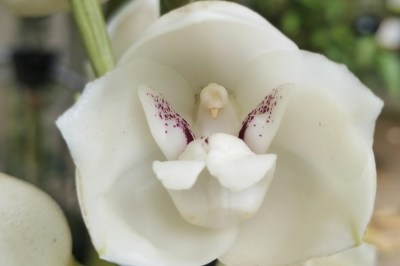
Alstroemeria Colorita Fabiana, also known as Peruvian Lily, is a stylish addition to containers and window boxes.
This compact, continuous-blooming annual is a great double-duty plant. It offers tapered dark green leaves with creamy-white variegated margins along the edges and an abundance of pale butter-yellow blossoms.
Alstroemeria’s signature linear markings (often called whisker lines) on the petals of Colorita Fabiana are dark burgundy.

Colorita alstroemeria Fabiana, aka the Peruvian Lily, is an awesome annual. (Colleen Zacharias photo)
Colorita Fabiana is a mid-sized, mounding plant (about 28 cm tall and wide) which makes it suitable as a filler that won’t overtake other plants. There’s a good chance it will steal the show, though!
I bought this beautiful annual for the variegated foliage and will look for it again next year for its amazing flowers.
I paired Colorita Fabiana with pink dipladenia, Little Lamb lamb’s ear, and Havana Sunrise lantana which has soft pink and lemon-yellow centres.
A really big hydrangea story
Recently spotted at a local retail store: A plant tag for Phantom Hydrangea paniculata shrub that states the mature height and width as 3.4 meters (or 10 feet).
That’s a mighty big hydrangea. Indeed, Phantom, which was first introduced in 1990 in the Netherlands, can reach up to 10 feet in longer growing seasons if left unpruned.
But it is a tried-and-true practice to cut stems back on panicle hydrangeas in early spring to promote healthy growth and maximize both bloom production and flower size.
I’m skeptical that a Phantom hydrangea shrub could grow to such an enormous size in our short growing season. I have grown this variety in my garden for many years and at best, it reaches 160 cm (a little over 5 feet).
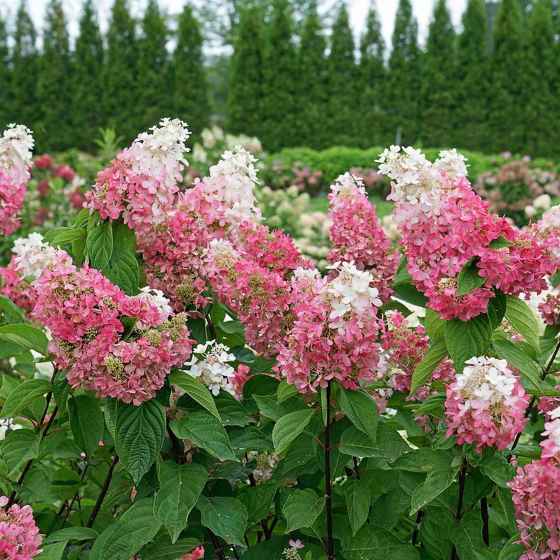
Pinky Winky Prime’s thick, sturdy stems, large dark green foliage, and long tapering blooms portend that something big is going to happen. (Proven Winners photo)
Still, I’m excited to see what Pinky Winky Prime does in my garden. A new panicle hydrangea introduction by Proven Winners, the plant tag for Pinky Winky Prime describes the mature height and width as 1.8 to 2.7 meters (6 to 9 feet).
Jeffries Nurseries in Portage la Prairie lists the mature height for Pinky Winky Prime as a more modest 1.5 to 1.8 meters (5 to 6 feet).
But even as a young plant, Pinky Winky Prime’s thick, sturdy stems, large dark green foliage, and long tapering blooms portend that something big is going to happen.
Beautiful gardens and décor
Garden vignette
A whimsical stone gate stopper with a carved face, a vintage weathered wood folding sling chair, and unusual, large-leaf foliage lapping at the edges of patio pavers with old-world charm caught my eye.

A charming vintage gate stopper from John Tinker’s garden. (Colleen Zacharias photo)
This charming vignette was one of many in John Tinkler’s stunning south Winnipeg garden, which was featured on the recent Manitoba Master Gardener Association tour.
The unusual perennial is Astilboides tabularis (also known as Rodgersia tabularis or Shieldleaf Rodgersia). Its huge round leaves on round hairy stems stretch to nearly 60 cm across. An astilbe-like flower appears on a one-metre-tall stem that shoots up rapidly around late July.
This unique plant is hardy to Zone 3 and suitable for part shade to part sun locations. But it is rarely found at local garden centres.
One reason is that Astilboides does not present well in a standard nursery pot. But plant it in your garden and watch as the tiny umbrella-like leaves first begin to unfurl. Once this moisture-loving plant gets started, growth is surprisingly rapid.
Wind can cause shredding to the enormous leaves but if it’s early enough in the season, cut the stems back to the ground. Eager replacements soon pop up to take their place.
What was your favourite vignette or garden scene on this summer’s garden tours?
Unexpected thriller: Emily Carr rose
John Tinkler’s container arrangements are showstopping. The owner of Design Manitoba, Tinkler has a knack for design and artistic arrangement.
In one display, he has planted a mature-size Emily Carr rose in a tall planter. Emily Carr’s fully double, ruby-red flowers, glossy green foliage and numerous prickles could be enjoyed at eye level.

An Emily Carr rose from John Tinkler’s garden. (Colleen Zacharias photo)
Part of the Canadian Artists Series, Emily Carr is a shrub rose variety that is a cross between Rosa Morden Cardinette and Rosa Cuthbert Grant. The cross was made by breeder Lynn Collicutt in 1982 at the Morden Research Station.
A bushy rose, Emily Carr grows close to a metre tall and 1.2 metres wide.
Tinkler grows the Emily Carr rose in one of his garden beds. In spring, he digs it up and plants it in a large container. Then in fall, he returns it to the garden to spend the winter.
It’s obvious from her pristine beauty that the rose doesn’t mind her role as a moveable feast. In fact, Emily Carr flaunts her beauty in Tinkler’s garden.
Sensational surrealist sculpture
Talk about a conversation piece. A sculptural surprise awaited visitors as they entered John Tinkler’s courtyard on the recent Manitoba Master Gardener Association garden tour – a monumental bronze cabbage sculpture with the legs and feet of a chicken.

A bronze sculpture of a cabbage with chicken legs greeted visitos to John Tinkler’s recent Manitoba Master Gardener Association tour.
More elegant than whimsical, the sculpture’s deep teal colour provides high visual contrast in the courtyard’s dappled light. A stone pedestal elevates the sculpture and creates a strong focal point.
Opposite the sculpture, two identical planter boxes hold upright cedars underplanted with a broad skirt of Kong coleus. Everyone had their camera in hand to capture the picturesque scene.
Miniature plant, bold statement
On Lothar Behnke’s deck, in a ceramic bonsai container on a side table, is a mini maple (Acer palmatum).
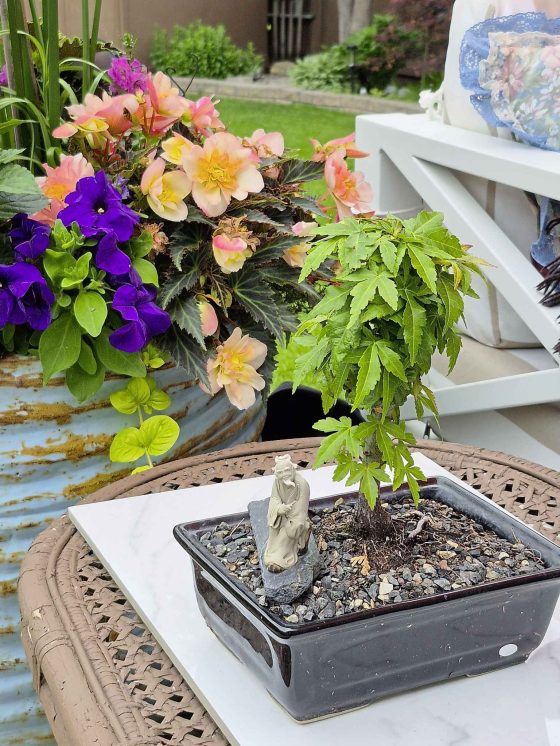
A mini maple bonsai starter plant from Lothar Behnke’s Winnipeg garden. (Colleen Zacharias photo)
Part of a unique selection of bonsai starter plants from Iseli Nursery, the mini maple goes indoors in the fall to spend the winter in Behnke’s sunroom.
Classic thriller, filler, spiller
Behnke has a selection of Vietnamese glazed ceramic planters which he brought with him when he moved back to Winnipeg from Texas in 2023.
“I only brought half of them with me because they are backbreakers, frankly,” says Behnke. The planters may be heavy to move, but they are also beautiful focal points in his garden.
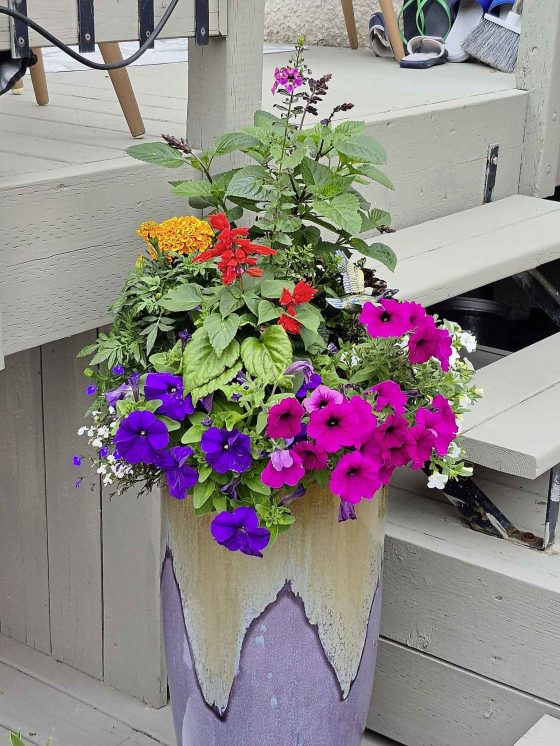
A stylish container arrangement from Lothar Behnke’s garden. (Colleen Zacharias photo)
In this classic arrangement with a good mix of height, vibrant colour, and texture, the main plants are:
- Angelonia (tall, upright plant with pink flower spikes)
- Red salvia
- French marigold (orange, ruffled flower)
- Bacopa (small white flowers cascading on opposite sides of the arrangement)
- Petunias (large purple and bright magenta flowers trail over the sides complementing the mauve colour of the planter)
Hosta Red Ninja coming in 2027
Described as the world’s first truly red hosta, Hosta Red Ninja received the Plant of the Year award at the 2026 RHS Chelsea Flower Show held in May in London, England.
Hosta Red Ninja boasts burgundy red foliage and red petioles. Hardy to Zone 3, Hosta Red Ninja is said to keep its reddish colour throughout summer. Mature height and width are listed as 35 to 60 cm.

Chelsea Flower show 2026 Plant of the Year, Red Ninja hosta. (Bloomin Easy)
It will be distributed in North America in 2027 by Bloomin Easy, a North American plant brand based in Abbotsford, B.C.
Garden centre owner enters politics
Ray DuBois, president of Ron Paul Garden Centre on St. Mary’s Road, has announced his intention to run for city councillor for the St. Norbert-Seine River ward.
I asked DuBois if he would continue to run Ron Paul Garden Centre, which he operates with his wife and co-owner Jeanne DuBois, should he be successful in being elected to city councillor
“It would be a challenge for me to do both long term. There’s a plan in place,” said DuBois.
Local nurserywoman honoured
Kelly Leask, owner of Prairie Originals, a native-plant nursery located in East Selkirk, is one of this year’s She Grows honourees.
An initiative by Greenhouse Canada and Fruit & Vegetable, She Grows highlights the achievements of women who are growing crops as well as women who are growing opportunity, sustainability and community across Canada’s horticultural landscape.

Kelly Leask (right), owner of Prairie Originals, pictured here with former owner Shirley Froehl. (Colleen Zacharias photo)
In this Greenhouse Canada podcast, Leask shares the story of her journey, which began with a summer job in 2013 at Prairie Originals, which was owned at the time by Shirley Froehlich.
“It was an incredibly eye-opening summer,” says Leask in the podcast.
Today, Leask is now the owner of Prairie Originals. The rapidly growing nursery has seen native plants go mainstream in recent years. Leask has also overseen the nursery’s recent transition from its former location to its new, larger home in St. Clements.
Congratulations, Kelly!
Proper tick removal is key
As their habitats expand and the risk of serious illnesses intensify, it is increasingly important to be mindful of ticks.
Not sure how to properly remove a tick if one attaches itself to you or someone else?

Lee Valley sells these handy tick removal tools, which fit on your keychain. (Lee Valley Tools)
This helpful video by Dr. Kateryn Rochon, tick expert and associate professor in the department of entomology has been viewed more than 5 million times.
In the video, Rochon uses a simple pair of tweezers and a straight upward motion to remove a tick versus a twisting or jerking motion which could cause the tick’s mouthparts to remain in the skin. Ugh.
Lee Valley sells a handy tick removal tool that attaches to your key chain. It can also be attached to pet collars.
Available in sets of three, the tick removal tool is made from durable aluminum. It uses forward leverage to remove the entire tick without leaving any parts behind.
Tick repellents are also available. Natrapel Tick and Insect Repellent spray is a plant-based DEET-free product that contains 20 percent icaridin, an odorless, non-oily synthetic compound first developed in the 1990s as an alternative to DEET.
It also protects against mosquitoes.
According to the Public Health Agency of Canada, icaridin should not be used on infants less than six months old. Natrapel Tick and Insect Repellent provides up to 12 hours of protection. Available at Sport Chek outlets for $16.49.
For more information on how to protect yourself, your family, and your pets from tick-borne diseases, visit Manitoba Health.
Cheeky chipmunk loves tomatoes
So cute — and cheeky — was this little chipmunk as he selected a small green tomato from Darlene Stack’s tomato garden, that she stood watching, amused, as he jumped out of the pot, then stopped on the path near her feet to adjust his grip on the tomato before scampering off.

Cheeky chipmunk runs off with green tomato (Darlene Stack photo)
“He didn’t care that I was there — he was on a mission,” says Stack.
But Stack wasn’t so amused when she discovered that squirrels had helped themselves to her ripening tomatoes, leaving only half-eaten fruits behind.
Juicy tomatoes can attract thirsty animals, especially during hot, dry periods. Wrapping tomatoes in netting is an effective deterrent.

Mark your calendars
Learn to hybridize daylilies! On Aug. 5, starting at 10 a.m., the Beausejour Daylily Society will host a hands-on hybridizer workshop right in the beautiful daylily gardens.
Learn how to choose parent plants, how to collect and apply pollen, how to remove anthers, how to tag the new crosses you make, and more!
Pre-registration is required. Download the registration form and submit to beausejourdaylilygardens@gmail.com. For more details and to find the registration form, visit their website.
On Aug. 7 from 2:30 to 8:30 p.m., and Aug. 8, from 9 a.m. to 4 p.m., the St. Vital Agricultural Society will host its 115th fair at St. Vital Centennial Arena, at 580 St. Anne’s Rd.
There are more than 500 categories in judged competitions which include flowers, vegetables, fruits, preserves, art, and handicrafts. There are also photography and junior gardening competition as well as demonstrations and vendors.
The event includes a pancake breakfast and hot dog lunch on Aug. 8. Admission is $5 cash for both days. Children 16 and under are admitted free with an adult. The seniors’ afternoon, which includes refreshments Aug. 7, costs $3. Find out more.
The Miami Horticulture Show, celebrating its 136th year, will take place on Thursday, Aug. 20 at the Miami Community Centre Hall on Highway 23.
The show opens to the public at 3 p.m, with an evening program and awards presentation at 7 p.m. The show features 613 categories including cut flowers, fruits, vegetables, houseplants, and container gardens. Locally grown gladiolus will be on display as well as a large junior gardener section.
Guest speaker is Peter Fowler, who will present on birding and growing native prairie plants at a local orchard. For more information and to download the horticultural show booklet, visit the club’s website.
The South Interlake Garden Club will host its 63rd Fruit, Flower, and Vegetable Show on Aug. 8 at Odd Fellows Hall, 374 1st Street West, in Stonewall, Man.
The show is open to the public from 1 to 4 p.m. For details of the program and entry form, visit their website.
|