|
“If arming more people meant that we would be safer, we’d be the safest country on earth.”
– U.S. gun control advocate Shannon Watts
A convergence of gun-related stories this week makes a strong case for increased firearm control, while also revealing the intractable political debate that surrounds this issue.
THE MACRO
The folks organizing the marketing campaign for gun rights might need to do a better job of reading the room.
On Monday, members of the Canadian Coalition for Firearm Rights protested outside Winnipeg City Hall as part of a national day of protest in support of gun rights in advance of what is expected to be a landmark case this fall in the Supreme Court of Canada.
Gun rights groups are seeking the high court’s views on the constitutionality of restrictions implemented by the Liberal government on military-style weapons.
Since 2020, Liberal governments have outlawed more than 2,500 types of firearms, arguing that they are primarily designed for military applications and thus, not appropriate for hunters or recreational gun enthusiasts.
(Spoiler alert: the Charter of Rights and Freedoms does not guarantee anyone’s right to own a firearm that fires 900 rounds per minute, which travel at 3,200 feet per second.)
Advertisement

Even though the legal case is tenuous, gun owners shrilly disagree with any effort to take their guns. This is a movement rooted in a dangerous tributary of libertarianism that believes it should be able to own any type of gun for any reason, without the need to register or any kind of restrictions.
“If they take away one freedom from us, they’re going to take more,” gun user Aaron Halbert, a lifelong Winnipegger, told the Free Press. “If you give them an inch, they’ll take a mile.”
Federal restrictions on military-style weapons — the gun of choice, it seems, for many mass-casualty shootings around the world — have become a core political issue in this country, particularly in western provinces where support for any kind of gun control is very low.
Unfortunately for the CCFR, Monday was not really the best day to be beating the drum of expanded gun rights.
First, many Canadians were still following coverage of the tragic mass casualty shooting at a street festival in Toronto last Saturday night that left two people dead and four others critically injured. Two different guns were seized at the scene although there have been no details about what kind or whether they were legally obtained.
The street festival shooting was one of three shooting incidents in Toronto last weekend, including one in North York that left a 22-year-old man dead and two others seriously injured.
A smart public-relations professional would likely tell gun rights activists to keep their powder dry and push their protest back so it did not take place in the wake of this wave of gun violence.
Or, to avoid protesting on the same day as prominent former Tory MP Inky Mark was being charged with a dozen firearm-related crimes, including firearms trafficking. RCMP found 438 firearms, many of them unregistered, most of them stored illegally, and $300,000 in cash in Mark’s Dauphin home.
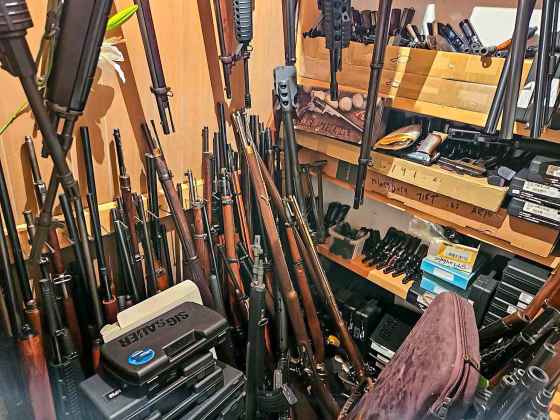
RCMP seized 439 firearms from Inky Mark’s property, but it will take weeks to determine which are illegally owned. (RCMP handout)
Most interesting, the RCMP was prompted to search Mark’s home after another Dauphin resident was arrested and charged with theft and trafficking in the United States.
Mark, a long-time champion of expanded gun rights, has not commented yet on his arrest or the charges, but there is a case building that he was not just an avid collector.
Again, it’s hard to know what gun-rights activists were thinking, if they were thinking at all, about how these stories might limit the audience for their arguments.
It’s particularly befuddling that they would push ahead with a protest that is trying to draw attention to a SCC hearing, when the SCC is really not persuaded by protests.
That is, however, the mystery of gun politics in this country.
Here are the basic dynamics: the vast majority of Canadians support increased gun control, with roughly 80 per cent historic support for increased restrictions on military-style assault weapons.
Opinions are more mixed about issues like the botched federal buyback program. In terms of overall gun control, Canadians believe that stopping the smuggling of illegal firearms into Canada is as or more effective than gun bans.
But there’s the rub: a poll question like that suggests it’s possible to stop the flow of illegal firearms when police have consistently said it’s a nearly impossible task.
Our proximity to the United States — the most heavily armed nation on the planet with millions of unregistered weapons floating through a robust illegal black market — and a 9,000-kilometre, largely unguarded border make gun smuggling interdiction pretty unreliable.
How do we know that? Despite spending millions upon millions of dollars each year to crack down on smugglers, between 80 and 90 per cent of guns involved in crimes and recovered by police are thought to be illegally smuggled into the country.
And while it’s important every Canadian be considered innocent until proven guilty, when you find hundreds of unregistered weapons and $300,000 in cash in the home of one of the country’s more famous gun-rights advocates, you can start to connect the dots between the illegal gun supply used in crimes and some — emphasis on some — so-called legal gun owners.
Either way, it would have been better for all involved in the campaign to remove restrictions on firearms if they had taken a beat and lived to fight another day.
Instead, the gun lobby has shot itself in the foot.
|