Biidaajimowin
Winnipeg Free Press Logo
 

Calling out racism

Recently, there’s been a lot of talk about racism, decorum in politics, and what constitutes respect by politicians.

I’ve never shied away from naming and confronting racism, even before I started working in media. See me here in 2013, trying to meet with the editor of the Morris Mirror newspaper over comments he made about the Idle No More movement.

As I showed on that day, acts of racism aren’t really about throwing rocks and words at another person but about what a community does to facilitate kindness, accountability, and justice once racism is called out for what it is.

Advertisement

The weekly playbook. News, notes and analysis from the week in sports - by Mike McIntyre. Get the newsletter sent weekly.


These days, I could choose any number of racist incidents used by politicians across North America — see, for example, U.S. President Donald Trump commenting on Chinese president Xi Jinping’s “physical features” and how Chinese citizens in the U.S. don’t match up to him (starts at 6:00) but Manitoba’s got its own special brand of divisive, harmful statements and actions based in racial stereotypes.

The most recent winner of the most xenophobic statement in Manitoba politics goes to Lac du Bonnet PC MLA Wayne Ewasko, who, on April 15 in the legislature, yelled at Premier Wab Kinew while he was speaking: “You’re drunk, you’re drunk. I thought you quit drinking” (see the official account of the Speaker of the Manitoba Legislature on page 1661 here).

Kinew has a well-documented history with alcohol, but hasn’t drank for years and, like other Canadian politicians, alcohol does not influence him or his decision-making.

The level of stupidity in this comment! It’s like defining a 50-year-old by their 20-year-old decisions; in other circumstances it could be called harassment. It’s certainly not a barometer for running a Canadian province.

Saskatchewan Premier Scott Moe, for example, has a well-documented toxic relationship with alcohol, but it apparently hasn’t negated his career. Moe’s alcohol use has resulted in a 1992 conviction for impaired driving, a 1994 charge of impaired driving (which was stayed/withdrawn), and most notably, a fatal car crash in 1997, for which he was fined for driving without due care.

Yet, Kinew is apparently the one who has to answer questions about alcohol.

“It is a discriminatory comment that plays on an ugly stereotype about Anishinaabe people,” Kinew told reporters afterwards.

“I don’t drink. But ask yourself why, as a native guy, do I have to come out today and say I don’t drink. (Ontario Premier) Doug Ford doesn’t drink. (U.S. President) Donald Trump doesn’t drink. I don’t drink. That’s something that a lot of successful people don’t do.”

Kinew later got into a heated — but very interesting — debate with CBC Manitoba morning host Marcy Markusa during his monthly visit to her show over the duty of those in the media to call something racist when they hear/see it and not treat it as “the other side” of arguments (that part begins at 9:00).

I cannot tell you how many times I have had similar situations, with blatant racism, hate and falsehoods about Indigenous peoples constituting the arguments of those who want to argue residential schools “intended well,” First Nations chiefs are all corrupt, or Indigenous peoples are welfare bums, addicts, and are only motivated by taking money and services from the government.

Other Manitoba politicians such as Deputy Premier Uzoma Asagwara point out this is not a first for Ewasko, saying the Manitoba politician has “a history of saying wildly offensive and racist things in the chamber,” and specifically aiming them at Kinew.

Ewasko offered a tepid acknowledgement of his statement (but did not acknowledge it was racist) and was briefly suspended from the legislature.

Then, in a baffling moment that didn’t deal with the situation in any meaningful way, Manitoba House Speaker Tom Lindsey “banned” all of politicians in the Manitoba legislature from calling each other racist, transphobic, misogynist or bigots.

I’m here to call Ewasko’s taunts racist. Period.

In any other place of employment, this would be called bullying and harassment, and would be handled through individual discipline, reparations and some sort of workplace-safety training.

No one is perfect, of course, and mistakes can be made in heated moments, but racism does nothing but cause division and harm, and is not an acceptable way to communicate in a civil society.

I wonder if citizens in Lac du Bonnet talk like that.

I wonder what they think of a person representing them who uses such racist language and won’t take responsibility for it.

I wonder what the majority of Manitobans think — and expect — of those who debate their issues, serve and represent them.


Niigaan Sinclair, Columnist


Advertisement

What's next in Manitoba arts, life and pop culture - curated by Jen Zoratti. Get the newsletter sent weekly.
 

FIVE STORIES ON TURTLE ISLAND

1. In the wake of the Court of King’s Bench judge finding Alberta’s chief electoral officer erred in approving a citizen-led initiative to hold a referendum on the province’s independence because it ignored Indigenous treaty rights, Alberta Premier Danielle Smith seems to be doubling down on creating more fights with First Nations.

She pronounced that an Alberta pipeline through First Nations-claimed territories in B.C. “could see construction on an oil pipeline to the West Coast start as early as September 2027.”

Here’s a note to any Canadian politician trying to fulfil a constitutionally mandated and legally required “duty to consult” with First Nations over Indigenous and treaty rights: When you announce you’re going to start a project without obtaining the consent of those you need to work with, they get very angry.

In other words, it doesn’t matter how much anyone says pipelines and loans to invest in them provide “benefits” for First Nations — it’s about treating people like human beings first.


2. Speaking of controversial resource projects, a new 234-mile gas pipeline was slated to begin construction across Navajo territory in New Mexico and Arizona this week.

The pipeline has been approved by Navajo lawmakers, but Navajo citizens and activists are suspicious of the frequent changes to the project as a whole and the discreet nature in which approval occurred.

Many are also concerned about the environmental damage that will be caused.

The project is now mired in state regulatory approvals — a process that will take years — leading many to ask why construction on small segments of the proposed route are beginning now.


3. Many are still reeling from the state of emergency declared by Manitoba Health officials to address a surge in HIV cases and an outbreak of Hepatitis A, which is disproportionately seen in many vulnerable and marginalized communities, of which Indigenous peoples make up a significant part.

The rate of HIV cases in Manitoba is now three and a half times that of Canada.

A huge kudos to longtime sexual health advocate Albert McLeod, who this week called for a “national inquiry” into the reasons Indigenous communities are being disproportionally impacted by HIV.


4. The Southern Chiefs Organization (SCO) — the group which lobbies for, represents and oversees projects in the interests of over two dozen First Nations in southern Manitoba — has announced that one-third of the construction has been completed of Wehwehneh Bahgahkinahgohn (meaning “it is visible”), the revitalization and re-envisioning of the former Hudson Bay Building in Winnipeg’s downtown.

In April 2022 the iconic downtown HBC building was obtained by SCO and Grand Chief Jerry Daniels, sparking much anticipation and interest in the project.

The new design is expected to include approximately 370 affordable residential units, a spacious atrium, the offices of SCO, a daycare, restaurants and commercial office and retail spaces.

Reflecting on where this building was a half-decade ago, this is a pretty remarkable development.

Speaking of the HBC, I am hearing rumours there will soon be a ceremony to welcome back to Treaty One the original 1670 Hudson’s Bay Company Royal Charter, which was recently purchased for $18 million and is now overseen by a consortium of four public institutions: the Manitoba Museum, the Archives of Manitoba, the Canadian Museum of History, and the Royal Ontario Museum.


5. Team selections are taking place right now for the much-anticipated return of the Manitoba Indigenous Summer Games — an event across two communities in July and August that will feature over 3,000 First Nations, Métis and Inuit athletes competing in archery, 3-on-3 basketball, volleyball, canoeing, softball, track, soccer, athletics (track and field), ball hockey and golf.

Competitions will take place in two communities over two separate weeks, with Norway House Cree Nation hosting events from July 8-12 and Sagkeeng Anicinabe First Nation hosting competitions from August 10-15 – the schedule is available here.

A non-profit and volunteer-run event overseen by the Manitoba Aboriginal Sports & Recreation Council, the previous Manitoba Indigenous Summer Games were co-hosted in 2011 by Opaskwayak Cree Nation and Peguis First Nation.

Last year’s event was postponed due to wildfires.

This is also a good time to revisit the widely successful 2002 North American Indigenous Games that were hosted on Treaty One here in Winnipeg and brought our entire community together to host Turtle Island.


IN PICTURES

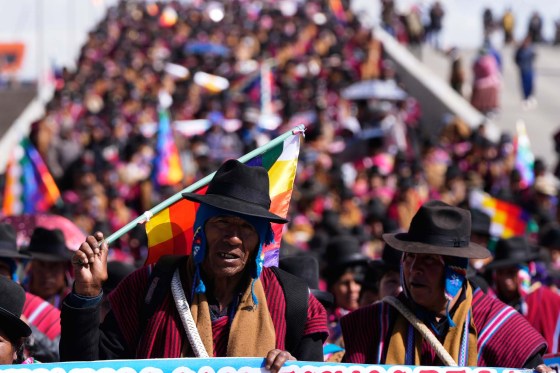
Aymara Indigenous people march during an anti-government protest in El Alto, Bolivia, last Wednesday. (Juan Karita / The Associated Press)

Aymara Indigenous people march during an anti-government protest in El Alto, Bolivia, last Wednesday. (Juan Karita / The Associated Press)


RECONCILI-ACTION OF THE WEEK

Every week I highlight an action, moment, or milestone forwarding reconciliation, illustrating how far Canada has come — and how far the country has yet to go.

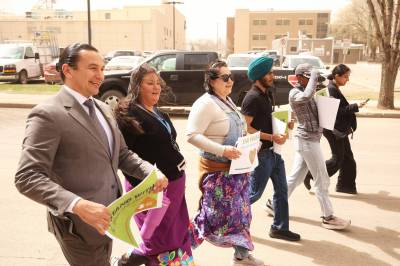
The reconciliaction of the week is the tremendous outpouring last week of thousands of Canadians, family members and supporters throughout Canada who walked, raised awareness and supported the Moose Hide Campaign against gender-based violence and other events that engaged the issue of men’s health and murdered and missing Indigenous men and boys.

The day served as an opportunity to demand better systemic support for suffering and grieving families and those still searching for missing loved ones.

Murdered and missing Indigenous men and boys are an issue infrequently addressed, but, as a report from the Ontario Provincial Police shows, they are more likely to go missing or be murdered than anyone else in the country.

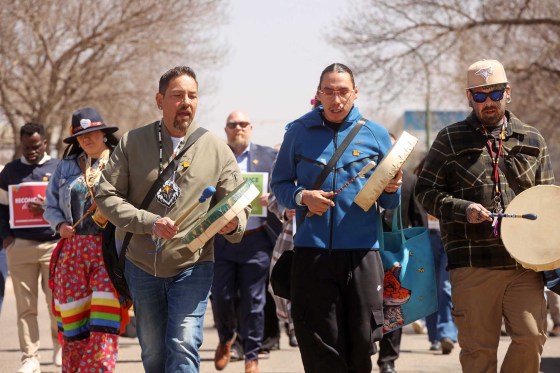
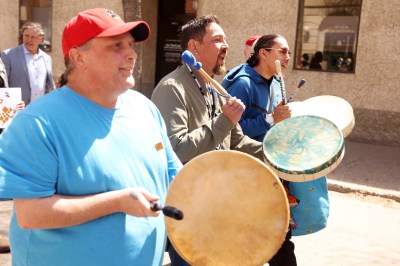
Jason Gobeil (left) with the Good Hearted Warriors men's group and other drummers lead the Moose Hide Campaign Community Walk in Brandon on Thursday. (Tim Smith / The Brandon Sun)

Jason Gobeil (left) with the Good Hearted Warriors men’s group and other drummers lead the Moose Hide Campaign Community Walk in Brandon on Thursday. (Tim Smith / The Brandon Sun)

Approximately 50 people took part in the walk organized by Assiniboine College and the Brandon Urban Aboriginal Peoples’ Council. (Tim Smith / The Brandon Sun)

Approximately 50 people took part in the walk organized by Assiniboine College and the Brandon Urban Aboriginal Peoples’ Council. (Tim Smith / The Brandon Sun)

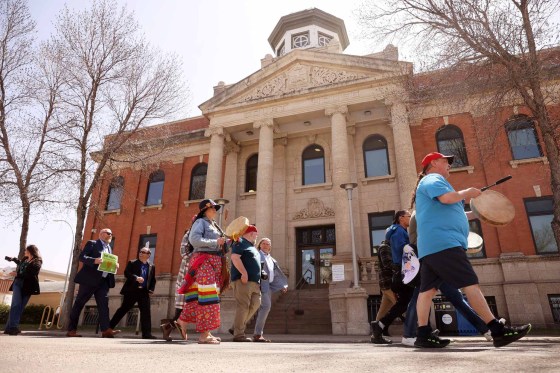
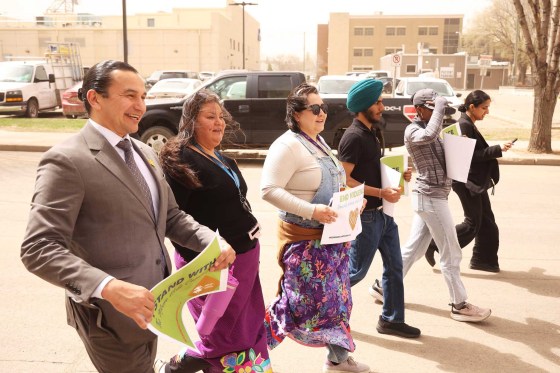
Manitoba Premier Wab Kinew walks with other participants in the Indigenous-led movement that engages men and boys in the commitment to ending violence against women and children.  (Tim Smith / The Brandon Sun)

Manitoba Premier Wab Kinew walks with other participants in the Indigenous-led movement that engages men and boys in the commitment to ending violence against women and children. (Tim Smith / The Brandon Sun)


Advertisement

That's a wrap. Today's must-read stories and a roundup of the day's headlines. Get the newsletter sent every weekday evening.
 

WHAT I'VE BEEN WORKING ON

Niigaan Sinclair:

Moose Hide Campaign against gender-based violence starts national conversations

This week marked the 15th annual Indigenous-led Moose Hide Campaign aimed at stopping gender-based violence. While the campaign is recognized by official observances in British Columbia, Manitoba a... Read More


LOCAL NEWS

Carol Sanders:

Hydro advisory circle brings ‘wealth of Indigenous perspectives’

The board of Manitoba Hydro has appointed an Indigenous advisory circle as part of the Crown corporation’s reconciliation efforts. Former Fox Lake Cree Nation chief and Keeyask Hydropower Limited P... Read More


Scott Billeck:

Community mourns six-year-old Poplar River drowning victim

The Assembly of Manitoba Chiefs and Southern Chiefs’ Organization are offering condolences following the death of a six-year-old girl in Poplar River First Nation over the weekend. RCMP say officer... Read More


Maggie Macintosh:

People for Education explore convergence of public education and truth and reconciliation

A national charity is putting Manitoba’s school system under the microscope as it develops a plan to protect and bolster publicly funded classrooms across Canada. Read More


Morgan Modjeski:

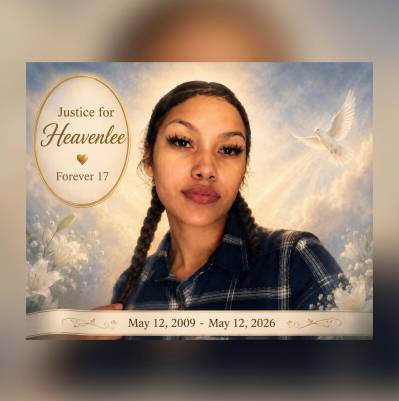
‘I feel like I lost my best friend’: mom

Mother mourns 17-year-old daughter slain in northern community Read More


Maggie Macintosh:

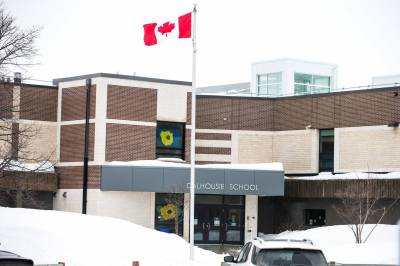
Fort Richmond elementary school shedding racist lord’s name

Dalhousie School is undergoing a rebrand so it’s no longer affiliated with a Scottish soldier, lord and colonial leader who supported slavery. The Pembina Trails School Division put a out a call th... Read More


Skye Anderson:

Eight-year sentence for fatally stabbing half-sister

BRANDON — A Sioux Valley Dakota Nation man has been sentenced to eight years behind bars for fatally stabbing his half-sister in 2022, robbing her children of their mother. Ernest Michael Blacksmit... Read More


Carol Sanders:

$61-M investment in high-speed Internet planned for northern First Nations

More homes on remote Manitoba First Nations will have access to high-speed Internet that most Canadians take for granted thanks to $61 million in new federal funding. “Your communities have been li... Read More


Tessa Adamski:

Walk raises awareness of gender-based violence

BRANDON — Premier Wab Kinew joined dozens of community members in Brandon Thursday on a walk to raise awareness among men and boys about the need to take action to end gender-based violence. The fo... Read More


Joshua Frey-Sam:

‘He was before his time’

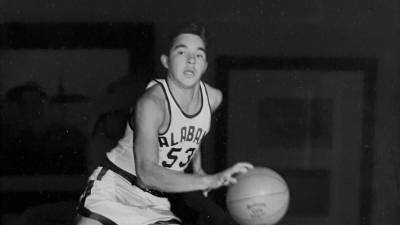
Garrow’s son on mission to get Indigenous hoopster inducted into Canadian Basketball Hall of Fame Read More


Erik Pindera:

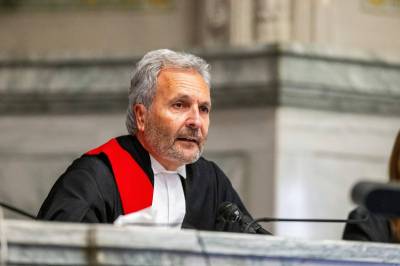
Ottawa, province breached First Nations’ constitutional rights, Manitoba judge says in ‘historic’ ruling

The federal and provincial governments have managed First Nations child welfare in Manitoba in a way that breached the communities’ constitutionally protected right to self-governance, the chief justi... Read More


Tyler Searle:

College of Registered Nurses of Manitoba apologizes to Indigenous people

The regulatory body that oversees registered nurses in Manitoba has issued a formal apology to acknowledge its role in racism against Indigenous people and pledged to do better. “This apology is lo... Read More


OPINION

Tom Brodbeck:

This not just in: treaty rights carry legal force and are protected in the Constitution

More than a century after the numbered treaties were signed across Western Canada, the courts delivered a blunt reminder last week that those agreements are not ancient historical footnotes. They s... Read More


David McLaughlin:

A premier firmly caught in her own trap

Pickle, meet petard. Alberta Premier Danielle Smith is now in a political pickle having been hoist with her sovereigntist petard. Read More


ARTS & LIFE

Ben Waldman:

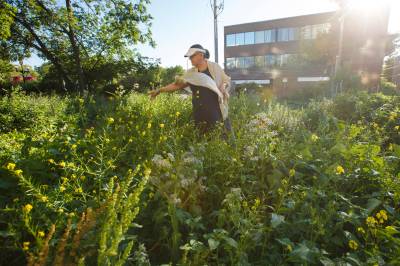
Connected to the land, rooted in tradition

Cree-Métis elder spread knowledge through gardening Read More


Scott Billeck:

Renowned composer, cellist Derksen dead after car crash

Award-winning Cree composer and cellist Cris Derksen, who had strong ties to Manitoba’s arts community, has died following a car crash in northern Alberta. They were 45. Read More


Nicole Thompson, The Canadian Press:

University of Toronto revokes Buffy Sainte-Marie’s honorary law degree

TORONTO -   The University of Toronto has rescinded folk singer Buffy Sainte-Marie's honorary degree. It's the latest recognition Sainte-Marie has lost since a 2023 CBC News i... Read More


The Canadian Press staff, The Canadian Press:

CBC pausing production on satirical Indigenous show

OTTAWA - The CBC is pausing production on a satirical show on Indigenous issues after blowback from some who claimed false pretences were used to lure high-profile guests. CBC spokesp... Read More


FROM FURTHER AFIELD


Share:


Download our News Break app