|
In between a whole bunch of author interviews I’ve done for the Free Press in the last couple of weeks (including Max Kerman of Arkells, Nita Prose, Eliza Reid and Madeleine Thien), I’ve been picking away at a story about the tumultuous 2024 vintage in B.C.’s Okanagan Valley — or, more accurately, how there wasn’t one, at least in the traditional sense.
After grappling with the effects of the smoke from yearly wildfires, a late 2022 cold snap in the B.C. interior killed off some of the area’s vines — and what survived was mostly decimated the following winter when a January 2024 deep freeze laid waste to vineyards.
It will take years for newly planted vines to bear wine-worthy fruit, leaving the industry on the brink of potential collapse.
Advertisement
Regulators and government officials reacted quickly, tweaking some rules around winemaking in the province and allowing B.C. producers to source fruit from elsewhere. And while a few producers looked to Ontario, many more looked south of the border for relief.
Most of the 2024 vintage B.C. wines that we’ll see in our market will be made from fruit sourced from Washington state, Oregon or even California.
A few have already landed — such as Quails’ Gate’s Field & Flight line and Gray Monk’s Pinot Gris.
Now keep in mind that a) this arrangement and the winemaking all went down before things south of the border went, well, south, and b) if wineries weren’t able to source fruit from elsewhere, there would be no 2024 wines at all — and some wineries wouldn’t have survived to 2025.
B.C. wineries have been transparent about how they’ve made the best of a very bad situation, creating new brands and unique labels for the wines, as well as corresponding info online, so consumers know exactly what’s in their glass.

Alistair Veen of JoieFarm Winery poses with a bottle of the Naramata winery’s 2023 single-vineyard Riesling. (Ben Sigurdson / Free Press)
Earlier this week, Alistair Veen of Naramata’s JoieFarm Winery was in Winnipeg as part of Manitoba Somm Week, where he hosted a portfolio tasting of the Alsatian/Burgundian-influenced wines.
They’re incredibly fresh and delicious, and will hopefully find a home at a Winnipeg private wine store (although they can be ordered from the winery in the meantime).
Veen was pouring pre-2024 wines alongside bottles from the troubled vintage featuring fruit from the Cascadia region (which is what some producers are calling the region south of the border).
Sourcing fruit from Washington state allowed JoieFarm to keep making some of its core bottlings (such as the A Noble Blend, an off-dry and vibrant white) while experimenting with some new wines.
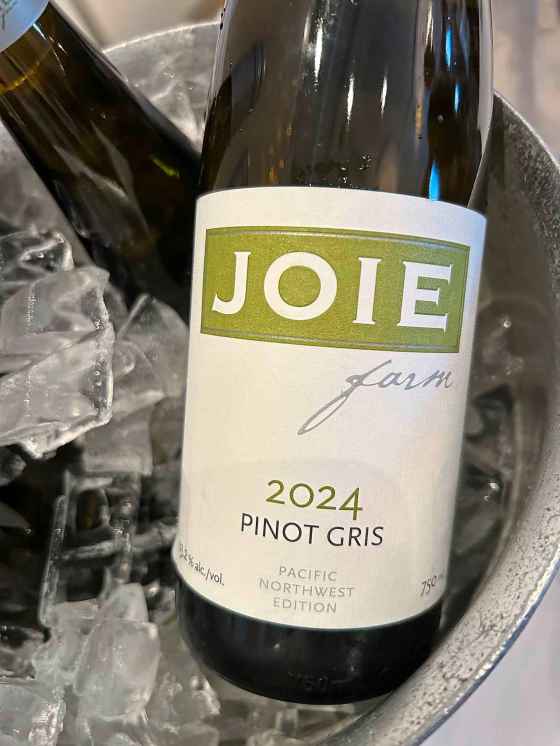
The 2024 edition of JoieFarm’s Pinot Gris notes it is the “Pacific Northwest Edition.” (Ben Sigurdson / Free Press)
Veen figures some customers won’t care about the provenance of the fruit as much as those in the industry will or do, and that wineries have done what they can to survive.
“I’ve tried to explain to everyone that it’s still our duty as wine drinkers and sommeliers to support and sell these wines,” he says. “We did our duty by making the wines, and not sitting on our hands, keeping everyone employed. Now it’s your duty to also support us. Is it a perfect scenario? No. Are we going to get through it? Yes.”
With the effects of climate change being felt in the Okanagan Valley, there’s no saying what the future holds.
“Nothing like this has ever happened before,” Veen says. “Will it happen again? Who knows, but it required a set of tools that hadn’t been used before.”
Speaking of elbows up, the Free Press has some cool new merch available featuring art by Kal Barteski — check it out here.
|