|
“I always seem to be in the right place at the wrong time.”
— from Right Place Wrong Time by Dr. John
Why is it that every time a province tries to separate, there is a Liberal prime minister at the helm? More importantly, is our current Liberal prime minister up to the job?
The Macro
A provincial referendum on separation is an exceedingly rare event. Canada has been through two of them — both in Quebec. In 1980, more than 60 per cent of Quebecers rejected independence. The result was the same in 1995 although the margin of victory for the ‘Non’ side was much, much tighter.
Today, Canada theoretically faces committed independence movements in two provinces: in Alberta, where pro-independence activists are trying to trigger a referendum; and in Quebec again, where a resurgent Parti Québécois has promised a third referendum if it wins a majority government in this fall’s provincial election.
How serious are these threats?
In Alberta, more than 300,000 people signed a petition asking for a referendum on independence. However, a court determined that no vote could take place because the government of Alberta had failed to make any attempt to consult with First Nations. Now, Alberta Premier Danielle Smith has promised to ask Albertans this fall to vote on whether they want to vote on independence. Yep, it’s a referendum on whether to hold a referendum.
Don’t ask.
Advertisement

It’s worth noting that more than 400,000 Albertans signed a petition to stay in Canada, and opinion polls show a majority of Albertans want to stay in Canada. Those results are similar to Quebec, where support for independence is cool to lukewarm.
However, there is another narrative here that does not necessarily tell us how separatists in either province will fare but is intriguing nonetheless: every time the country has faced the possibility of a province seeking to leave the federation, a Liberal prime minister has been in charge.
As his career wound down in 1980, former Prime Minister Pierre Trudeau galvanized his place in history by defeating PQ Premier René Levesque in a referendum showdown.
Trudeau’s role in the referendum campaign cannot be understated. The pivotal moment came after Levesque suggested Trudeau was not a true Quebecer because he had an English middle name (Elliott); Trudeau went to the Paul Sauvé arena in Montreal and delivered what would become known as the “Elliott speech.”
“Mon nom est Québécois,” Trudeau declared defiantly. Trudeau’s speech certainly resonates with political historians to this day.
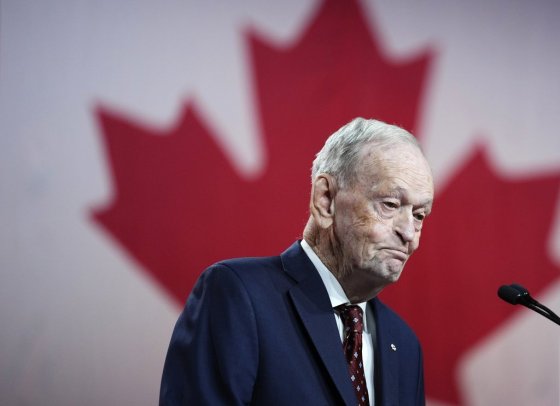
Former prime minister Jean Chrétien (Justin Tang / The Canadian Press files)
Flash forward 15 years and another Liberal prime minister, Jean Chrétien, played a critical role in a referendum vote that was decided by fractions of a percentage point. Chrétien also delivered a speech that was considered a seminal moment in the campaign, this time at the Verdun Arena in October 1995. Reversing a previous position, Chrétien announced Quebec should be recognized as a “Distinct Society” within the Canadian federation. He repeated the core of that speech the next night in a nationally televised address.
Flash forward again to today, and Liberal Prime Minister Mark Carney is the grit in charge. Can Carney play the same role as Trudeau and Chrétien? It remains to be seen whether Carney will be pressed into that kind of battle; support for independence in both provinces is arguably weaker than it was in 1980 or 1995 Quebec.
However, Carney does have some advantages should he be asked to fill the role of Captain Canada. First, Carney is demonstrably more popular in both Alberta and Quebec than either Trudeau or Chrétien. Carney is the most popular federal leader in Quebec, and his Liberals boast the strongest support among voters.
Of course, neither Trudeau nor Chrétien was forced to fight a unity battle in Alberta. That having been said, both Quebec-born prime ministers were hated in the heart of oil country. And despite the fact that both prime ministers played critical roles in the ‘Non’ campaigns, their relationship with Quebecers was, well, complicated. Anglophones revered both leaders; Francophones, in the majority, reviled them.
Carney is already showing he wants to lead the case for unity. In a news conference on Monday, Carney reflected on his time as the Bank of England governor, during which the Brexit referendum took place.
Carney warned Britons they were being deceived by the Brexiteers, who promised a new age of prosperity if they would authorize the British government to negotiate an exit from the European Union.
“In these separation issues, it is often advanced that, ‘Vote for this and it’s a free option. Vote for this and we will strengthen our hand in a future negotiation.’” Carney said. “That is a very dangerous bluff.”
Carney is not facing the imminent unity threat that Chrétien and Trudeau did in their days. But he is giving off signs that he’s ready for the fight.
|