Winnipeg Free Press | Newsletter
|
Consultation between government and Indigenous communities necessary
|
|
After the announcement from the premiers of Alberta and Ontario outlining a proposed 3,300 km pipeline to transport oil from Western Canada to refineries in southern Ontario, Manitoba premier Wab Kinew responded by saying the project cannot proceed through this province because Indigenous groups were not consulted.
Over the past year — in the midst of economic pressure from the U.S. government and the response of the Canadian federal government to fast-track domestic resource extraction projects — the word “consultation” has been thrown around a lot.
So, what is “consultation” and why does Canada have to do it?
Enacted in 1982, Section 35 of Canada’s constitution explicitly “recognizes and affirms” the “Aboriginal and treaty rights” of First Nations, Inuit, and Métis peoples. This means, according to the Supreme Court, the Crown (represented by the federal government) has a legal obligation to work with those communities recognized as “Aboriginal” or “Indigenous” on issues impacting their rights in what is called the “duty to consult.”
This requirement is obvious when it comes to the use of lands and resources in this country, but Aboriginal and treaty rights encompass issues surrounding language, culture, education, child welfare, intellectual property and even building the economy, working with the environment, and national heritage too.
Yup, section 35 of Canada’s constitution and the “duty to consult” involves every single policy, practice and decision any government in this country makes.
Canadian governments at all levels are obviously very uncomfortable with this, so while any representative of the Crown is supposed to act honourably while fulfilling the “duty to consult,” this does not always happen.
This is because the “duty to consult” has never been clearly defined, so it is endlessly debated in the courts.
For one government, consultation represents a series of proactive and ongoing rigorous meetings, years of negotiations, and intricately worded agreements.
In Manitoba, Premier Kinew’s policy is to include Indigenous communities at the outset of project development, not after the fact.
For other governments, it means much less.
Still, the “duty to consult” is not something that any Canadian government can sidestep or ignore — such as a provincial government invoking the “notwithstanding clause.”
Further muddying the situation is the fact that most Canadian courts have said Section 35 is “not absolute” and governments may legally infringe on Aboriginal and treaty rights if a “high legal threshold” is reached, such as when the environment or public safety is at risk.
And here’s the rub: Are the threats of U.S. President Donald Trump to turn Canada into the 51st state an issue of public safety? The environment?
Is it worth the huge amount of conflict created when a government appears to ignore Section 35 and invites the most important stakeholders to “consult” after a decision has been made?
Which is more efficient?
|
|
Niigaan Sinclair, Columnist
|
|
|
|
Advertisement

|
FIVE STORIES ON TURTLE ISLAND
- Normally I start with a more local or Canadian story, but this week it’s been hard to ignore the cacophony of resistance from Indigenous writers, communities and museums south of the border who have been responding to the celebration of the 250th anniversary of the United States by highlighting histories of Native American displacement, warfare and resilience. USA 250 is very complicated for Native Americans, and the international community has noticed. This is particularly evident in the current U.S. administration’s ongoing attempts to sanitize historical accounts of events including Indigenous peoples in the Smithsonian Museum. Some Indigenous curators, artists and historians have put together their own exhibits in response.
- Best thoughts to all who have been impacted by flooding in Manitoba, but especially to my relations in Dauphin, Swan River, and in particular Minegoziibe Anishinabe First Nation (also known as Pine Creek) who declared a state of emergency after overland floodwaters washed out roads and critical infrastructure and prompted the government of Manitoba to ask Ottawa for help. Federal emergency assistance was announced for the region on July 5. The destruction cut off the Parkland-area community’s access to vital emergency and regional medical services, fueling urgent leadership calls for immediate federal aid and a travel warning which is still active in some places.
- The Winnipeg Police Service unveiled their newest cruiser, which features Indigenous designs created by WPS member and Métis artist Brian Hunter.Created through a partnership with the Assembly of Manitoba Chiefs, the art on the cruiser depicts the animals which represent the seven sacred teachings — love, respect, courage, honesty, wisdom, humility and truth — as well as an Inuit kayak and ulu knife. The first of three featuring such designs, the cruiser will appear at community events, pow wows and cultural gatherings (rather than respond to emergency calls) and is “meant to spark conversations and strengthen relationships with Indigenous communities.”
- Late June featured a ground-breaking ceremony for a future 130-room hotel owned by Gambler First Nation in the city of Brandon and Gambler First Nation.The design is truly incredible and will feature three giant teepees at the front of the building, with one serving as a lobby, another as a restaurant and third as a conference room. This is phase two of the first urban reserve in my old hometown of Brandon.
- A huge congratulations to my Red River Métis colleague at the University of Manitoba, Matthew Tétrault, who announced the unveiling of his book cover for his exciting upcoming text Through Rise and Rupture: Red River Poetics and the Shaping of a Métis Literary Tradition, which will be available in April 2027, published by the University of Alberta Press.The book is the first comprehensive literary history of the Red River Métis and traces more than 200 years of literary production in English and French, so it is well anticipated. Matthew is also brilliant — check out his conversation with fellow Métis poet Katherena Vermette here — and a great person. I know this text will have a great impact.
IN PICTURES
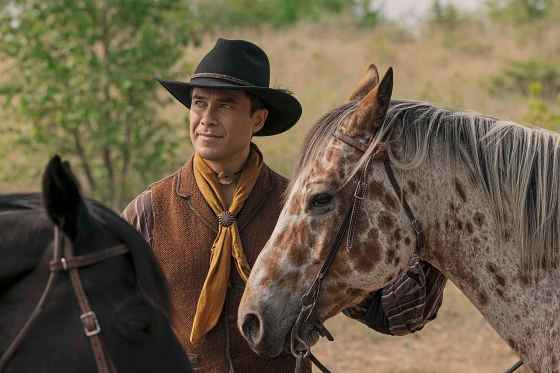
Meegwun Fairbrother plays William Mitchell in a scene from Netflix’s Little House on the Prairie, which debuts Thursday. Mitchell is a member of the Osage Nation who acts as a bridge between the Indigenous community and the settlers who are taking over the land around him. (Handout-Netflix / The Canadian Press)
RECONCILI-ACTION OF THE WEEK
Every week I highlight an action, moment, or milestone forwarding reconciliation, illustrating how far Canada has come — and how far the country has yet to go.
The reconciliaction of the week is a bit late as it happened in late June but a big AHO! anyway to the five First Nations in this province who completed major water-plant upgrades, successfully lifting several long-term drinking water advisories and giving clean water to 10,000 people.Congrats to Long Plain First Nation, Tataskweyak Cree Nation, Berens River First Nation, Misipawistik Cree Nation, and Tootinaowaziibeeng Treaty Reserve. Let’s hope that one day this won’t be a “reconciliaction” but the norm to treat Indigenous peoples like human beings.
|
|
Advertisement

|
WHAT I'VE BEEN WORKING ON
Winnipeg Free Press | Newsletter
|
LOCAL NEWS
|
ARTS & LIFE
|
FROM FURTHER AFIELD
|
|
Share:


|
Download our News Break app


|
|
|