FIVE STORIES ON TURTLE ISLAND
1. For those who haven’t heard, Shark Tank celebrity and venture capitalist Kevin O’Leary has been trying to build a controversial AI data mega-centre on the traditional territory of Sturgeon Lake Cree Nation in Alberta.
A well-known friend of Alberta Premier Danielle Smith, O’Leary has received special governmental exceptions in the approval and regulatory process. I’ve previously written about this issue.
Last April, Sturgeon Lake Cree Nation asked for a judicial review of O’Leary’s license, prompting the capital investor’s lawyers to ask an Alberta court for the request to be rejected. In the first court battle over the project, the First Nation won; their request for a review of O’Leary’s license is set to go forward.
This battle is not over, of course, but this case should be compelling for anyone interested in Indigenous nations’ rights in having a say on what business happens on their territories.
2. Mathias Colomb Cree Nation Chief Gordie Bear drew attention to the housing crisis in Pukatawagan (also known as Mathias Colomb Cree Nation) when he spoke about protests in the community.
Here’s hoping this northern community, which has been devastated by wildfires, evacuations, and infrastructure issues that have led to local conflict and crime, will find some support.
3. Last week, an Alberta court officially renamed Gladue reports, opting for the term “Indigenous background report” to better articulate Indigenous experiences and encourage systemic justice reform.
Named after Jamie Tanis Gladue, an Alberta woman accused of killing her spouse in a case that prompted a landmark Supreme Court of Canada decision in 1999, a Gladue report is often prepared in court cases when an Indigenous person has been accused of a criminal offence. The report attempts to contextualize that offence in the broader experience of Indigenous Peoples in Canadian history for the purposes of providing an adequate and culturally-considered sentence.
This name change within the Alberta Court of Justice is intended to help the public understand more clearly what the reports are for. I hope other provinces will follow suit.
4. An interesting report commissioned by the polling firm Angus Reid states that while 57 per cent of Canadians want to take part in an Indigenous-led travel experience, only 18 per cent have actually done so.
The report also stated 42 per cent of Canadians who had never participated said they had not encountered an Indigenous-led experience while planning a trip and 30 per cent didn’t know where to find one.
For those who don’t know, Indigenous tourism is a growing industry in Manitoba and I encourage everyone to check out the many operators throughout the province.
5. The Manitoba Indigenous Summer Games wrapped up this past week in Sagkeeng Anicinabe Nation after kicking off in Norway House Cree Nation last month.
Featuring Manitoba’s best Indigenous athletes under 18 years old, competitors battled it out in archery, track and field, basketball, ball hockey, golf, and the most-watched event of the entire games: lacrosse.
IN PICTURES
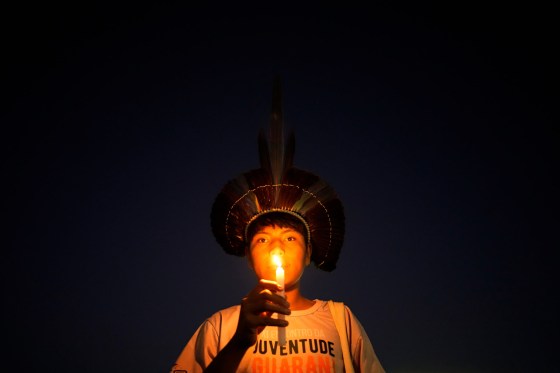
An Indigenous youth holds a candle during a protest calling for the protection of Indigenous land rights and demarcations outside the Supreme Court in Brasilia, Brazil, last Tuesday. (Eraldo Peres / The Associated Press)
RECONCILI-ACTION OF THE WEEK
Every week I highlight an action, moment, or milestone forwarding reconciliation, illustrating how far Canada has come — and how far the country has yet to go.
It was a great week for Manitoba’s educational leaders, who spent the week at Elkhorn Resort in a Manitoba Association of School Superintendents retreat working with speakers, attending planning sessions, and collectively sharing best practices on how to incorporate Indigenous education into Manitoba schools.
I was one of the speakers and was joined by Indigenous educational leaders Kevin Chief, Wade Houle and a host of others. The association of school superintendents has been one of Canada’s foremost leaders in integrating Indigenous education into Canadian schools. The organization produced a position paper on why incorporating Indigenous knowledge, perspectives, and pedagogies is good for all Manitoba students at all grade levels. Here is its most recent statement.
|