|
Happy Valentine’s Day!
I’m not much of a romantic and tend to concur with a quick-witted colleague who recently wrote that Valentine’s Day is a “ginned-up sham of a ‘holiday’ that makes the lonely feel lonelier and the coupled-up stressed to impress.”
My lovestruck daughter, on the other hand, spent hours in the kitchen last week whipping up a double-layered, cherry chip Valentine’s Day cake for her main squeeze, a good-natured young man she’s been dating for about six months.
Advertisement


SUPPLIED
It took Emily, a true romantic, nearly five hours to put together the sweet, baked endowment. And after more than a dozen teeny hearts had been sculpted out of pink fondant icing, she proudly announced that gift-giving — or in this case baking a cake for someone you adore — is clearly her love language.
The term ‘love language’ was coined by American marriage counsellor Dr. Gary Chapman, author of The Five Love Languages: How to Express Heartfelt Commitment to Your Mate. In his book, which I poured through about five years ago, Dr. Chapman maintains that different people with different personalities give and receive love in different ways.
In addition to gift-giving/receiving, the other potential love languages include physical touch, acts of service, quality time, or words of affirmation.
And, according to Dr. Chapman, once we can pin down what our love language actually is, we can identify the root of our conflicts and connect more profoundly with those we love.
Now, it just so happens that dogs, our most compatible companions and my favourite sidekicks, also possess not just one, but any number of love languages.
In an article in the Daily Wag, American veterinary geneticist Dr. Angela Hughes suggests that our pooches’ love languages are determined by genetic, brain chemistry, upbringing and even training methods.
“Breeds were created to have different behavioural traits and to serve various roles,” she says. “Therefore, each breed group can have innately unique ways of showing their love and affection.”
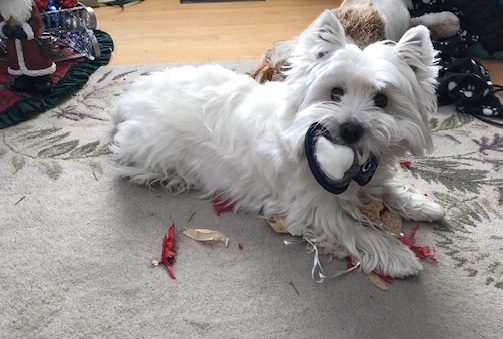
Moreover, positive reinforcement training that emphasizes praise might lead your dog to develop the ‘words of affirmation’ love language. Or, if your four-legged friend is like my Yorkie and loves to receive a new stuffy, than it likely leans toward ‘gift receiving’ as their love language.
Whatever the case, understanding your dog’s love language could be the answer to forming a strong bond with your furry friend.
If nothing else, unravelling the mystery of how our dogs show affection and express emotion is a Valentine’s Day gift that will keep on giving.
And that’s a love language I can definitely get behind.
What’s your dog’s love language? Drop me an email and let me know!
Have a great week!
|