|
After the January deep freeze comes the February thaw, which creates the perfect conditions for Snowman Snow.
I love snowman season. I love seeing all their misshapen bodies, in various sizes and heights, pop up all over the neighbourhood. Some of this is nostalgia; it reminds me of being punted outside for recess and spending our time making people, or giant snowballs that eventually took several kids to roll, or elaborate forts with blocks created by snowplows.
Of course, snowmen are not all men. On my street there now stands a pair of snowladies, one of them with a bosom so ample it threatens to topple her.
Advertisement

With all the screens and schedules, it’s nice kids still do this.
Making snow people is a time-honoured winter tradition, the roots of which are unclear; research suggests people have been making them for centuries.
In 1511, Brussels was the host of The Miracle of 1511, a festival in which disaffected Brusseleers made over 100 satirical (and, in some cases, pornographic) snowpeople in protest of the growing wealth disparity between the rich and poor, put into stark relief by a brutally hard winter.
Welsh photographer Mary Dillwyn is believed to have taken the earliest known photograph of a snowman, circa 1853 or 1854.
By the 1950s, snowmen became firmly ensconced in Christmas iconography, thanks to the song Frosty the Snowman, who later got his own holiday special in 1969. And then, they received new life again when the juggernaut that is Disney’s Frozen introduced a generation of children to Olaf.
But I like to think of them as public art. Little temporary monuments to play and human creativity and imagination.
Consider it: someone spent time outside building this thing and had to rely on ingenuity to do it. There are your classics, with a corncob pipe and the button (or carrot) nose, but plenty of people make theirs with found objects. Sticks and branches become arms and sometimes mouths and eyebrows. Pine cones can be eyes or noses. I saw one that had a crown — and also a very long nose — made out of a fir branch. One of my aforementioned snowladies had leaves for eyelashes.
Making a snowman challenges the idea that art — making it, considering it, looking at it — is “inaccessible.” If you make a snowman, you are a sculptor, and the snow is your clay. Anyone can do it.
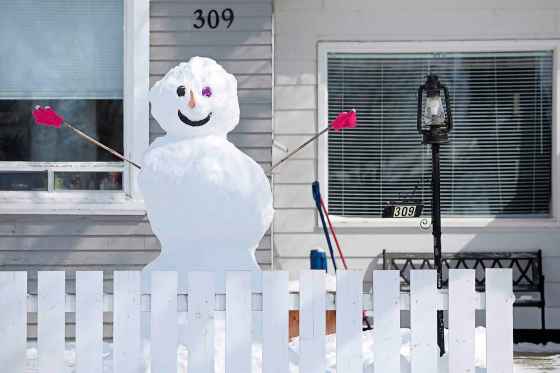
A large snowman sits in front of a home in Brandon. (Tim Smith / The Brandon Sun files)
These impulses are encouraged when we’re kids; to pick up a paintbrush, to draw a picture, to write a little story, to move our bodies to music, to make up a song, to blow into a recorder, to put on a play or to go build a snowman (or a snowbunny or a snowcastle). But then, as adults, we stop doing this.
I think, when it comes to art, adults get too hung up on being “good” (as creators) or “getting it” (as patrons). But you don’t need to be a professional or a scholar to make or enjoy art; you just need to be curious. And there’s no wrong answer in terms of how it moves or affects you.
So I like to see snowmen because they bring me joy, but they also remind me that expressions of creativity don’t need to be professionalized or monetized or even permanent. They can just exist for fun’s sake.
If they stay up long enough, they become a group project. A passerby might add to them or knock parts off of them. Dogs lift their legs on them. Squirrels and birds spirit away their eyes and noses. They become dingy with road salt and dirt. Their heads shrink when the mercury rises, their bodies change shape.
And then, eventually, they are gone, never to exist the same way again.
|