Biidaajimowin
Winnipeg Free Press Logo
 

Don’t look away: Human trafficking is happening here

I heard about the human-trafficking problem in Thunder Bay within an hour of arriving in the northern Ontario city in 2014. After I landed, someone I chatted with while waiting for my luggage brought up this news report right away.

Indigenous women and children in Canada have been kidnapped, sold, and trafficked into the global sexual slave trade via Lake Superior’s northern shipping port for decades — a growing problem Thunder Bay’s mayor has attributed to international drug cartels.

The issue, according to new research, is spreading farther inland, with newspapers and online ads being used to lure victims. A study released this week from the research firm Thomson Reuters illustrates a disturbing intersection between two ongoing national crises in Canada: missing and murdered Indigenous women and human trafficking.

The report, Missing and Stolen: Disappearances and Trafficking of Indigenous Peoples in Canada, says urban centres such as Winnipeg, Edmonton and Toronto have high numbers of missing women and sex ads featuring Indigenous women — suggesting the two issues are connected. Winnipeg is a “feeder” city for sex-trafficking operations, the report suggests.

We already know Indigenous women make up just five per cent of Canada’s population but account for more than 50 per cent of trafficking victims.

Earlier this year, in fact, the Assembly of First Nations produced a report specifically referring to the trafficking of Indigenous women and girls as a national crisis.

The issue of human trafficking was also referenced in the 2019 National Inquiry on Murdered and Missing Indigenous Women and Girls final report.

As identified in the report, traffickers often target young people living in group homes, those who are experiencing poverty and addiction, and those who are away from home (such as for medical reasons) and in transit from remote and northern communities.

Human trafficking is not something that happens in far off countries. It starts right here, in our front yards and on our computers.


Niigaan Sinclair, Columnist


Advertisement

1.2 Million users visit The Free Press's network of sites each month.
 

FIVE STORIES ON TURTLE ISLAND

1. Canadian Prime Minister Mark Carney travelled to the North last week to present Bill C-5 and meet with the Inuit-Crown Partnership Committee.

By most accounts, this meeting went far better than the disastrous “summit” with First Nations leaders in Ottawa earlier in the month.

This time, Inuit leaders proposed 79 projects that would fit the parameters of “projects in the national interest.”

Carney appears to have learned from his mistakes after his meeting with First Nations leaders, as he is now regularly (and very publicly) promising to “fully respect treaty rights” and appeared regularly with president of the Inuit Tapiriit Kanatami Natan Obed (even co-chairing the summit with him).
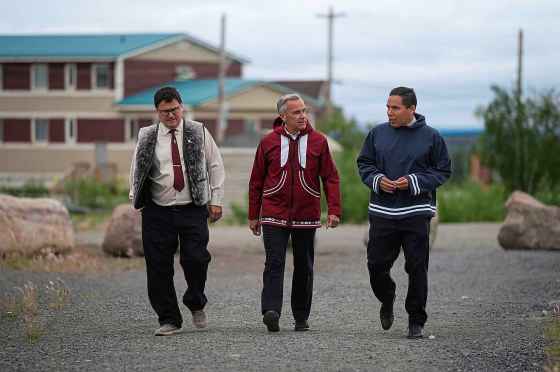
Prime Minister Mark Carney walks with Duane Smith, left, chair and CEO of the Inuvialuit Regional Corporation, and Natan Obed, right, president of the Inuit Tapiriit Kanatami, to a meeting of the Inuit-Crown Partnership Committee in Inuvik, N.W.T., on July 24. (Darryl Dyck / The Canadian Press files)

Prime Minister Mark Carney walks with Duane Smith, left, chair and CEO of the Inuvialuit Regional Corporation, and Natan Obed, right, president of the Inuit Tapiriit Kanatami, to a meeting of the Inuit-Crown Partnership Committee in Inuvik, N.W.T., on July 24. (Darryl Dyck / The Canadian Press files)

Next up for a “summit” on Bill C-5: the Métis. But: who will represent the Métis in view of the federal government?

The Manitoba Métis Federation and the Métis National Council — arguably the two largest representative entities in the Métis world, do not associate with one another, with the MMF questioning the legitimacy of the MNC.


2. Indigenous programs can expect federal cuts worth nearly $4.5 billion as Carney’s government promises to divert funding to higher military costs and tax cuts, among other changes.

The cuts to Indigenous programs represent nearly a fifth of total cuts across federal programs, according to the Canadian Centre for Policy Alternatives.

The funding reductions will result in “deep cuts” to First Nations education, health care, policing, and infrastructure projects. Indigenous Services warned “difficult decisions” were on the way in an internal email when the department announced these cuts nearly three weeks ago.

Carney has told the Assembly of First Nations that education, health care, policing, and infrastructure on First Nations do not qualify for forthcoming “projects in the national interest.”


3. A majority of Canadians believe the country is making “good progress” on reconciliation with Indigenous peoples, according to a new online poll from the firm Leger.

The survey was conducted between June 20 to 22. Nearly half of those polled self-identified as Indigenous. An age divide appeared: 40 per cent of respondents aged 18 to 24 said Canada was making progress, while 67 per cent of respondents 65 and older said the same.

Another kind of odd fact: Roughly six in 10 non-Indigenous respondents said they trusted Indigenous people, with the highest percentage in Nova Scotia (71 per cent) and Ontario (64.3 per cent) and lowest in Saskatchewan (38.3 per cent), P.E.I. (43.8 per cent) and Manitoba (44.8 per cent).

Online surveys such as this one cannot be assigned a margin of error because they do not randomly sample the population.


4. Indigenous-led cannabis and hemp businesses in North America are exploding — from dispensaries to agricultural operations to construction companies that create building blocks from fibre.

The boom follows a June 2023 Senate of Canada report that offered 13 recommendations to expand the cannabis industry in Indigenous communities.

Indigenous-led cannabis operations are also expanding in the United States, with many tribal nations applying federal laws in savvy ways to target a potential market in Europe.

The U.S.-based Indigenous Cannabis Industry Association released the first-ever map of tribal cannabis and hemp programs this past May.


5. Due to the wild fire situation in Manitoba and its impact on many Indigenous communities in the province, the First Nations Pavilion will not be part of this year’s Folklorama Festival.

It’s the first time in recent memory the First Nations pavilion has not been a fixture at the annual summer festival. Folklorama is on from Aug. 3 to Aug. 16.

Dancers perform at the Folklorama First Nations pavilion in 2023. (John Woods / Free Press files)

Dancers perform at the Folklorama First Nations pavilion in 2023. (John Woods / Free Press files)

An Indian taco is served up at the First Nations pavilion. (Jen Doerksen / Free Press files)

An Indian taco is served up at the First Nations pavilion. (Jen Doerksen / Free Press files)

IN PICTURES

A dancer in Indigenous clothing performs during a celebration to mark the 700th anniversary of the founding of Tenochtitlan, known today as Mexico City, in the capital's main square on July 26. (Eduardo Verdugo / The Associated Press files)

A dancer in Indigenous clothing performs during a celebration to mark the 700th anniversary of the founding of Tenochtitlan, known today as Mexico City, in the capital’s main square on July 26. (Eduardo Verdugo / The Associated Press files)

A dancer dressed in Indigenous clothing blows on a conch shell during the 700th anniversary celebration in Mexico City. (Eduardo Verdugo / The Associated Press files)

A dancer dressed in Indigenous clothing blows on a conch shell during the 700th anniversary celebration in Mexico City. (Eduardo Verdugo / The Associated Press files)

RECONCILI-ACTION OF THE WEEK

Every week I highlight an action, moment, or milestone forwarding reconciliation, illustrating how far Canada has come — and how far the country has yet to go.

This week’s reconcili-action is for my friend Dan Lett, my Free Press colleague and Niigaan and the Lone Ranger podcast co-host, who announced his semi-retirement and departure from Winnipeg this week via his newsletter, Not For Attribution.

Dan and I have done 54 episodes of our “pod” together, and we’ve had an incredible time bringing local, national and international stories together with banter, chats, and the occasional argument. The two of us will continue to offer NTLR episodes, but not on a regular schedule.

You’re likely familiar with Dan’s dynamic political columns, but you may not know he’s become a leading voice in Canada for commenting deftly and uniquely on Indigenous issues.

Check out this 2013 piece, for example, on the Brian Sinclair inquest, or his career-long commitment to advocating for the wrongfully convicted — many of whom are Indigenous.

Truth be told, I have learned a lot from Dan’s vast and intricate knowledge of Canadian election campaigns, Manitoba political history, and his rich sense of music and humour.

There is, of course, his sarcasm and blunt way of speaking the truth, too. Although I’d never tell him to his face, I’ll miss the Lone Ranger and I wish him and his wonderful wife Danielle good travels. I look forward to seeing them both down the trail.


Advertisement

Applause. A weekly look at what's happening in Winnipeg's arts and entertainment scene.
 

WHAT I'VE BEEN WORKING ON

Niigaan Sinclair:

Dying early, suffering in silence: the harms of toxic masculinity

Everyone pays when men are taught not to cry or ask for help


Niigaan Sinclair:

Carney’s one-day meeting with chiefs too little, too late

First Nations chiefs and leaders will convene for a one-day meeting with Prime Minister Mark Carney, several key ministers, and bureaucrats on Thursday to discuss the controversial One Canadian Economy Act.


Niigaan Sinclair:

Cracks begin to appear in Kinew’s rock-solid popularity

Victorious leaders and political parties, especially after defeating longtime incumbents, have a honeymoon period where polls are high and little disrupts that. Well, the honeymoon appears to be over and the harsh reality of governing is here.


LOCAL NEWS

Steve Lambert, The Canadian Press:

Manitoba government poll suggests concerns over health care, crime and immigration

WINNIPEG - The number of Manitobans concerned about crime and public safety has risen steadily, an opinion poll done for the Manitoba government suggests.


Tyler Searle:

Winnipeg ‘feeder’ city for sex trafficking

Report looks into link between Indigenous missing, murdered cases and posts on sex websites


Matthew Frank:

York Factory stresses urgent need for road link to outside world

Manitoba chiefs want the provincial and federal governments to build an all-season road to an isolated northern reserve after its ferry was grounded owing to low water levels caused by drought.


Marsha McLeod:

‘We’re not numbers’

Indian Act's ‘second-generation cut-off’ poses an existential threat to treaty people in Canada


Malak Abas:

‘Innovative and inclusive’ approach to transform five Winnipeg properties into 700 housing units

Bryce Nelson knows how difficult it is for people with disabilities to live independently in Winnipeg. He hopes new accessible housing in store for St. Boniface will change that.


Nicole Buffie:

Evacuees express frustration in march to Garbage Hill

Brenda Dysart said she would rather be swimming at the beach in Leaf Rapids Thursday afternoon.


Malak Abas:

Improving accessibility, ‘doing better’ the focus, Fontaine says in wake of insensitive remarks caught on microphone

Manitoba’s minister responsible for accessibility said Wednesday she’s focusing on improving accessibility standards after remarks she made about a sign-language interpreter sparked criticism last month.


Carol Sanders:

Manitoba signs deal with Saskatchewan to bolster trade through Port of Churchill

Manitoba’s experience as a leader in reconciliation will give it a leg up when it comes time for Canada to fast-track megaprojects, Premier Wab Kinew said Tuesday after signing an agreement with Saskatchewan to expand trade through the Port of Churchill


OPINION

Dan Lett:

Carney, Kinew rev up economic engines despite Indigenous, environmental concerns

It’s one of the great trade-offs in politics: invest in something that has ambiguous public support on the promise that it will lead to significant economic growth.


Dan Lett:

If Tories aren’t careful, old yellow dog could learn new NDP tricks in rural byelection

If the stars align just so, they might end up calling this the “Miracle of Spruce Woods.


Tom Brodbeck:

Promising news on crime front underscores need to invest in people, communities

For the first time in years, there’s a flicker of good news on the violent crime front in Manitoba. Statistics Canada data released last week show Manitoba’s violent crime severity index dipped by 2.24 per cent in 2024 — a modest but notable decrease after years in which the rate increased.


ARTS & LIFE

Ben Sigurdson:

Carefully curated

Kanata Classics book series explores Truth and Reconciliation 10 years after the report was released


Shel Zolkewich:

Wonders of the Whiteshell

Boreal landscapes beckon with a multitude of wonders


FROM FURTHER AFIELD


Share:


Download our News Break app