|
Two automakers that have built in Canada for more than a century came into the federal government’s crosshairs in October after cancelling production in the wake of U.S. President Donald Trump’s trade war.
General Motors, which began production in Canada in 1907, and Stellantis, which opened its plant in Windsor as Chrysler in 1925, earned Ottawa’s retaliation by cancelling the BrightDrop EV production (GM) and Stellantis by relocating a planned build of the new Jeep Compass from Brampton, Ont., to a plant in Illinois.
In fairness, ending BrightDrop may have been due to poor sales rather than trade actions, but it earned GM no favours on Parliament Hill.
Advertisement

First, some background: when Trump began his trade war last year, Ottawa instituted retaliatory tariffs on U.S. steel, aluminum and vehicles. In recognition of their contributions to Canadian manufacturing, it also instituted in April a release valve: carmakers were granted relief from Canadian tariffs based on manufacturing in Canada.
When GM and Stellantis both pulled their plugs, Ottawa hit back. Stellantis earned a 50 per cent reduction in its tariff relief, while GM was penalized with a 24.2 per cent reduction. Basically, it means both companies can import fewer American-made vehicles without tariffs.
Each company is walking a very fine tightrope trying to satisfy Trump’s demands while still trying to hold on to a Canadian sales and manufacturing base.
That tightrope means that neither company will come right out and say that anything they’re doing is related to the trade war, lest they earn the mercurial president’s wrath. But some of their recent moves certainly seem to be an attempt to make amends with Canada.
Stellantis is on a hiring spree, hiring 1,700 to staff a third shift at its Windsor Assembly plant, plus 34 more jobs in manufacturing, sales and customer service across Canada, while General Motors is investing another $63 million, part of a $1.1-billion investment since 2020, in its Oshawa Assembly to prepare for the next generation of internal combustion pickup trucks.
“We are building Canadian sales, aftersales and marketing throughout Canada, to better ensure we are serving our customers and dealers,” said Jacqueline Oliva, vice-president, human resources, Stellantis Canada, in an interview.
Despite the concern by the federal government over Stellantis moving Compass out of Brampton, the story of that plant isn’t over, Oliva said. “We are continuing to work with the government relative to finding a solution for Brampton Assembly.”
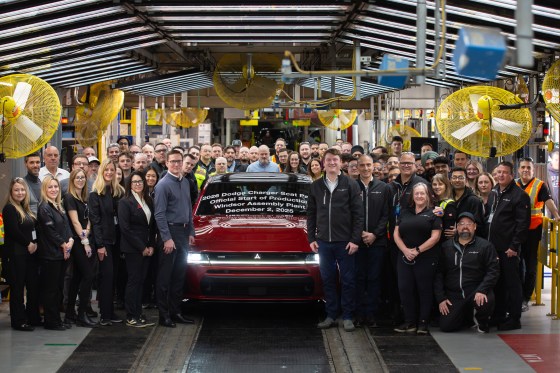
Stellantis employees in Windsor, Ont., produce the Dodge Charger EV as well as the Chrysler Pacifica minivan. (Stellantis)
Stellantis continues to build the Chrysler Pacifica minivan and Dodge Charger EV in Windsor. It launched NextEnergy, a battery plant in Windsor, in collaboration with LG, and then sold its share to LG. It has also been expanding its Windsor R&D operation.
“Since 2023, we’ve added 650 highly skilled engineers at our Automotive Research and Development Centre, and they support product development for all of our products in North America.”
It’s easy, during this time of trade friction, to pick favourites and tar others, but given the turbulence, doing so fairly isn’t easy at all.
What I’ve been working on
I was in Los Angeles a week ago to drive the new Jeep Cherokee. You can read my report here.
|