|
Like a battery running out of juice, Canada’s push towards electric vehicles is rapidly losing its charge.
When enthusiasm in former EV hotbeds such as British Columbia and Quebec fades, it can only be a matter of time before the federal government runs the numbers on EV adoption and realizes a 2035 mandate for 100 per cent zero-emission sales is hopelessly unrealistic and, potentially, political suicide.
The National Post, reporting on a Leger survey the Post commissioned, said interest in EVs is cratering, with petroleum-rich Alberta more in favour of the vehicles than either B.C. or Quebec. Wow.
Advertisement

Those Quebec votes play perhaps the largest role in Prime Minister Mark Carney’s political calculus.
Still, collectively, the automotive industry isn’t going to turn its back on more than US$1.2-trillion worth of investment in developing various forms of zero-emission mobility.
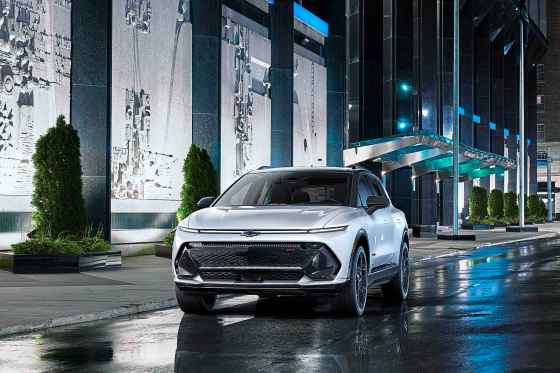
The Chevrolet Equinox EV is one of dozens of electric vehicles on the market in Canada. (Supplied)
Even the most ardent critics of EV mandates, including Brian Kingston, president of the Canadian Vehicle Manufacturers’ Association, and Dave Adams, president of Global Automakers of Canada, who represent domestic and foreign carmakers respectively, support the move to EVs and insist the market is going to go electric.
Just not in nine years.
The EV mandates were the equivalent of pushing on a string, and when Ottawa, Quebec, British Columbia and other provinces were spending billions on subsidies, it wasn’t working so much as it was being purchased. Now that many of those subsidies are yesterday’s news, EV sales have plummeted.
So, where does that leave Canada? Back where it should have been all along.
Success in the market is driven by consumer demand. Consumer demand is driven by companies providing solutions to consumer problems, something that with EVs the market as a whole has failed to provide, at least in Canada. The fault lies primarily with government, which has fallen far short of its projected installation of charging stations.
The vehicles are here, and while it’s true that some of the objections to EVs are grounded more in myth than reality, you can’t force consumers to buy anything. It comes down to letting them believe it’s their decision: basically by letting them come to their own conclusions about range, safety and ability to meet their needs. That happens by installing enough chargers, by incorporating new technologies to increase range and decrease fire risk and demonstrating the vehicles’ abilities.
Give the automotive industry realistic targets, don’t dictate specific technology for meeting them and let engineers do what they do best. Sure, there’s often the need for a stick to go with that carrot: companies will take the easy way out if you let them, but you can’t force a breakthrough in solid-state batteries, or some other technology nobody’s dreamed of yet.
Some of this will be helped by Canada’s trade deal Friday with China, which trades access for 49,000 Chinese EVs in exchange for tariff relief on canola and other ag products. It’s a foot in the door for China, but it’s also a relatively small number of vehicles in a market that sells typically 1.9 million vehicles a year.
Canada is a much different animal than EV panacea Norway, for a number of reasons. You can take the longest road you can find in Norway and if you drive the equivalent distance here, it is not enough to get you out of Ontario. Over that same distance, you’d probably pass 100 times or more the number of charging stations in Norway than during that Ontario drive.

Charging station availability continues to be a concern holding back EV sales. (Nic Adam / Free Press files)
Norway, and much of Europe, is also much better-served by rail, so for more people, the only drive during an intercity trip is a short commute to a railway station. Norway’s system of punishing taxes on gas-powered vehicles also drives EV demand.
The government launched a review of the EV mandate and we’ll find out the results soon. Hopefully, the results are based on a pragmatic look at today’s reality.
|