|
The marathon is not an event at the Winter Olympics.
However, our Mike McIntyre was running the equivalent of a reporting marathon for 20 straight days from the moment he touched down in Milan prior to the lighting of the Olympic cauldrons, until those flames were finally extinguished to mark the end of the Games.
I caught up with the jet-lagged Mike upon his return home, while the memories of all he witnessed in Italy were still fresh in his mind.
Since there are five Olympic rings, I put five questions to him:
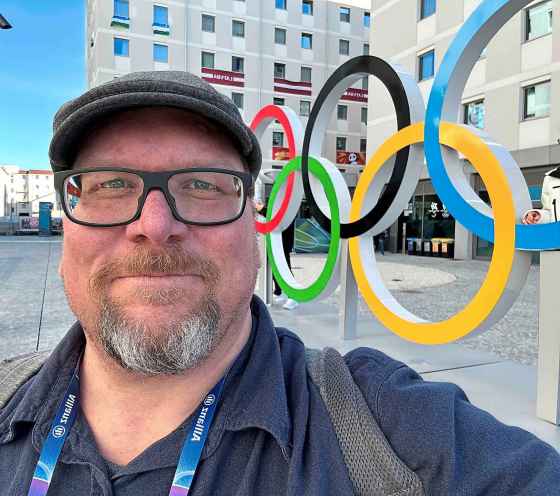
Mike McIntyre on the ground in Milan.
Let’s start with something easy. What was the high point of these games for you?
It’s hard to nail down just a single high point, given that I had a wide-eyed, kid-in-a-candy-store approach to so much of it. Just touching down in Italy — a place I’d long hoped to visit — provided the first of many “pinch me” moments.
Milan certainly delivered in every way. The pomp and circumstance of the Opening Ceremony was a real “now I’m here and it’s official” event.
The atmosphere inside the venues is something I will remember forever, with the cheering and chanting and singing and dancing and all the obvious joy fans were feeling watching athletes from their countries competing. It was a vivid reminder of the beauty of sport.
Last, but certainly not least, as both a hockey writer and a fan of the sport itself, getting to see the return of NHL players up close was certainly a spectacle, and attending both the women’s and men’s gold-medal games was the perfect way to end a memorable 20 days on the ground.
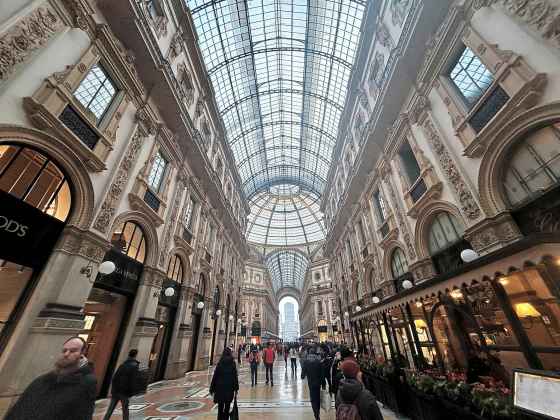
The beauty of the Italian setting was not lost on Mike. (Mike McIntyre / Free Press)
Since I asked about the highs, what was the low?
“No cheering in the press box” is a pretty hard and fast rule in sports journalism, and one that I generally have no trouble observing.
To be clear, I have no rooting interest when I’m covering the Winnipeg Jets, save for hoping the games provide ample juicy storylines and that they move quickly and don’t go right down to overtime/shootout, especially during Central and Mountain time zone starts, which can be an absolute nightmare for meeting print deadlines.
However, being at the Olympics and being a proud Canadian, I’d be lying if I said I wasn’t cheering internally for the women’s and men’s hockey teams to find a way to win. Seeing them both lose in overtime — to the United States, to boot — was a bit of a wet blanket, that’s for sure.

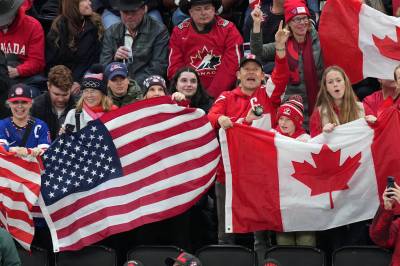
Canadian and American players shake hands after Canada lost in overtime during the men’s gold medal hockey game on Sunday. (Darryl Dyck / The Canadian Press)
Politics has always been part of the Olympics. How did you see that come into play in Milan?
It was refreshing to see Canada treated so well — fans, athletes and even us media — on a world stage such as this. There’s no question our profile has been raised in a significant way. It was a vivid reminder of how we are viewed outside our own little bubble.
As for the Olympic events, I would say it was a bit surprising to see politics not play a bigger role, with respectful cheering and applause and no reports whatsoever of conflicts either between competitors or spectators. (Well, the Canada-Sweden men’s curlers aside. That was a doozy!).
There were constantly announced reminders before events to abide by the Olympic ideals of good sportsmanship and fair play, and it seems like pretty much everyone was able to park politics for at least a few hours to focus on the athletes themselves.
Of course, what happened after some events — I’m looking at you, U.S. men’s hockey team — is another issue entirely.
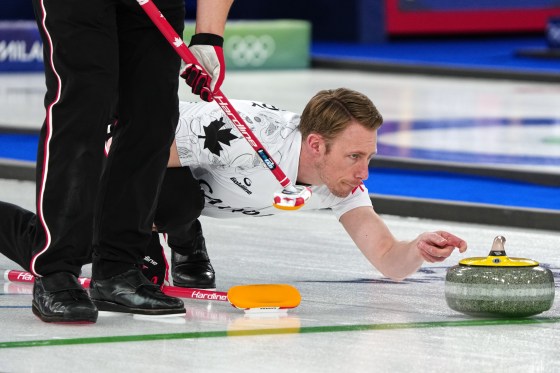
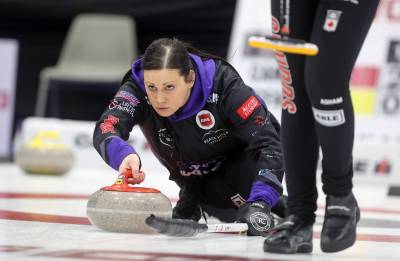
Canada’s Marc Kennedy used profanity during an in-game discussion with Sweden’s Oskar Eriksson, who felt the Canadians were committing an infraction by ‘double-touching’ curling stones. It snowballed into one of the major buzz stories of the Games. (Misper Apawu / The Associated Press)
What was the biggest surprise for you at these Games?
The biggest surprise would be the fact Canada took a big step back in terms of overall performance, with its lowest medal count since 2002.
I hope nobody blames me! But seriously, it became apparent in talking to various athletes and Olympic Committee members and others on the ground that this has been a worrying trend for some time now, and what happened in 2026 might just be a bit of a canary in a coal mine when it comes to high-level competition.
As someone who loves the Games and seeing our country fare well on a global stage, I personally hope this ends up being a bit of a wake-up call.
I heard and read and learned a lot about the way Norway does business, particularly as it pertains to youth sport, and it’s pretty inspiring how that country repeatedly punches way above its weight.
The other biggest surprise: how the whole “six degrees” thing really applies to Manitoba. I was stunned at how many connections I found to our province, which certainly paid off when it came to storytelling.

Faye and Mark McGregor (from right), parents of Swiss speedskater Kaitlyn McGregor, were among the Manitobans Mike met in Milan. (Mike McIntyre/ Free Press)
On the eve of the Games, the Washington Post announced major cuts that included closing their Olympic bureau in Milan. You talked on X (formerly Twitter) about how grateful you were to be there for the Free Press. Why do you think it was important for us to be at these games?
It was certainly revealing to learn that only about 40 Canadian journalists — print and broadcast, English and French combined — were accredited for these Olympics. And I’m so proud that the Free Press was one of them.
Although there were only five Manitoba athletes at these Games — one of the smaller delegations we’ve ever sent — we found a way to produce 52 unique stories, features and newsletters over the 20 days I was on the ground. The vast majority of the stories had location angles and connections that you simply couldn’t find anywhere else.
The Olympics are supposed to be about bringing people together, and I certainly felt that way when it came to my role.
This event provided a terrific chance to show how the relationship between the newspaper and our readers is something that needs to be celebrated and preserved.
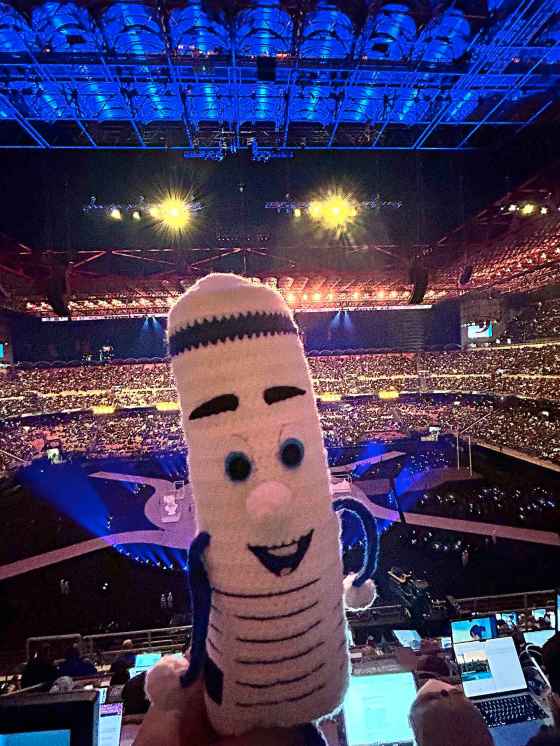
A mini version of Free Press mascot Scoop was Mike’s guest at the Games. (Mike McIntyre / Free Press)
|