THE MACRO
I can’t tell you how many times I’ve sat up late at night — eyes wide open in exasperation, editors nervously pacing — as I struggled to find a lede — any lede — for a story on a federal leaders’ debate.
For most journalists, but particularly for opinion writers, leaders’ debates are the ultimate test: important story, deadline pressures and — oh yeah — not much to write about. As much as we want the leaders’ debates to provide seismic moments that upend the campaign, most turn out to be a reminder of just how badly behaved adults can be when given the chance.
Notwithstanding those realities, many journalists are guilty of some pretty shameless embellishment in the lead up to the debates. “Pivotal” and “game-changing” are words often attached to the advance stories we file. We do that even though most of us know the likelihood of a leaders’ debate producing a pivotal moment is as likely as Maxime Bernier posting a selfie after he got his second dose of Pfizer.
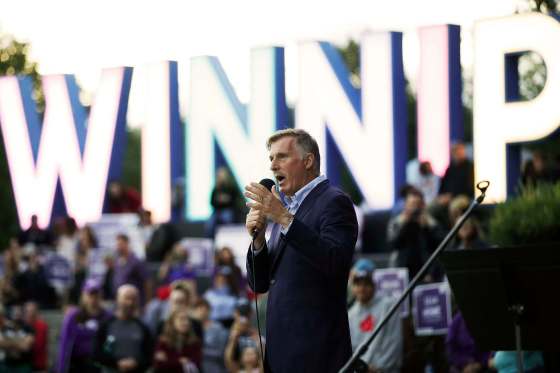
About 400 people gathered to hear Maxime Bernier, leader of the People’s Party of Canada, speak at the Forks in Winnipeg Monday. (John Woods / Winnipeg Free Press)
That is not to say that pivotal moments have not happened. It’s just that in just over a half-century of federal leaders debates in this country, you can count the truly pivotal moments on one hand.
Canada very nearly had its first leaders debate in 1962, when Liberal leader Lester Pearson challenged Progressive Conservative leader and prime minister John Diefenbaker to a televised debate, but was turned down. The Tories no doubt were aware of what had happened in the 1960 U.S. presidential election, when televised debates did, in fact, have a seismic impact on the campaign. A sweaty, fidgety Richard Nixon suffered a thrashing at the hands of the elegant, not-so-sweaty John F. Kennedy. The myth of the debate as tectonic campaign event was forged right there and then.
Canada would ultimately join the TV leaders’ debate club in 1968 when then Liberal leader and prime minister Pierre Trudeau faced off against Tory leader Robert Stanfield, NDP leader Tommy Douglas and Réal Cauoette of the Railliement crédiste. The two-hour debate was jointly hosted by CTV and CBC and did not produce much in the way of drama. That might explain why there were no debates in the 1972 and 1974 elections.
Starting in the 1979 election, a total of 31 debates have been held in the 12 previous federal election campaigns. In most years, there were two (one English and one in French) but in a couple of elections, there were quite a few more. In 2015, a remarkable five showdowns took place: three general debates on all issues; one on the economy and a fifth on foreign policy. Two of the five debates were in French.
But even all those debates couldn’t produce “the moment” even though, taken in their entirety, they did expose the contrast between an older, stodgier and increasingly angry Harper, the equally stodgy and angry NDP leader Thomas Mulcair (whose party actually led in the polls when the writ was dropped) and the younger, charismatic Trudeau. So, I guess in their totality, that did play a role in Trudeau roaring up from behind to win a majority government.
Other moments. Most of the aforementioned political animals are likely to identify two key knockouts from past debates.
The first was 1984, when newly minted PC leader Brian Mulroney eviscerated Liberal leader John Turner over a glut of patronage appointments made by Trudeau before he left office. Turner insisted that he “had no choice” but Mulroney shot back with the now-infamous “You had an option, sir, to say ‘no.’” Turner was reduced to a stuttering, exasperated mess and Mulroney went on to win a huge majority.
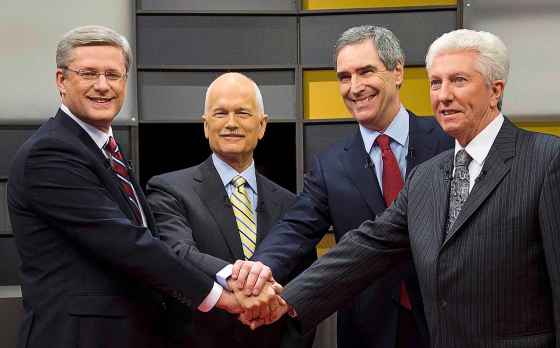
CPPrime Minister Stephen Harper, left to right, New Democratic Party leader Jack Layton, Liberal leader Michael Ignatieff and Bloc Québécois leader Gilles Duceppe, exchange hand shakes as they arrive to the English language federal election debate in Ottawa Ont., on Tuesday, April 12, 2011. (Adrian Wyld / The Canadian Press files)
The second moment, perhaps a bit less impactful than 1984, involved an exchange between Liberal leader Michael Ignatieff and NDP leader Jack Layton in the 2011 English-language debate. After triggering the election with a non-confidence vote that toppled Harper’s minority, Ignatieff struggled. Layton made history when, without warning, he shifted from Harper to Ignatieff and attacked on the latter’s poor attendance record in the House of Commons.
Ignatieff’s attendance had not been identified as a campaign issue; not even the Tories had brought it up. But Layton pounced with surgical rigour. “You know most Canadians, if they don’t show up for work, they don’t get a promotion.”
Although Harper was seen by most as the winner of the debate (he would go on to win a majority), Layton’s debate performances (particularly his effort in the French-language debate) helped the NDP win 107 seats, catapulting the perennial third-place party past the Liberals, who stumbled to just 34 seats.
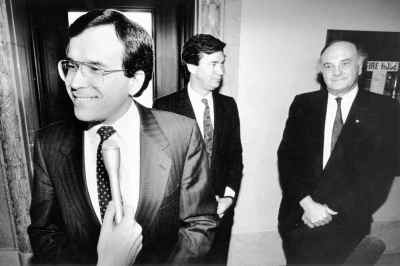
In Manitoba, genuinely pivotal debate moments are just as rare, although the 1999 televised debate does come to mind.
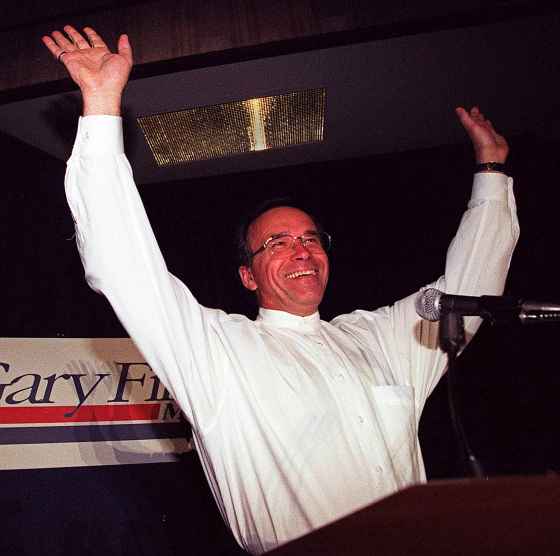
In pre-election fanfare form, Premier Gary Filmon waves to a crowd after entering Manitoba PC convention. (Joe Bryksa / Winnipeg Free Press files)
In that debate, Progressive Conservative leader and incumbent premier Gary Filmon became the unwitting victim of an unflattering cutaway camera angle that captured his clear and utter disdain every time he was attacked by challenger and NDP leader Gary Doer.
At the debate, Doer launched stinging attacks at Filmon for cuts to health care and education, and the 1995 vote-splitting scandal. With each thrust Filmon became more and more visibly angry.
As University of Manitoba political scientist Paul Thomas would say afterward, the image of a scowling Filmon strongly made for a very unflattering image. “You could just see him grimacing and holding back losing his temper because he didn’t want to get into a mud-slinging fight with Doer,” Thomas told the CBC.
Although the debate was not the pivotal moment, the NDP did come roaring back to a majority victory in that election and held power for a remarkable 17 years.
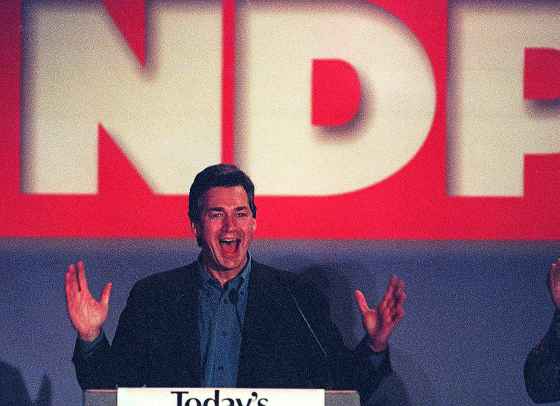
NDP Manitoba leader Gary Doer enjoyed taking many shots at premier Gary Filmon and the provincial government during his speech. (Joe Bryksa / Winnipeg Free Press files)
So, what are we to make out of all this history?
First and foremost, politicians are professional public speakers and with the right amount of preparation, most are very difficult to knock out in a televised debate.
And second, I will be glued to my television this week to watch this week’s debate.
Thanks to the good work of the Leaders’ Debates Commission, you have more options to watch the debates than ever before, and in more languages than ever before.
One debate has already taken place, organized by Quebec television network TVA. Although it did not produce a seismic moment, it did help introduce new issues (gun control) to a somewhat moribund campaign.
The two LDC debates take place on Wednesday (French at 8 p.m. EDT) and Thursday (English at 9 p.m. EDT). You can watch on Facebook, YouTube and either stream or tune into the feed from just about every major network and news organization in the country. Translations will be available in East Cree, Innu, Ojibway, Punjabi, Arabic, Mandarin, Italian, Cantonese and Tagalog.
As in past campaigns, I’ll have my eyes and ears peeled for that knockout moment. If it doesn’t happen, I will adopt an approach to writing first described by legendary American sports journalist Red Smith.
“You just sit at your typewriter (or computer keyboard) until little drops of blood appear on your forehead.”
Do you have a subject you would like to see covered in Not For Attribution? Do you have specific questions about journalistic practices or the business of news? Do you have specific concerns about politics or political leaders? Email me your questions and I will respond. Promise.
|