|
Anyone with a little too much time on their hands — OK, stop looking at me — can tell you there are a lot of so-called “awareness days” on the special-day calendar.
And September, the ninth month of the year, is literally packed with days on which we are meant to pause and make ourselves aware of a particular issue, thing, person or event.
For instance, this coming Saturday, Sept. 11, is Farmers’ Consumer Awareness Day, wherein we members of the grateful public are meant to spend some time thinking about the lives and works of the farmers who help put food on our tables.
Advertisement

Next Wednesday, Sept. 15, is National School Backpack Awareness Day, which is the day parents, teachers and students come together to be aware that an improperly worn backpack can lead to back pain or injury, all of which can make it harder for kids to learn.
But of all the weird awareness days on the calendar, today is the one that always turns me green with envy, because it involves little green dinosaurs, by which I mean iguanas.
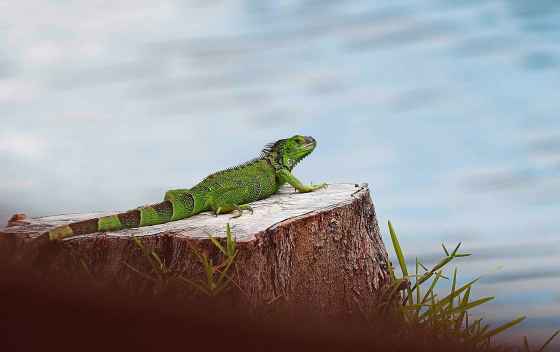
Iguanas are very large lizards that can live 20 or more years in captivity and can grow as long as six feet, nose to tail tip, with more than half of their body length due to their tail. (Brynn Anderson / AP photo files)
Yes, as many of you already know, today, Wednesday Sept. 8, 2021, is National Iguana Awareness Day, a day on which people who know nothing about iguanas suddenly decide to learn everything there is to know about iguanas.
OK, in reality, it mostly appears to be a day for iguana owners to become more educated about their scaly, green cold-blooded pets. “What’s not to love about an aggressive, cold-blooded, reptile with a nasty bite and a powerfully strong tail? Learn all about these cute critters and how to care for them on Iguana Awareness Day,” urges the website daysoftheyear.com.
“As with so many pets, not all new owners realize what they are committing to when they first take home their baby iguana. That little bundle of scales could one day grow to six feet in length. With very specific dietary needs and a rather reptilian personality, iguanas are said to be easy to love, but hard to care for.”
To help kick-start what I’m sure will be a day of constant celebration, here are a few fun facts about these long-bodied, predominantly green lizards:
Fact No. 1 — Iguanas are very large lizards that can live 20 or more years in captivity and can grow as long as six feet, nose to tail tip, with more than half of their body length due to their tail. Adult males can weigh up to nine pounds, with some especially large ones reaching as much as 18 pounds, while smaller females may grow up to seven pounds;
Fact No. 2 — They have an extra eye. Really. Not only do iguanas have great vision and see colours, but they also have a photosensory organ on top of their heads called the pineal gland, or parietal eye. This “third eye” cannot form images but helps wild iguanas detect predators lurking above them;
Fact No. 3 — Their tails come off. Yes, according to vetstreet.com, iguanas in the wild can break off their tails to escape if a predator grabs the tail and holds on, while pet iguanas can release their tails if they are restrained by the tail, or if the tail gets caught and they can’t move.
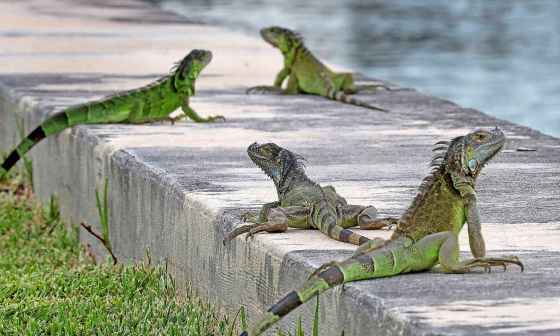
Tribune Media TNSIguanas have great vision and see colours, and they also have a photosensory organ on top of their heads called the pineal gland, or parietal eye. (Mike Stocker / Sun Sentinel / TNS)
My favourite fact is that when there is a sudden cold snap in tropical places like Florida, it will literally start raining iguanas. “Iguanas fall out of trees during cool weather because they’re cold-blooded and tropical. Low temperatures cause them to become sluggish and, in some cases, immobile. If it happens while they’re sleeping in trees, they often fall to the ground,” warns the South Florida Sun Sentinel.
Here’s another alarming true tidbit: the National Weather Service in Miami actually issues an advisory for the possibility of falling iguanas. (“Good morning, there’s a 50 per cent chance of showers and a 70 per cent probability of being hit on the head by a plummeting iguana.”)
So what I’d like you to do now is put on your helmet — because you never know, right? — and then get ready to be uplifted by reading today’s upbeat batch of inspirational and heart-tugging news reports, which have nothing to do with iguanas.
|