|
It was a pretty good crowd for a speaking appearance by the Free Press editor.
A former governor-general. A current lieutenant-governor. Two former premiers. The speaker and the clerks of the Legislative Assembly of Manitoba. Numerous provincial cabinet ministers and MLAs from the ranks of the NDP, Tories and Grits. And, to help balance the demographics from tipping all the way to the senior end of the spectrum, some wide-eyed high school and university students.
The formal title for Tuesday’s presentation to the Association of Former Manitoba MLAs was “Headlines and Bottom Lines: The democratic case for a newspaper like the Winnipeg Free Press.”
Advertisement

But the informal Question Period, which followed, was when I really had to be on my toes. I also had a chance to get something off my chest when Ed Schreyer rose to pose his question.
Schreyer, the first Manitoban to reside in Rideau Hall as well as the first NDP premier of the province, wanted to know what I thought the loss of The Winnipeg Tribune meant to this city and province.
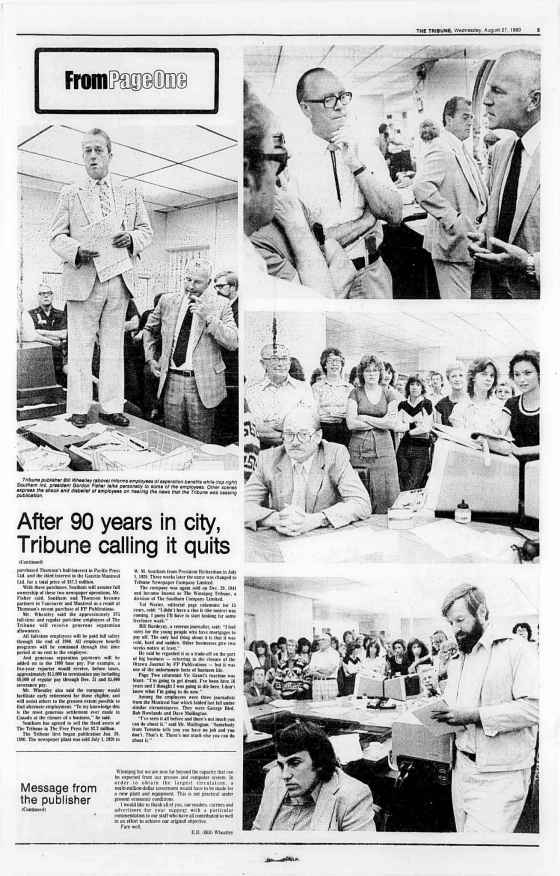
The Tribune was another Winnipeg daily, operating from 1890 to 1980. This is a page from its final edition on Aug. 27, 1980 (University of Manitoba Digital Collections)
My response began by noting I was a Free Press paperboy on that fateful Aug. 27 day in 1980. I remember seeing the bundle dropped for the Trib carrier sitting on the boulevard, abandoned and destined to never make it into the mailboxes of my Silver Heights neighbourhood.
But as editor of the paper I used to deliver, I wasn’t afraid to say the end of the longstanding rivalry between the Freep and the Trib was a sad day.
Competition kept everyone on their toes. Competition meant more and better stories.
The closing of the Trib — on the same day the Ottawa Journal was shuttered — sparked concern about the concentration of media ownership in Canada, and led to the creation of the Royal Commission on Newspapers, better known as the Kent Commission.
But the media concentration we worried about in the 1980s is dwarfed by what we are staring at today.
As my presentation slides made clear, Google and Meta are hoovering up roughly 80 per cent of every advertising dollar spent in Canada. The dominance of those Silicon Valley behemoths is largely the reason for another presentation slide, which showed Free Press revenues are half what they were a decade ago — the reason so many newsrooms across this country have closed in recent years.
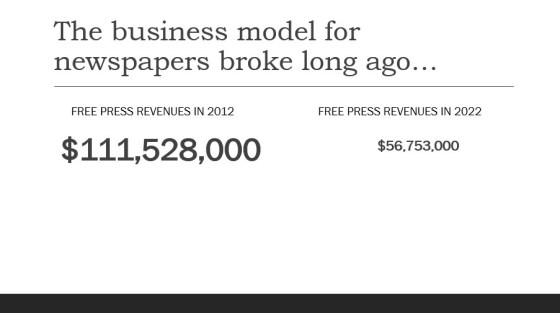
A slide from the presentation. Interested to see more? Watch all the slides here.
To put it another way, the scale of the Free Press dominance, post-Trib in 1980, compared to the domination of the two tech giants today is akin to the difference between Riding Mountain and Mount Everest. The former rises almost imperceptibly from the Manitoba Prairie while the latter is impossible to ignore, even from space.
We are at a point in the media ecosystem where the survival of a newspaper like the Free Press is no longer a given. Yet Canadians seem willing to do little more than shrug when staring at media monopolies getting ever larger, ever more powerful.
History shows we were prepared to take on the railroads, the banks, the telcos when they got too big, too powerful. A national outcry spurred Parliament to act when Winnipeg and Ottawa suddenly became one-newspaper towns. But in today’s digital age, our politicians are still flocking to Facebook even as Mark Zuckerberg blocks news entirely in Canada.
I can’t really explain the discrepancy, the dichotomy, the disconnect. But at least I put it all on the record.
As one former cabinet minister whispered to me before my talk: “Don’t tell them what they want to hear; tell them what they need to hear.”
|