|
“I don’t mind going back to daylight saving time. With inflation, the hour will be the only thing I’ve saved all year.”
— pianist and comedian Victor Borge
Manitoba Premier Wab Kinew is the latest first minister to suggest ending switching our clocks twice a year. What the “spring-forward” is going on?
The Macro
Can someone please tell me why daylight time is such a big deal?
Save for a couple of small hiccups — failing to change the clock and showing up one hour early or one hour late for something I was doing on a Sunday — it hasn’t had much of an impact on my life.
So I’ll ask you, dear reader, why does the debate over ending daylight time seem so robust right now? This month, British Columbia moved to adopt permanent daylight time. The province joins Saskatchewan and the Yukon in not observing a time change (Saskatchewan made central standard time permanent in 1966).
Five years ago, Alberta held a referendum on adopting permanent daylight time that failed but Premier Danielle Smith won’t stop talking about revisiting the issue now the neighbouring province to the west has made the change.
The four Atlantic provinces all passed laws to move to permanent daylight time but then decided to hold off until other, neighbouring jurisdictions did the same. The same wait-and-see approach is being taken in Ontario, which passed a law in 2020 to move to permanent daylight time but Premier Doug Ford said later he would not implement it unless Quebec and New York state did the same. And for the record, despite an online survey showing 91 per cent support for permanent daylight time, Quebec has not considered a law to make it so.
Advertisement

If you’re keeping score at home, that leaves Manitoba as the only province that has not engaged on this issue. But wait — THIS JUST IN — Manitoba Premier Wab Kinew wants to get in on the daylight time debate.
Or does he?
The Free Press reported in early March Kinew did not want to waste a lot of time discussing daylight time.
“Everybody’s got an opinion on it, but we only have so many hours in a day, and we’re going to spend those hours on health care and lowering your cost of living,” Kinew said the day before the resumption of the fall session of the Manitoba legislature.
A week and a half later, however, Kinew was singing a different tune. “Nobody would design the system this way if we were starting from scratch today,” Kinew said at a news conference on March 13. “The challenge just comes from us trying to transition away from this sleep-destroying structure that we currently have and trying to get it to something that’s more healthy and sustainable for the public in the long run.”
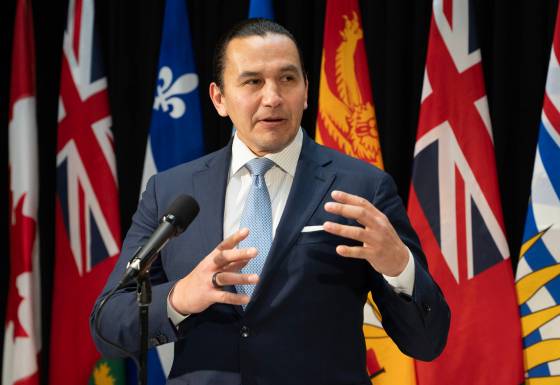
Manitoba Premier Wab Kinew (Adrian Wyld / The Canadian Press files)
Okey-dokey, then.
I won’t go too deep into the arguments for and against clock changes except to say many of the claims made about the impacts of changing clocks twice a year are alarming and, lamentably, not entirely accurate.
The daylight-time-and-back tradition has been blamed for everything from multibillion-dollar losses on financial markets, to a spike in heart attacks, to poor milk production from cows. I can’t say for sure whether any of these things are true because they come in the form of largely unattributed claims from studies that are either quite old, or meta-studies where the results are from a gaggle of older and (in some instances) flawed studies.
One issue — the spike in heart attacks — is perhaps the most repeated by opponents of the time change. While it is true that not getting enough sleep is definitely connected to cardiac events, and that the shifting of clocks does disrupt sleep for some people, the link with heart attacks is pretty tenuous.
The original study that linked time changes and heart attacks, authored by researchers from the American Heart Association, was published in 2022 by the American College of Cardiology. Looking at data on cardiac events between 2013 and 2022, it claimed there was a 24 per cent spike in heart attacks on the Monday following the move back todaylight time in the spring.
Unfortunately, it appears that study is way wrong. Researchers from Duke University Medical School did a comprehensive review of the 2022 study last year and found “no significant differences were found in the incidence rates of acute myocardial infarction in DST weeks compared with the week before or after. Moreover, there were no significant outcomes, including in-hospital mortality and stroke, between those weeks.”
All-righty then.
Adopt permanent daylight time, or don’t. But please don’t tell me that getting rid of the clock shifts is going to save my life.
|