|
“I have struck a city — a real city — and they call it Chicago. I urgently desire never to see it again. It is inhabited by savages.”
— Rudyard Kipling
We have strong opinions about the cities in which we live. But are they fair opinions?
Advertisement

The Macro
The quote I used today to open this edition of NFA is one that I have treasured for a long time. Not because I think Rudyard Kipling was being fair about describing Chicago — it is one of my favorite American cities, a place I will willingly visit again when, you know, there is a change in administration in Washington D.C. — but because it serves as a cautionary tale for journalists.
Kipling’s dislike of Chicago is chronicled in Sea to Sea and Other Sketches, Letters of Travel, a two-volume collection of 37 letters the great author wrote while travelling from India to England via Burma, China, Japan and the United States.
Kipling’s writing in Sea to Sea is impeccable. However, his methodology was lacking: he spent a total of 10 hours in the Windy City before deciding that it was a repulsive place.
This is where the cautionary note comes in: journalists must always beware the conclusions we draw from briefly visiting a place.
In fact, it’s also important for us to guard against conclusions we develop over longer visits but which are still based only on limited anecdotal evidence.
Flash forward to last week, when I was in Toronto researching a story about how the FIFA World Cup is impacting Canada’s biggest city.
Toronto and Vancouver will play host to 13 World Cup matches, the former city with six and the latter with seven. The first game will be in Toronto on June 12, the same day my feature story will appear online.
While in Toronto, I stayed at a downtown condo located right near Union Station. It was a very busy, very tall, two-tower development that appeared to have a huge number of units being used as Airbnb short-term rentals.
In the elevator one day, I struck up a conversation with two young women who were visiting Toronto for the first time and were looking for somewhere to have breakfast. I was making suggestions when another man interjected with: “This used to be such a great city but it’s just a shithole now.”
As he stormed out of the elevator, I looked at the two young women, who were quite alarmed.
Quietly, so the angry man could not hear me, I told the women, “Not to worry. Toronto’s a great place.” They smiled and went off for breakfast.
I am curious about why the man thought Toronto was such a bad place. Could be a number of things: he had a crappy job that made it hard to afford the city; he bought a condo in that building and realized it’s worth half of what he paid for it; he had a bad experience with an act of random violence; he finds the incredible diversity of the city unsettling; he’s just a bitter fellow who simply does not want to live in a big, noisy, densely populated city.
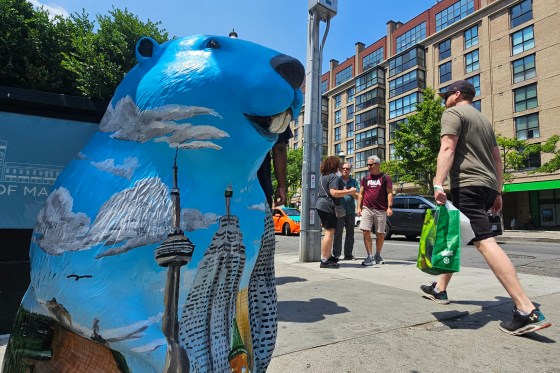
Pedestrians pass around the Old Toronto beaver sculpture, near the St. Lawrence Market, in Toronto on, June 5. (Giordano Ciampini / The Canadian Press files)
Whatever the reason, I wondered how much he knows about Toronto. Obviously, he’s spent more than 10 hours in the city. But does he really know the city?
I grew up here and I know for a fact that today’s Toronto is not the Toronto I knew as a child. The city is bigger and way more expensive, and has big-city problems with crime, poverty, homelessness and decay.
But it’s also way more diverse and has way more to do now than ever before. By international standards, Toronto is a very clean, very safe, very interesting place.
The fact I’ve travelled extensively has given me some peace about big-city problems in a place like Toronto, or my adopted home of Winnipeg, from which I moved last fall.
I try to take the good with the bad of every city I visit or live in. No place is totally good or totally bad, and it takes years to discover the true nature of any setting.
If you find yourself spending a lot of time bad-mouthing your home city, my advice would be to travel and see how people live in other urban areas.
If that doesn’t give you peace, then consider moving out of cities altogether to see if the rural life suits you.
Either way, don’t spoil the adventure of discovering a new place for other people.
|