|
The U.S. Supreme Court appears poised to reject a key demand of U.S. President Donald Trump, a rejection that has positive implications for the Canadian economy.
Trump wants to fire Federal Reserve governor Lisa Cook, citing as-yet-unproven allegations of mortgage fraud. I’m sure a certain German bank, a children’s cancer charity and alumni of Trump University appreciate the irony of Trump’s concern about fraud… but I digress.
The Supreme Court justices on both sides of the political spectrum, led particularly by Trump appointee Brett Kavanaugh, Wednesday expressed grave reservations about firing any Fed governor but particularly in a case such as Cook’s, where due process has yet to render any judgment about guilt or innocence.
Advertisement

Trump has made clear he thinks current Fed chairman Jerome Powell — whom Trump appointed — has not moved quickly enough to lower interest rates. Powell and the other governors insist their decisions on interest rates are based on sound economic analysis and not political whim. Throughout both his terms as president, Trump has tried to fire Powell to no avail.
The justices appear set to rule, in the coming weeks or months, in favour of Federal Reserve independence from political pressure. They have history on their side.
In 1971 and 1972, U.S. president Richard Nixon applied that pressure to then-Fed chairman Arthur Burns, who capitulated. Nixon believed, correctly, that keeping interest rates low would help him in the 1972 election, which he won overwhelmingly, 520 electoral college votes to 17 over Democrat George McGovern. (A faithless elector explains the missing vote — 538 electoral college votes are available.)
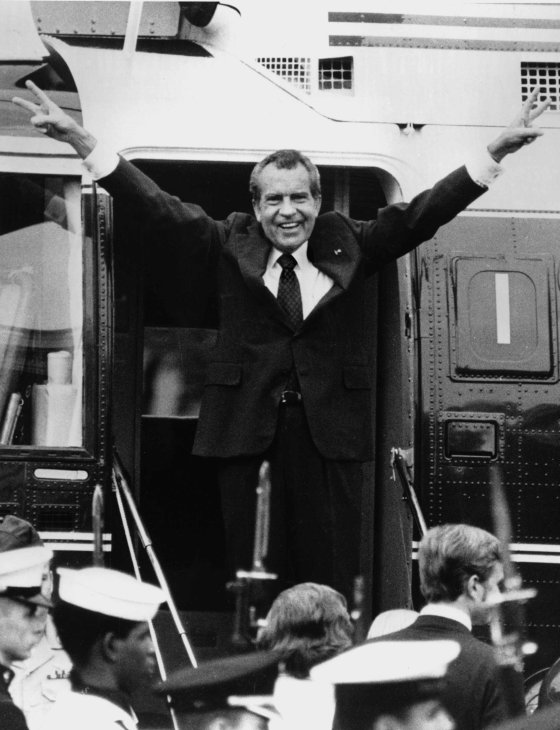
Ahead of the 1972 election, U.S. President Richard Nixon pressured then-Fed chair Arthur Burns to keep interest rates low regardless of economic fundamentals. The effects were devastating. (The Associated Press Files)
It would end up as a case of winning the battle but losing the war (even excluding Watergate): Nixon’s pressure on Burns allowed the U.S. economy to hyperinflate. It would take a decade and 20 per cent interest rates to restore order.
Of course, with Canada’s economy tied so closely to that of the U.S., the Bank of Canada had little option but to match the Fed’s rates, lest the Canadian dollar dive into near-worthlessness. The result was interest rates peaking at 20 to 22 per cent and many Canadian homeowners, most famously in Calgary, either handing over their keys to the banks or selling their homes for $1 to pass on the mortgage obligations to the buyers.
Further complicating Trump’s desire to seize control of the Fed is that once Powell’s term as a chairman expires this year, his term as one of seven governors doesn’t until 2028. Since the Fed chair has only one of those seven votes on interest rate policy, a new Fed chair would need three governors on his side to exercise Trump’s wishes on interest rates. Only one Fed governor’s term expires during Trump’s term as president and all have signalled agreement with the Fed’s position on interest rates.
This is shaping up to be only one of the cases Trump loses in the Supreme Court. The world awaits the court’s ruling on Trump’s use of the International Emergency Economic Powers Act to impose tariffs, but during arguments last year, the justices — again on both sides — appeared skeptical, noting the U.S. Constitution reserves the right to set tariffs to Congress.
Canadian businesses have paid a portion of the US$1 trillion in tariffs attached to Canadian exports to the U.S., according to an analysis by Western Canada law giant MLT Aikins. That firm raised the possibility of Canadian businesses recovering that should Trump’s challenge fail, as MLT Aikins suggested it might.
All eyes, it seems, are on the Supreme Court. You might want to get the popcorn ready.
|