Vegetables: bring on the heat
Lenore Linton has been growing vegetables in her St. Vital garden for more than 40 years. Cool, wet conditions have had a negative effect, she says, on vining vegetables such as beans, squash, and cucumbers.
“I have replanted some beans and others have made very little growth,” says Linton. “Only one variety of pole beans has begun to climb.”
As of this week, Linton says that her squash plants are also growing slowly.
“Johnny’s Select Seeds says that winter squash plants like consistently warm temperatures, ideally between 18 and 24 C. Most temperatures in May and June have been in the low 20s and many night temperatures were below 10 C. My squash plants have not begun vining and there is no sign of flowers. Temperatures below 10 C and over 32 C can be detrimental to fruit set.”
Tomato plants, however, are growing well, with lots of flowers and some fruit set, says Linton. “Carrots and beets are small but growing well.”

Fresh local strawberries (Anthony Mintenko photo)
Linton bought new potatoes, peas, beets and strawberries at Jardins St-Leon Gardens, an outdoor farm market on St. Mary’s Road this week. “I think the rain and cool (weather) have been good for those vegetables and the strawberries are great and early as well. I’m hoping for a sunny, warm July and a long, warm fall.”
Overwintering potted hydrangeas
Tim Evans, a Winnipeg gardener, installed a Victory Orangery greenhouse in his backyard in 2015. An avid hydrangea enthusiast, he’s experimented over the years with overwintering potted Hydrangea arborescens Annabelle in his greenhouse, which he kept warm with a low wattage heater.
“The pots were kept too warm,” says Evans. “The hydrangeas would push leaves too early and have blooms in April.” The humidity levels were also too high.

Victory Orangery greenhouse (Tim Evans photo)
But this past winter, Evans experimented with overwintering potted Hydrangea paniculata Quick Fire shrubs in his greenhouse. He used a low-wattage Lasko ceramic heater with an automatic adjustable electronic thermostat, which he set at 1500 watts for the duration of the winter.
Success! The temperature was just warm enough to keep the potted Quick Fire hydrangeas from freezing and the roots dying, says Evans.
In spring, Evans moved the potted hydrangeas from the greenhouse to his deck. He watered and fertilized the plants and pruned off dead tips of the branches and a few stray branches, but only once new leaves emerged.
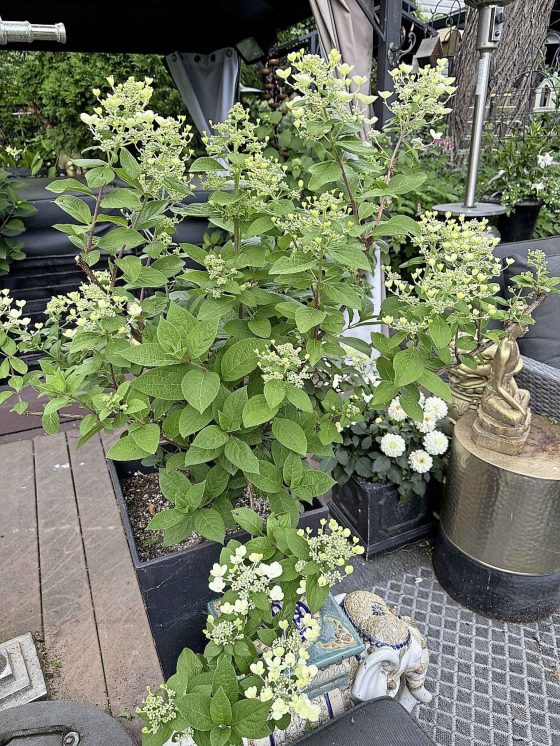
These hydrangeas were overwintered in pots in a backyard greenhouse. (Tim Evans photo)
“I have wanted my multi-level deck to be an explosion of colour all summer long and found that the best and longest-lasting blooms are hydrangeas,” says Evans.
This July, Evans’ deck is decorated with several potted hydrangeas in full bloom.
Mad for peonies
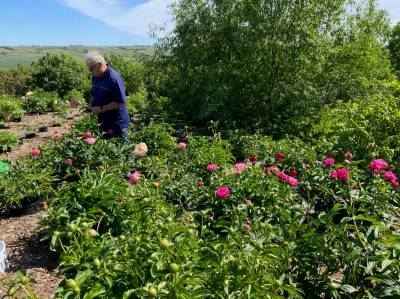
Gardeners have gone mad for peonies this year. Is it because of their voluptuous flowers, which have never looked better after a mild winter, cooler spring temperatures, and abundant moisture?
Peonies are so easy to grow and the selection at local garden centres is the best we’ve seen in years.
If you have space for more peonies, consider the Patio Peony series. However, ignore the claim that the series can be planted in patio containers. In our cold climate, peonies are meant to be grown in garden beds.
Bred in the Netherlands, there are eight varieties in the herbaceous Patio Peony series. Each cultivar is named after a city: Athens, Dublin, Kiev, London, Madrid, Moscow, Oslo and Rome. The cultivars have different bloom times from early and midseason to late season. The series boasts strong stems, but staking is recommended.
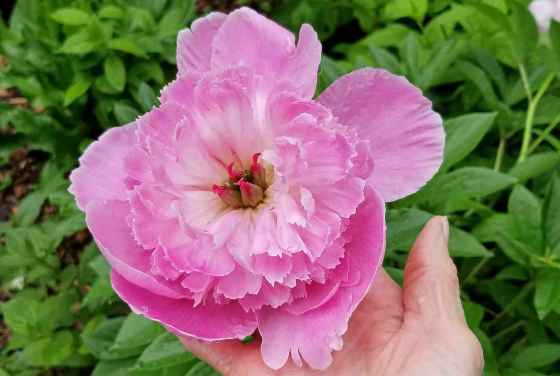
Patio Peony series: Rome (Colleen Zacharias photo)
All the varieties in the series are described as having a compact height of 50 to 60 cm; however, I grow Madrid, Rome and London in my garden and can attest that each one of these far exceeds the listed height!
Rome, which is highly fragrant, stands 93 cm tall. What I have noticed, though, is that the varieties in the Patio Peony series are narrower in width than other types of herbaceous peonies, which makes them suitable for smaller spaces.
Tackling weeds
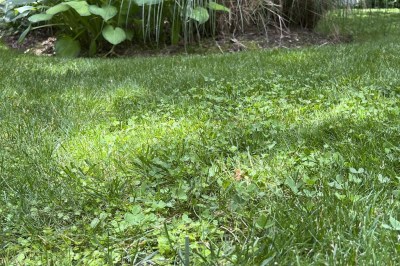
Have you ever seen so much weed growth? In last month’s Winnipeg Gardener, we recommended the use of a long-handled swoe to remove tiny tree seedlings from open areas.
But that won’t be sufficient for removing masses of the little nuisances that are congregating in tight spaces between plants, not to mention all the other types of weeds thriving in garden beds.
If you are spending too much time on your hands and knees pulling out weeds, Silvia Ferraro from Lee Valley Tools has some suggestions for short-handled tools that will assist you in getting the job done quickly.
“In garden bed settings, a tool that scuffs the surface can be enough to dislodge (tree) seedlings, and if done during the driest part of the day, they can be left on the ground and will desiccate and die on their own,” says Ferraro.
She suggests using a traditional Japanese weeder or a san-kaku hoe. Both are Japanese-made tools that slice through soil with wicked efficiency.
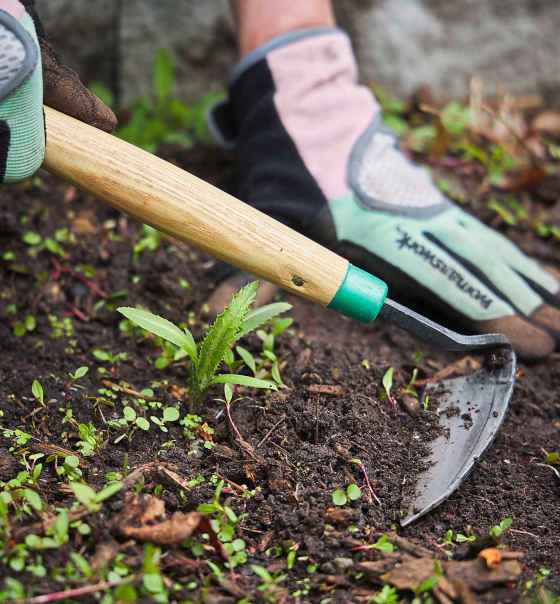
Traditional Japanese weeder (Lee Valley Tools)
I took one look at the traditional Japanese weeder — with its sharp, hand-forged steel blade — and it was love at first sight. The blade is set on a right angle and is designed for drawing the weed growth towards you. I still must get on my hands and knees to remove weeds, but they are no match for this amazing tool.
Now, the san-kaku hoe is a different beast altogether. The name is Japanese for triangle, which accurately describes the shape of the unique blade. There is a short-handled version as well as one that is long-handled.
By using a push motion, stainless-steel spear points break up the soil and sever roots and sharp edges slice through soil to remove shallow-rooted weeds. Try it, you will like it.
There also seems to be no end to the number of weeds popping up between cracks in sidewalks and driveways and between paving stones.
Pouring vinegar or boiling water on weeds can be problematic, unless weeds are located in the midst of an expanse of hardscaping. If vinegar is used as a herbicide, it can cause injury, possibly death, to nearby plants that you want to keep. Take care to not use vinegar anywhere near your garden beds and keep in mind that soil is a living thing with millions of living organisms.
Boiling water may seem a less harmful method to kill weeds on a driveway, but it will take repeated applications.
A propane torch works wonders to remove weeds from driveways and sidewalks. Do not try this on windy days.
Older paving stone patios and walkways can develop gaps between pavers in which weeds flourish. After removing weeds either by pulling or with a Yankee weeder, should you fill the gaps with dry sweeping sand, crushed limestone or polymeric sand? I asked Stephen Derksen at Barkman Concrete for his advice.
“One of the problems with sand or crushed limestone is that it can easily be washed out of the joints,” says Derksen.
“The polymers in the polymeric sand bind the particles together to create a semi-permeable joint that will withstand water as well as weeds. While it won’t entirely seal the joint and it has limited flexural characteristics, it will bind the joint much better than a standard sand or limestone.”
To install polymeric sand in an existing patio, Derksen says it important to ensure that all the existing sand has been removed to the bottom of the paver and the paver is completely dry prior to polymeric sand installation.
“The risk with polymeric sand, if installed incorrectly, is the formation of polymeric haze. This is caused when, as the polymers are wet during the activation process, they are left on the surface to dry causing a milky white residue.
“Ensure the proper installation method is used to prevent this from happening and ensure that the surface is properly rinsed during this process.”
Meet Max Frei
Geranium sanguineum Max Frei (pronounced “fry”) is a variety of bloody cranesbill native to Europe and Turkey. It was found as a natural mutation in the Swiss garden of nurseryman Max Frei and introduced by Hans Frei nursery in Germany in 1976.
This hardy perennial geranium has a tidy habit with finely dissected leaves and saucer-shaped magenta flowers in June and early July. The perfectly mounded shape makes Max Frei ideal for full-sun to part-sun borders, terraces, rock gardens or the edges of retaining walls.
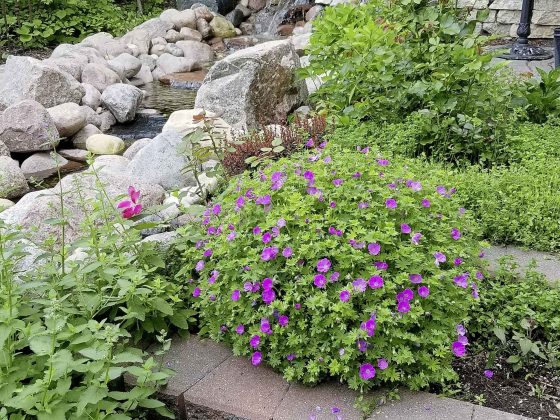
Meet Max Frei: perennial geranium with a tidy habit (Colleen Zacharias photo)
Long-lived and reliably winter-hardy, Max plays well with roses, creeping phlox and a host of other perennials. There are no serious pest or disease problems, and very little maintenance is required other than division every few years or so. Your gardening friends will clamour for a piece!
New plants for 2025
Monarch Magic Ageratum from Ball FloraPlant is a one-of-a-kind ageratum with a spreading, trailing habit. This popular garden annual is commonly known as floss flower.
Ageratum’s long-lasting fluffy, mauve flowers hold irresistible appeal for monarch butterflies as well as hummingbirds and insect pollinators. Monarch Magic is well-suited to hanging baskets or garden borders and is drought tolerant. Height: 15 to 30 cm. Width: 20 to 41 cm. Sun to part-sun.

Ageratum Monarch Magic: new for 2025 from Ball Flora (Plant Ball Horticultural photo)
Salvia Living Large Big Sky from Proven Winners is a super-sized perennial salvia hybrid with large fragrant green leaves and violet blue flowers — flower spikes can reach up to 30 cm.
Later to bloom than other perennial salvias, Living Large Big Sky is hardy to Zone 3a. This new variety is the first in a new series of perennial salvia so you can expect to see more!
Living Large Big Sky salvia is heat tolerant, drought tolerant, and resistant to deer and rabbits. Suitable for containers or beds in a full sun location.
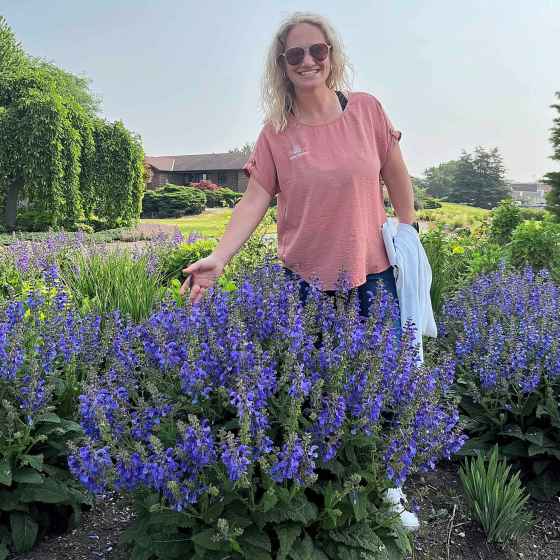
Salvia Living Large Big Sky perennial (Walters Gardens Inc.)
Just think of the design possibilities and extended bloom season if you were to combine this new cultivar with an earlier blooming salvia such as May Night.
New garden centre
Two Sparrows Greenhouse www.twosparrows.ca is a new retail greenhouse business located at 396 Second St. NE in Altona, Man.
Owner Nicole Wood was a nurse for 16 years before operating a retail garden centre. Two Sparrows Greenhouse opened in 2023. A seasonal greenhouse that operates from May 1 to mid-July, Two Sparrows offers a range of annuals, herbs, veggies, perennials, trees and shrubs.
“We started out with a hoop house last year,” says Wood, “but this year we built two gutter-connected greenhouses with individual bays, so we doubled in size and more than doubled our foot traffic. I’m very pleased.”
Wood does not have further plans for expansion in the near future but instead wants to settle into her new space and focus on learning what her customers really want. She is on the lookout for plants that are eye-catching and different.
“I always try and take suggestions or listen to what people are missing out on, so I will be aiming to adjust my plant orders accordingly to better serve the community.”
Wood has offered planting sessions for seniors who live in apartments as well as designated shopping sessions for newcomers to Canada who are learning English and want to know more about plants and gardening.

Capitán Purple and White Dianthus (Selecta One photo)
“We’ve also had students from three local schools come through the greenhouses to learn about growing vegetables and plants for pollinators.”
Wood’s favourite pick for a captivating annual is Dianthus Capitán Purple White from Selecta. “It has a deep purple edge and is just gorgeous.”
Support for plants – and the arts
Handcrafted steel plant supports made by gardeners for gardeners at Birtle Centre for the Arts in Birtle, Man., are now available for the first time at Jensen Nursery & Garden Centre in Winnipeg (2550 McGillivray Blvd.).
Available in three different sizes with a curl-top detail, the plant supports are made from quarter-inch hot-rolled round steel. Perfect for supporting peonies or weak-kneed plants such as Annabelle hydrangeas, the sturdy plant supports can also be used as an innovative option for elevating your low-bowl planter designs.

Dual use for a steel plant support (Susan Southern photo)
Stay tuned: a second retail location in southern Manitoba may soon be carrying these classic plant supports. For more details, visit the Birtle Centre for the Arts.
Japanese beetle trap?
First, let it be stated: the Japanese beetle has not yet been detected in Manitoba, but this voracious pest, which feeds on 300 different plant species, does occur in small numbers in Grand Forks, N.D. In this time of climate change, the beetle’s expansion further north could be just a matter of time.
But an innovative eco-friendly solution by two student entrepreneurs at the University of Minnesota is growing hope. Aditya Prabhu, a computer engineering student at the University of Minnesota honours program, and James Duquette, a finance and entrepreneurship student at the Carlson School of Management, have devised a unique non-toxic bait-and-kill trap with pheromones that is safe for humans and pets but knocks out Japanese beetles after just 30 minutes of contact to the surface. This is one to watch! For more details, visit their website.
Celebrating 25 years
The Steinbach and Area Garden Club is celebrating its 25th anniversary. “We will be planting 25 trees near the Blind Creek Pond at the Mennonite Heritage Village in early September in partnership with Falk Nurseries,” says Elsie Kathler.
The new grove of trees will be named “The Fred Kaita Memorial Grove” in honour of Fred Kaita, who founded the SAGC.
“We were thrilled to learn recently that our application for a Trees Canada Grant has been approved. This means that the cost of purchasing the trees will be covered,” says Kathler.
The garden club is also holding a garden tour and high tea to celebrate the anniversary; it’s already sold out.
Apple scab fungus
Apple scab is a fungus that can affect crab-apple and apple trees. The cooler temperatures and abundant rainfall we have been experiencing have provided ideal conditions for apple scab. Leaves affected by apple scab develop unsightly brown spots. The leaves turn yellow and begin dropping in early to mid-summer.

Apple scab fungus on leaves of Rosybloom crabapple (Colleen Zacharias photo)
It’s important to clean up the fallen diseased leaves to prevent the fungus from overwintering. As big a task as that may be, you will help lessen the disease impact for next year.
Next, you will want to decide what action, if any, to take next spring. Ask an arborist about the best time to prune your tree to improve air circulation, which can help reduce the risk of infection, or if treatment with a fungicide is needed.
Shou sugi ban
Shou sugi ban (pronounced shoh shoo-gee bahn) is a traditional Japanese method of wood preservation. It can be used to create unique wooden gates, sheds, raised beds, arbors — almost anything that is built out of wood.
A quick and easy method for charring wood surfaces is to use a propane torch. Simply wave the flame across the wood until all surfaces have been charred. Choose a safe space outdoors that is well-ventilated and protected from wind.
Cedar is the traditional choice of wood for this ancient method. An application of linseed oil to the surface of the charred wood helps to protect the wood from the elements. Just apply the oil with a clean rag — an old cotton t-shirt, for example; do not use a sponge.

Shou sugi ban: charred faux garden door with weathering steel (Colleen Zacharias photo)
Shou sugi ban will last for decades. Over time, with exposure to the elements, the charred wood develops a weathered patina. Repeat applications of linseed oil every few years will help to maintain the charred finish in our harsh climate.
Cedar wood that has been charred goes well together with weathering steel that has a rusty patina. Last year we discussed weathering steel in this newsletter.
What to do with plastic plant pots
Plastic plant pots have a way of piling up until you throw them into plastic bags. Soon you have an accumulation of plastic bags of pots. So, where can you take them to be recycled or reused, and are there any stipulations?
The City of Winnipeg does not accept plastic nursery pots in recycling bins or at 4R Depots.
I checked in with a few garden centres. The following accept plastic plant pots:
- Lacoste Garden Centre, 2787 St. Mary’s Rd.
- Ron Paul Garden Centre, 2641 St. Mary’s Rd.
- Jensen Nursery & Garden Centre, 2550 McGillivray Blvd.
- Home Depot garden centre locations.
Only plastic plant pots will be accepted at the above locations. Make sure the pots are emptied of excess dirt and do not include plant pots from other garden centres or retail locations that are custom or branded.
Shelmerdine Garden Centre on Roblin Boulevard is no longer holding its annual recycling event. Shelmerdine is actively seeking a new local waste management team to recycle garden plastics. Check their website shelmerdine.com or inquire in-store for updates.
Schriemers Market Centre on McGregor Farm Road is not accepting plastic plant pots.
Both Red Valley Plant Market and Sage Garden Greenhouses on St. Mary’s Road accept clean plastic nursery pots that originated at their greenhouses.
Your questions, answered
Why does my newly planted boulevard tree look dead?
On May 29, the City of Winnipeg planted a tree on the boulevard in front of Bonnie Lenton’s house to replace a mature ash tree that had died the year before. Within days, the new tree’s leaves drooped severely and to all appearances, it looked dead.
Newly planted trees often experience transplant shock due to loss of roots in the digging process and lack of water during storage, planting and post-planting, says Julie Dooley with the City of Winnipeg’s public works department. Dooley shares the following:
“This spring/summer season so far has been particularly stressful for newly dug nursery trees due to the unusual wet weather and excess water in the fields and during storage, as opposed to lack of water.
“Symptoms still appear as a lack of water (wilting, browning and dying leaves) as the soil lacks oxygen for the roots to function, which impedes their ability to take up water to keep tissues hydrated.
“The extent of transplant shock varies amongst tree species — some are more resilient than others.
“The cooler, very wet weather has also contributed to the development of a variety of foliar fungal diseases which can also affect newly dug and planted trees. We continue to monitor newly planted trees and will replace if necessary.”
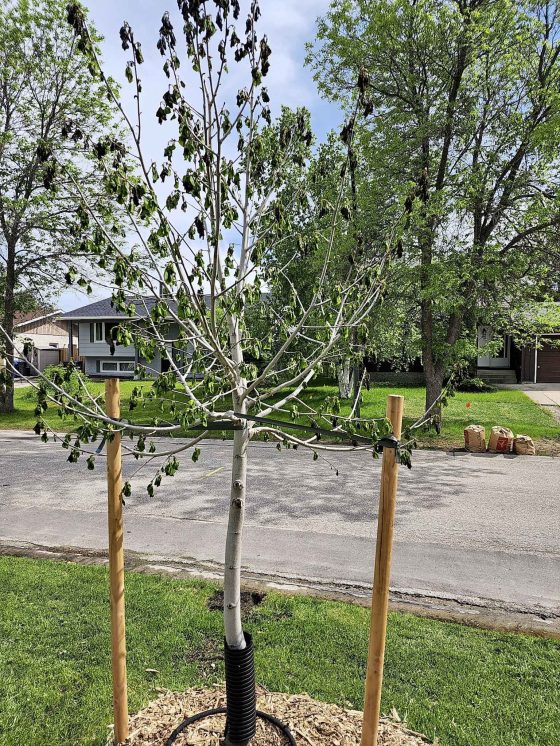
A newly planted boulevard tree suffering transplant shock. (Bonnie Lenton photo)
The City of Winnipeg provides an information sheet to the directly adjacent residence before planting a boulevard tree. The sheet includes the following information:
- We maintain new trees for two years after planting … but you can help the tree succeed.
- We water new trees five to six times over the planting season. When you’re out watering your lawn or gardens, give the tree a little drink if you’re able. If the soil below the wood chips is very dry, you can also pour a few pails of water slowly around the outer part of the wood chip mulch.
- Allow the soil to dry somewhat between applications. Do not overwater the tree.
- We provide the proper amount of wood chips around the base of the tree. Do not add to, remove, or modify the wood chips.
- Do not pile wood chips against the trunk of the tree. The stem of the tree needs to be open to the air to allow for air exchange.
- Do not remove the weeping tile placed around the trunk of the tree. Weeping tile protects the tree from grass cutting damage and animal feeding.
Why won’t my Royal Wedding poppy bloom?
Alyssa Rempel has been admiring the early summer floral show put on by poppies this year at Kildonan Park and is wondering why the Royal Wedding poppy that she planted years ago in her own garden stubbornly refuses to bloom.
She mulches her flower beds each year, waters as needed, and adds compost and fertilizer.
“The poppies in Kildonan Park I know wouldn’t even get extra watering, let alone compost or fertilizer,” says Rempel, a former city gardener who worked at Kildonan Park.
Royal Wedding is an Oriental poppy (Papaver orientale) with white flowers. This giant-flowered beauty is native to the southern Caucasus, Armenia, northeastern Turkiye and northern Iran. In its natural habitat, Oriental poppies grow robustly in full sun on poor, rocky soil. Its survival in these droughty regions is enhanced by the plant’s ability to send out long, deep roots.
In our cool climate, Oriental poppies require full sun (defined as more than six hours of direct sun per day) and a well-drained location. The crown of the plant is subject to rot in heavy, wet clay. Often, gardeners will cut back the foliage after their poppy has finished blooming. I suggest leaving the foliage in place, but if you do decide to cut back the foliage, do not remove the new leafy growth in the fall.
It sounds to me like Alyssa is doing everything to encourage her poppy to grow. Sometimes an individual plant sulks for a few years or just won’t behave. I suggest planting another Oriental poppy in a sunny, well-drained location.
I would forgo mulching as well as the use of synthetic fertilizer but continue with annual spring applications of compost.
How to turn hydrangea flowers blue
Stewart and Jeannette Astleford grow numerous types of hydrangeas in their St. James garden. They would like to change the colour of the blooms on their Let’s Dance Sky View big leaf hydrangea (H. macrophylla).
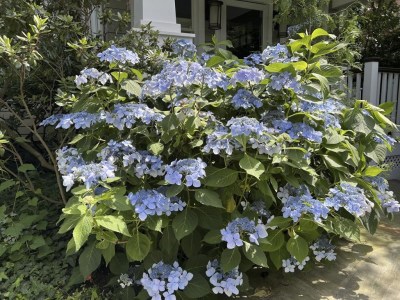
The pink blooms of macrophylla or mophead hydrangeas can easily be changed to blue by using a granular soil acidifier such as Orgunique Soil Acidifier, 0-0-0+90S which works by lowering soil pH with fast-acting sulphur.
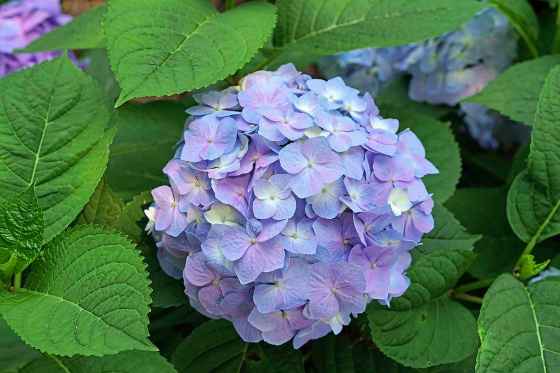
Turn hydrangea blooms blue (Let’s Dance Sky View Proven Winners)
Apply 5 to 10 ml directly to the soil surface at the base of your macrophylla hydrangea and water in thoroughly. You will see the desired results in two weeks or less.
A second application will be needed in one to two months. The blue colour will last for one growing season only.
It is possible to change the bloom colour of macrophylla (mophead) hydrangeas but not panicle hydrangeas (Hydrangea paniculata).
Have a question for a gardening expert? Reply to this email with your question and we’ll seek answers from some of Manitoba’s most knowledgeable gardeners. If you’re asking about a problem with a plant or pest, please attach a photo to help our experts diagnose the issue.
Mark your calendars
From now until Sept. 30, the Manitoba Agricultural Museum in Austin is hosting an Exhibition: Manitoba Farmstead Shelterbelts — Stories of Land, Trees, People, and Dwelling. See a video here. For more information, contact Tricia Dyck at 204-637-2354 or email collectionsmanager@mbagmuseum.ca.
Nature Manitoba hosts its 2024 Gardens of Distinction fundraising event on July 6. Established in 2000, this self-guided tour features 13 gardens in the St. Vital, St. Boniface and Osborne Village areas between 9 a.m. and 4 p.m. Tickets are $20. Visit Nature Manitoba www.naturemanitoba.ca for a list of locations where tickets are sold.
The 2nd Annual Holiday Avenue Project Garden Tour will take place in Portage la Prairie on July 13, 9:30 a.m. to 2:30 p.m. Eight gardens will be featured. Tickets are $25 and include admission to the tour and a garden-themed yard sale and craft sale. More information and tickets available by email: holidayaveproject@gmail.com.
The Margaret Laurence Home is hosting its third annual Manawaka Garden Party on July 20. Tour three gardens in Neepawa. There will also be local artwork on display. Tickets are $20. Register and pick up your garden pass and map at the Margaret Laurence Home, 312 First Ave. For more information, call 204-476-3612.
The Manitoba Master Gardener Association will host its annual garden tour on July 20 in the North River Heights, Wolseley, and East and West Gates areas in Winnipeg. Tickets are $20 and can be ordered on the MMGA website www.mgmanitoba.com. Tickets are also available at retail locations; visit their website for a complete list.
Open Garden Tours take place in Brandon on July 20 and 21 from 10 a.m. to 2 p.m. This free weekend event gives visitors access to some of Brandon’s most beautiful private and public gardens. Email for information on where you can obtain a garden passport: recreation@brandon.ca.
The Manitoba Regional Lily Society will host the 40th Annual Manitoba Regional Lily Show on July 20 from 10 a.m. to 4 p.m. at the St. Vital Shopping Centre, 125 St. Mary’s Rd.
Red River North Tourism Garden & Art Tour features seven gardens in the municipalities of St. Andrews, St. Clements, and the City of Selkirk on July 21 from 10 a.m. to 5 p.m. Self-guided tickets are $25 or travel by VIP bus to all the gardens on the tour for $65, including lunch at the Shops of St. Andrews. For more information, visit their website.
|