|
Annie Shoapik Bowkett had one foot in a kamik standing in the past and the other in the future.
Annie, who was 71 when she died of cancer on Jan. 7, was born in 1954 to her father, Seemeeonee E6-300, and mother, Rachel E6-216, at an outpost camp on the shores of Baffin Island.
At the time, the Canadian government forced Inuit people — who did not use surnames — to carry leather discs on a cord around their neck showing their first name and an identification code with letters and numbers. An E or W meant the person lived east or west of Gjoa Haven, a hamlet on King William Island in present-day Nunavut; the number was individualized.
Annie’s first language was Inuktitut and she spoke it with family and friends until the day she died.
Annie, from her mother, learned how to prepare seal skins for sewing both kamiks (footwear similar to mukluks used further south) and mitts. When her family moved into the hamlet of Pangnirtung, she met women who made clothing from seal skins, including her two aunts, who taught her all they knew about the craft.
Annie loved to sew. She made parkas, kamiks and mitts for all of her children and grandchildren, and she opened a store in the community called Miqqut (“needle” in English) to sell her works to area residents and visitors.
She also carried all of her children in traditional white amoutiks.
As her family says, “All nine of her children and grandchildren would know the warmth and security of this clothing.”
After moving to Winnipeg, Annie created a home-based business, called Inuit Custom Clothing, to sell her creations. It was at this time Annie was featured in a Free Press story about her business.
“I make people warm,” she said about the clothes she made.

Annie Bowkett wearing one of her parkas in her backyard in Winnipeg in 2011. (Wayne Glowacki / Free Press files)
Noting she once shot a polar bear on Ellesmere Island, ate the meat, and turned the animal into polar bear pants, she said, “They’re the warmest pants in the world and they cool off in summer, so you can wear them year-round.”
The clothes were sold to customers around the world. She also made the clothing worn in the movie The Snow Walker, based on a novel written by Farley Mowat.
At the time of the article, Annie had lived in Winnipeg for four years, but admitted she still couldn’t get used to “southern food,” and was continuing to ship caribou, beluga whale and Arctic char from the North, eating most of it raw.
Annie made sure the Inuit sewing craft would not be forgotten by future generations. Over the last 20 years, she visited Inuit communities, spending a month to six weeks there at a time to teach women how to prepare and sew seal skins.
In recent years, Annie was responsible for lighting a kulliq, a sealskin oil lamp, and keeping its flame lit when Truth and Reconciliation hearings were being held in Winnipeg.
In recent years, she never went anywhere without her sewing, but her family said she left several works unfinished.
“She can rest content, though, knowing her sewing gifts will be continued in many Inuit communities.”
Annie is survived by her husband Roy, three sons, two daughters, two grandsons, and three stepsons.
Read more about Annie.
Advertisement

How They Lived
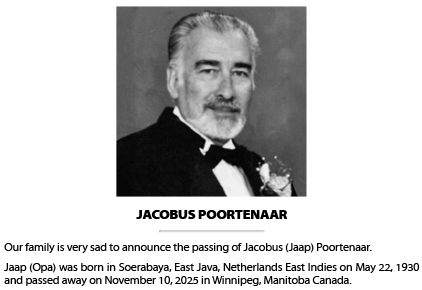
Jacobus Poortenaar was one of the last people to see the son of a future American vice-president before he disappeared.
Before Jacobus moved to Winnipeg, he worked for a time for the airline KLM, which was running an airport in Dutch New Guinea. He met and briefly spoke with Michael Rockefeller, the son of Nelson Rockefeller, who was vice-president under President Gerald Ford.
Shortly afterward, the younger Rockefeller disappeared. His body was never recovered; there have been theories through the decades that he drowned or was the victim of cannibalism.
Jacobus was later hired by Standard Aero Engine co-founder Ernie Moncrieff.
Read more about Jacobus.
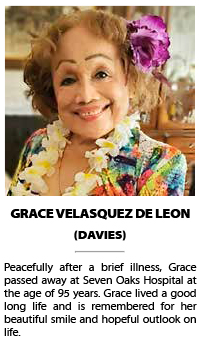
Grace De Leon and her husband were two of the first Filipino families to immigrate to Winnipeg.
Grace, who died Jan. 25 at 95 years of age, was forced to flee into the mountains and jungle of her home country during the Second World War.
She trained as a nurse in the Philippines and worked as a public health nurse before coming to Winnipeg in 1968.
She worked as a nurse at Misericordia Hospital and, in total, was in nursing for 37 years.
Read more about Grace.
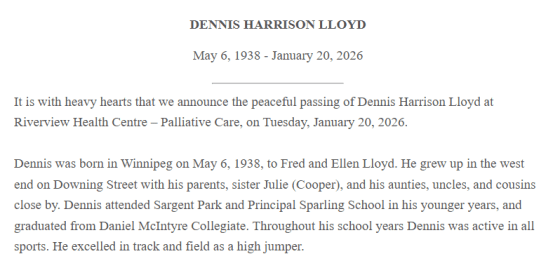
Dennis Lloyd was a firefighter for 40 years.
Dennis, who was 87 when he died Jan. 20, retired as a battalion chief.
He was also president of the United Firefighters of Winnipeg for almost two decades, and he served as a Canadian trustee with the International Association of Firefighters.
Dennis is credited with beginning what became the successful fight for presumptive cancer legislation for firefighters. He accessed those benefits himself during his cancer journey.
Read more about Dennis.
Rose Knight and her husband were founding partners of the Herzlia-Adas Yeshuran synagogue and its day school.
Rose, who died Nov 28. at age 96 years, served as president of the sisterhood while also organizing fundraisers. She was part of theatre productions at the synagogue, and she volunteered with both Hadassah and the ORT organizations.
She loved art and opened a gallery on Selkirk Avenue. After she closed the gallery, she worked at the art gallery at Eaton’s.
Read more about Rose.

If you’ve had a Jeanne’s cake or a pizza in western Canada, you saw George Rano’s work.
George, who was 86 when he died Jan. 26, founded and owned Advance Paper Box, which made the boxes that those pizzas and cakes came in. He ran the company for more than three decades until he sold it when he retired.
Earlier in life, he was a world-class polo player who represented Canada at the 1967 Pan Am Games in Winnipeg.
Read more about George.

A Life’s Story
Deborah Lee Kernested wrote two textbooks that are still used by Canadian child-care facilities.
Deborah wrote the first book, Well Beings, after moving to Toronto in 1989, and later co-wrote Healthy Foundations in Early Childhood Settings.
Jodie Kehl, the Manitoba Child Care Association’s executive director, says both textbooks are commonly found in daycares to this day.
Deborah is also remembered by her family for teaching them the finer things in life.
Read more about Deborah in this week’s A Life’s Story feature.
Until next time, I hope you continue to write your own life’s story.
|