FIVE STORIES ON TURTLE ISLAND
1. A deeply controversial court decision was delivered this week in the case of a professor at the University of Regina who was publicly challenged by another professor over claims of Indigenous identity.
Dr. Darryl Leroux, an associate professor at the University of Ottawa who has spent his career researching Indigenous identity (and, in particular, fraudulent Indigenous identity claims) was sued by Dr. Michelle Coupal after he made several public and private statements about her identity.
In the decision of Coupal v. Leroux, Justice Daryl Labach determined that Leroux’s comments were defamatory and he has to pay Coupal $70,000 in damages.
This wasn’t the fascinating part of the decision, though; it is that the judge pointed out that Leroux’s claims were basically correct and Coupal’s claim to Indigenous identity is dubious— but she claimed she was Indigenous because of an “honest belief” that she was.
The case has illustrated something I’ve written about before: how allowing anyone to simply “self-declare” they are Indigenous without anything beyond “good faith” in the claimant puts institutions in very problematic positions and undermines ways Indigenous communities identify their citizenry.
2. It’s been interesting these past few weeks to note how the international media world is starting to notice that achieving consent through adequate consultation with Indigenous peoples is going to be Canadian Prime Minister Mark Carney’s biggest hurdle for his national economic plans.
Even Canadian ex-pat and international media commentator David Frum decided to weigh in (albeit with what I think is an abhorrently divisive and ignorant take).
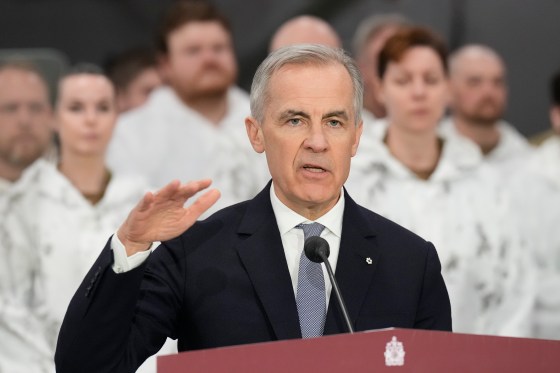
Prime Minister Mark Carney speaks in Yellowknife on March 12. (Adrian Wyld / The Canadian Press files)
Carney, to his credit, has noticed and this no doubt explains his targeting of particular Indigenous communities and some of their longstanding issues that he will no doubt need to negotiate with later.
3. Sixty-two Indigenous artifacts came home from the Vatican last month — something I wrote about a few years ago — but finding where they belong will take likely years.
The three primary national Indigenous organizations in Canada — the Assembly of First Nations, the Métis National Council and Inuit Tapiriit Kanatami — are developing their own processes for repatriating and researching the history and importance of items like ceremonial dishes, sap collecting containers, baby carriers, embroidered gloves, a bow and arrow, moccasins, a sealskin kayak and a model Métis sled and dog team.
Some items have clear homes, but others do not and it will take much research, investigation and ceremony to figure out where they come from and where they now belong.
4. An interesting battle is taking place in Nova Scotia over the issue of jurisdiction of cannabis and tobacco operations on First Nations.
This week the chief and council of Membertou First Nation passed a new resolution saying the province of Nova Scotia and the RCMP have no right to carry out enforcement on their traditional lands after police and provincial officials raided several of what they call are “illegal cannabis operations.”
A few weeks the government of Nova Scotia announced a crackdown on cannabis growing in the province and specifically targeted Mi’kmaw First Nations in the province through a letter — which solicited an equally combative response.
First Nations have been in on the cannabis industry for a while now — particularly six First Nations in Manitoba — but have to follow stringent provincial government rules and oversight. This uneven treatment of First Nations federally over the issue of cannabis growing and sales is the kind of issue that leads to a march to the Supreme Court over the issue of Indigenous rights.
5. U.S. President Donald Trump’s newest nominee to replace the controversial Kristi Noem as Secretary of the Department of Homeland Security is a Cherokee citizen: Markwayne Mullin.
He is a senator in his home state of Oklahoma, a socially conservative Republican, and a former MMA fighter. He is also a huge Trump supporter and controversial in his own right.
If confirmed, Mullin will be the first Native American to ever head up the agency.
Native News Online re-ran a 2019 profile of Mullin and it’s here if you want to learn more about him. Or, if you want to hear about Mullin’s description of his own Indigenous heritage and background here is a short clip.
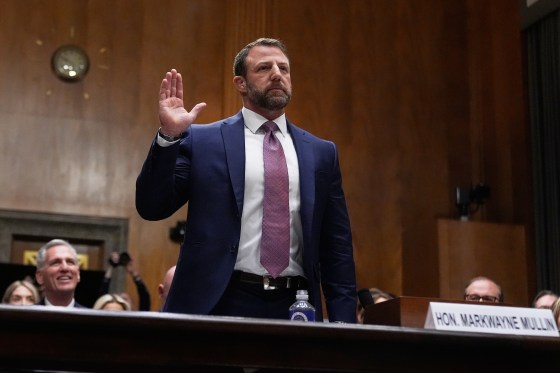
Sen. Markwayne Mullin, R-Okla., is sworn in before testifying during Senate Committee on Homeland Security and Governmental Affairs hearing Wednesday. (Manuel Balce Ceneta / The Associated Press)
Native American reaction to Mullin’s nomination is mostly based in the hope that he can somehow stop the mistreatment of Indigenous peoples by Immigration and Customs Enforcement agents in crackdowns happening across the United States. This is what you call a “low bar” of success.
IN PICTURES

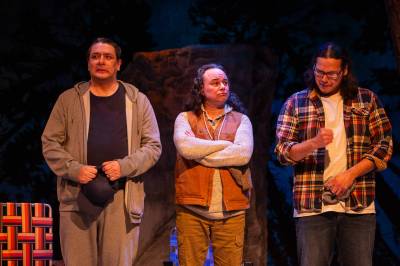
A sacred backwoods fire serves as the narrative centrepiece for In the Shadows Beyond the Pines, starring (from left) Jeremy Proulx, James Dallas Smith and Daniel Knight. (Dylan Hewlett / Royal Manitoba Theatre Centre)
RECONCILI-ACTION OF THE WEEK
Every week I highlight an action, moment, or milestone forwarding reconciliation, illustrating how far Canada has come — and how far the country has yet to go.
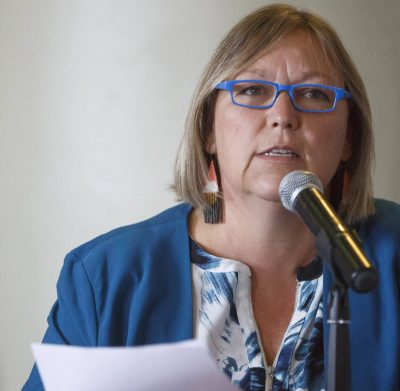
This week’s reconciliaction of the week is a big CONGRATS to the new chief and council of Norway House Cree Nation who not only selected a decidedly young chief and council at their band elections but elected Cree lawyer Season Roulette — who became the 166th female chief on a First Nation.
Female chiefs are outnumbered four to one by male chiefs on First Nations in Canada but this number appears to be shrinking more and more. As someone with deep familial and ancestral ties to Norway House, I am very excited to see such an exciting direction for one of Manitoba’s largest First Nations.
|