|
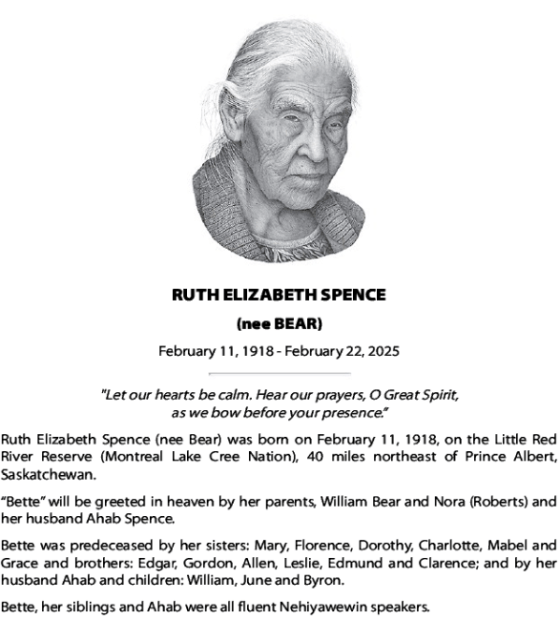
Ruth Elizabeth Spence had a long life during which she helped people — many of them Indigenous.
Ruth, known by all as Bette, died on Feb. 22, just days after her 107th birthday on Feb. 11.
Bette was born on the Little Red River Reserve about 60 kilometres northeast of Prince Albert to parents William and Nora Bear.
Advertisement

Life was tough, but Bette was tougher.
She survived tuberculosis, which kept her in hospital in both Prince Albert and Fort Qu’Appelle from age five to 11. She went to day school at her reserve before being sent to the Brandon Indian Residential School. And, she was born with limited vision which left her completely blind later in life.
The latter did not stop Bette from getting on a steam train and heading to Toronto to go to Deaconess House after high school. She couldn’t see the chalkboard, so she memorized all the lectures. The main thing she learned was that education was a lifelong pursuit.
Returning to Prince Albert, Bette tripped and Reverend Ahab Spence grabbed her hand to help her — and never let it go.
The couple married and, once again, Bette followed her own path. She was told by doctors not to have children, so she had six.
They were married for sixty years and they lived in several places in Saskatchewan, Manitoba and Ontario, finally returning to Winnipeg for the rest of her life.
As a minister’s wife, and just like many others at that time, she helped by taking the lead in youth auxiliary groups at the Anglican congregations he preached at, but she also took on many other roles in the communities she lived in.
Bette was house mother at the Pelican Lake Residential School, a youth counsellor at Dales House Regina, and a community developer for the Manitoba Indian Brotherhood.
At the University of Manitoba, she was a native student advisor, resident elder and social animation and linguistics co-ordinator. At what is now called the First Nations University of Canada, she was women’s elder.
You might also have heard her voice. It’s Bette’s voice that says the opening and closing prayers in Cree in the First Nations film which greets you when you visit the Canadian Museum for Human Rights.
Bette even went back to school decades later and graduated with a Bachelor of Fine Arts from the University of Manitoba in 1979.
As her family says, Bette lived her life in wonder at nature and the gifts of the creator.
She was predeceased by her husband and three of her six children, and is survived by two sons and a daughter, and several grandchildren, great-grandchildren and great-great-grandchildren.
Read more about Bette.
How They Lived
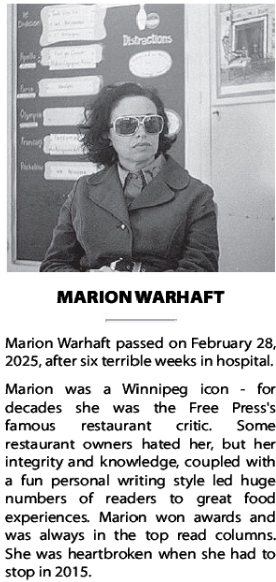
Marion Warhaft could make or break a restaurant with her words.
Marion, who died on Feb. 28, worked as restaurant critic for the Free Press for decades, helping legions of readers discover where to eat. She always worked incognito and, to continue the mystery, she even chose the photo of her in sunglasses for her obituary.
And, for her, while the position made her a local icon, it also helped her deal with the early loss of her husband.
Read more about Marion.
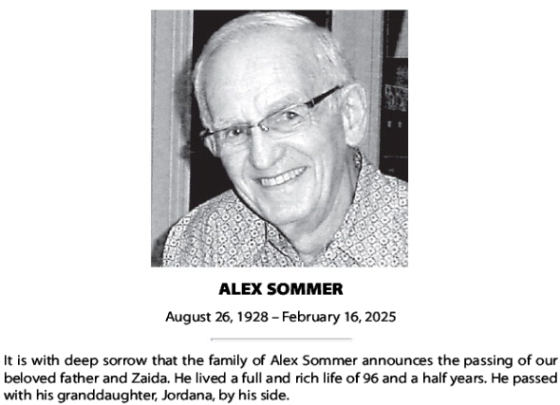
Alex Sommer’s wife, Sarah, founded the Chai Folk Ensemble, but he helped make it what it is today.
After his wife died at age 40, Alex, who was 96 when he died on Feb. 16, became the ensemble’s first president.
In that position, Alex created and set up a board of directors while putting in an infrastructure which allowed it to thrive and go on to celebrate its 60th anniversary last year.
Alex worked for the family’s business, helping it grow to become Century Craft, a manufacturer of furniture and fibreglass boats.
Read more about Alex.
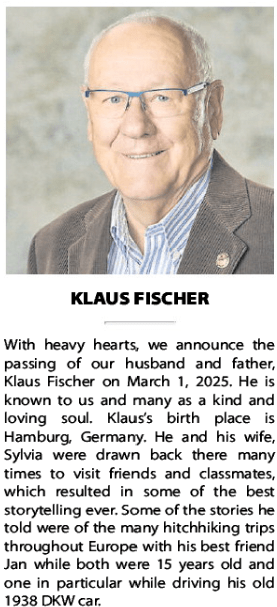
Klaus Fischer had more than one career.
Klaus, who died on Mar. 1, began driving cabs and even founded Fischer Taxi Co.
He then began selling commercial real estate and, with his wife, he successfully did this for 28 years.
Klaus was also proud to initiate the Hillside Beach Trailer Park Cooperative which celebrated its 50th anniversary last year.
Read more about Klaus.
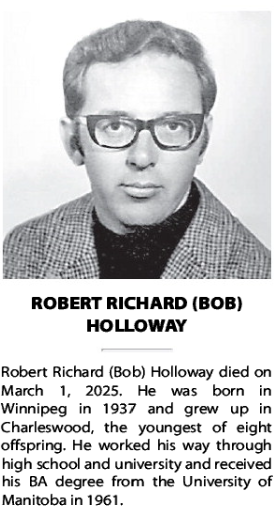
Bob Holloway worked for dance companies but never took the stage.
Bob, who died on March 1, began working as publicity director for the Royal Winnipeg Ballet in 1968 before becoming the founding managing director for the Contemporary Dancers two years later.
Before that, Bob wrote three books while working with a social-service agency and worked with the Manitoba Dental Association as its public relations director.
He later was the director of the University of Manitoba’s University Centre until buying a farm in Sperling. He also bought Carman’s movie theatre and, after selling it, began a print business which grew to produce seven periodicals in south-central Manitoba.
Read more about Bob.
Derek Black’s family says he is likely organizing a folk festival in the sky with musicians like Gordon Lightfoot, Stan Rogers and John Prine.
That’s because Derek, who died on Mar. 4, was president and chair of the Winnipeg Folk Festival from 1981 to 1987. He was also a past president of Home Routes, which coordinates holding concerts in peoples’ homes.
Derek’s day job for decades was as a machinist with CN Rail.
Read more about Derek.

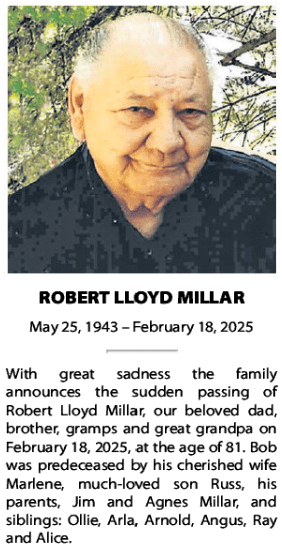
A love story: Bob Millar’s wife was the love of his life.
His family said that when she died in 2008, Bob, who was 81 when he died on Feb. 18, had a bit of himself go with her. They said the couple were always together.
It’s probably why Bob added a handwritten note with his will: put his ashes in the same urn so they can be together forever.
Read more about Bob.
A Life’s Story
Lorraine Macleod was a volunteer force on and off the golf course.
Lorraine, who was 91 when she died on Aug. 24, was at first a competitive figure skater who went on to organize the Morris Figure Skating Club with her sister.
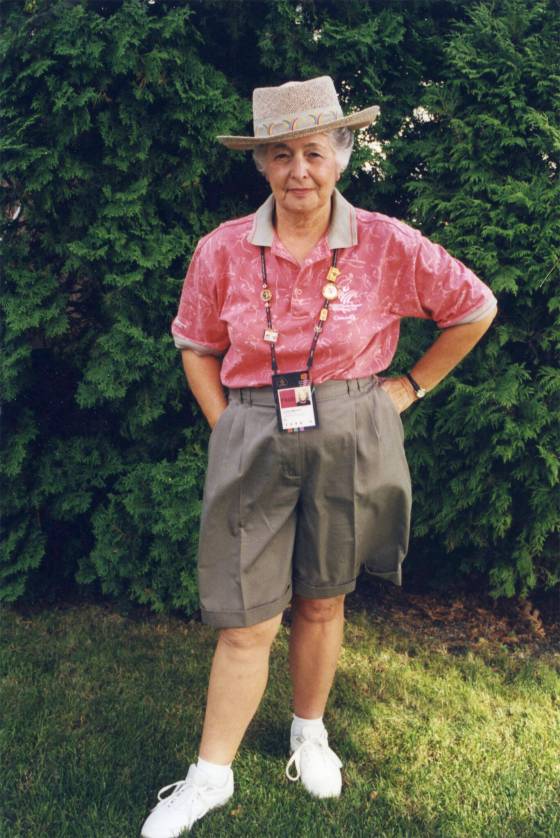
Lorraine volunteered at the Pan Am Games. (Supplied)
But, after moving to Winnipeg with her husband, it was golf Lorraine focused on. She not only became a member of the Winnipeg Canoe Club to tee off there, but went on to serve as tournament chair, volunteer at both provincial and national championships, and even write a history of the Canoe Club’s Ladies Golf.
Lorraine also served as president of the Manitoba Ladies Golf Association and sat on several committees with the Canadian Ladies Golf Association.
She was inducted into the Manitoba Golf Hall of Fame as a builder in 2014.
“She knew everyone in the golf community,” Don MacDonald, president of the hall of fame, said. “She never sought any recognition or limelight, but full respect and credit to her for all she did… Lorraine was an outstanding person and volunteer.”
Read more about Lorraine.
Until next time, I hope you continue to write your own life’s story.
|