|
The idea of using penalties for one problem to solve another isn’t new, but it is worthwhile.
The City of Winnipeg is proposing using funds received from its vacant building fines to inject money into changing the script on vacant buildings. It makes sense on a number of levels. The money would support enforcement, redevelopment and prevention.
Of course, the city actually has to collect the money first.
On that count, the city’s record is about 21 per cent. Between 2020 and 2025, the city has handed out citations for about $4.04 million in vacant building fines. It has collected $878,761.
Nearly a million seems like a lot of money, and to an average Winnipegger, it would be life-changing. In the property development world, however, it’s but a drop in a very large bucket.
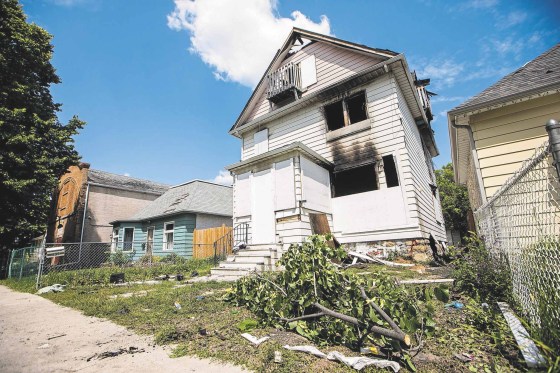
Vacant homes are a growing scourge in Winnipeg, home to squatters and drug users and draining significant resources from fire personnel. (Mikaela MacKenzie / Free Press Files)
With many of these vacant buildings being older properties, costs of even rehabilitation can ratchet up quite quickly: find asbestos or knob-and-tube wiring and these will have to remediated.
It wouldn’t surprise anyone with knowledge of the industry to see a complete two-storey rewiring job run between $7,000 and $10,000, or even more. Costs of asbestos removal vary widely depending on which home components contain the fire-resistant fibre. A bad case could be in the tens of thousands.
Nobody cares about knob-and-tube in a demolition, but asbestos — which is quite likely — also makes demolition considerably more expensive. It still has to be handled safely, which means a team of specialists and considerable haz-mat equipment.
It would be a challenge to bulldoze three homes and replace them with even modest homes for $878,000. Building costs currently range between $170 and $260 per square foot for standard, wood-framed residential homes, according to the 2026 Canadian Cost Guide by the Altus Group. A 1,200-square foot home would cost about $222,000, assuming a construction cost of $185 per square foot and not including landscaping or the cost of land.
More likely than the city being the developer, however, would be grants to spur private money into developing the properties. Here’s where it could get interesting: if the city’s program can mitigate the costs of demolition — particularly with regards to asbestos remediation — and if the land could be transferred at a nominal value, it could spur a wave of infill development.
Advertisement

The city opened applications for the Vacant Building Grant July 2. It hasn’t received any applications yet but “there is interest from members of the community in the program,” city communications officer Pam McKenzie said in an email.
“We’ve been receiving inquiries from individuals who want to learn more about the program and how to apply. We’re also continuing to accept registrations for the upcoming information session on July 22.”
Many such properties are residential, so I reached out to the Manitoba Home Builders’ Association for comment. President Lanny McInnes said the proposal is new enough the organization’s infill committee hasn’t yet had time to digest the details.
A problem is that many of these properties are in distressed neighbourhoods, so wouldn’t necessarily command a high price. Also, seizing properties is currently a cumbersome process. The city is hoping to work with the province to streamline seizure procedures.
The key will be finding ways to make the process make sense financially, either by providing lower-cost housing for individuals or by making the redevelopment of properties viable.
|