This month’s gardening tasks
HYDRANGEAS: PRUNE SOON!
Last year’s wet spring delayed planting as well as pruning. By the time May arrived, snow and rain continued to fall and I regretted not trudging out into my garden in April while the ground was still frozen to prune my hydrangeas. I contacted Craig Gillespie, horticulturist at Assiniboine Park Conservancy, and asked him when park staff typically prune hydrangea shrubs in the English Garden.
“Panicle hydrangeas are pruned as early as the last week in March,” says Gillespie. Panicle hydrangeas (Hydrangea paniculata) are known for their panicle or cone-shaped flower heads. So long as your panicle hydrangea has a nice structure, says Gillespie, only a light pruning is required.
“Prune below the dried flowerhead to the next set of nice, clean buds. Deer will sometimes browse panicle hydrangeas in the English Garden, in which case I have to be a little more drastic in my pruning cuts to try and keep a nice shape to the plant.”
In addition to hydrangea shrubs, many gardeners now grow hydrangea tree forms. Hydrangea tree forms are sold at some garden centres but in a lesser quantity than hydrangea shrubs. Tree forms are produced by training and retaining a single dominant stem of a hydrangea shrub.
“I think Hydrangea paniculata ‘Quick Fire’ tree form is excellent,” says Gillespie. “I only prune lightly because I’m trying to increase the size of the tree form. As long as the structure is sturdy and hardy, I do a light trim — prune off remaining dried flowerheads and prune to the next set of clean buds.”
Gillespie also recommends pruning out any branches that are crossing or rubbing together. “Remove those early so you create a nice shape.”
When should you prune Hydrangea arborescens, also known as smooth hydrangea? A popular example of H. arborescens is ‘Annabelle’, known for its huge creamy-white mop-head flowers. ‘Incrediball Blush’ is another example. Gillespie prunes H. arborescens shrubs in April or just as soon as the snow is out of the way.
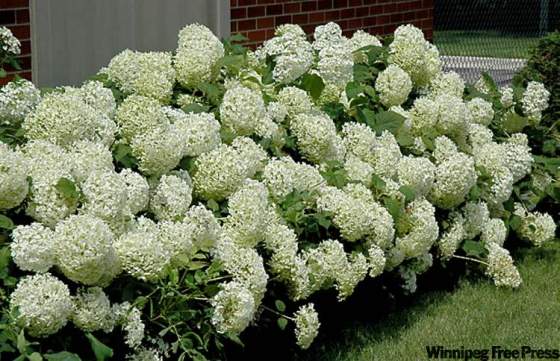
‘Annabelle’ is known for its huge creamy-white mop-head flowers.
“I prune Hydrangea arbrorescens shrubs down to roughly one foot keeping only the thickest canes with a nice bud,” he says. “Anything smaller than the diameter of my pinky finger is removed. Weak growth can shoot so prolifically. ‘Annabelle’ hydrangeas, for example, have huge flower heads that cannot be supported by weak stems. Removing weak shoots at the beginning of the growing season really helps to make your shrub sturdier.”
Last spring, the ground was so sopping wet that park staff were unable to get into the beds to prune hydrangeas until the second week of May. “In the fall we put down a couple of inches of wood chips around our ‘Annabelle’ hydrangeas, so it won’t be so muddy this spring. But again, it’s reliant on weather. We prune the ‘Annabelle’ shrubs in April if enough snow is out of the way.”
So, pull on your boots this March, clean your pruning shears, and snip off the dried flowerheads on your panicle hydrangeas.
If rabbits have stripped the bark from stems and the bark has been completely removed, then more aggressive pruning will be needed because flower and leaf production will be affected. Prune just below the damage and if possible, place a ring of hardware cloth fencing around your plant to prevent any further damage from feeding by rabbits. Set the ring into the snow and adjust it as needed as the snow melts.
If there is potential for more feeding damage, spray your plant with a natural and organic animal repellent, but only once daytime and nighttime temperatures stay reliably above 2 C.
START YOUR PEPPERS
This year I am growing “Pepper Trailblazer,” a new introduction for 2023. It is an early-ripening sweet bell pepper that holds its bright yellow colour when ripe, so it is slower to turn gold/orange than other varieties on the market.
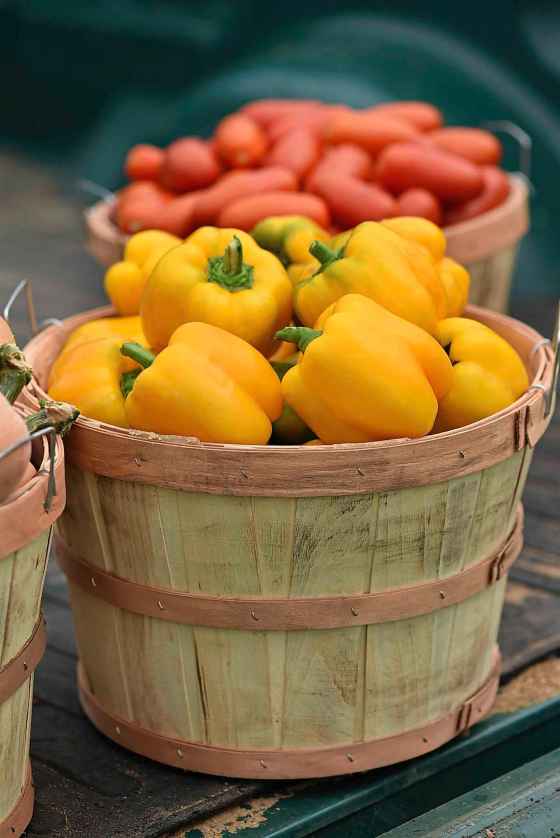
Pepper Trailblazer
I’m also excited to trial a new pepper for 2024, “Prism Pepper,” with green, orange and red fruit on the plant at the same time. There is no denying the ornamental qualities of homegrown peppers in beds and containers, but the real value is in the savings on our grocery bill and the benefits to our health.
Now is the time to start peppers from seed indoors! Peppers need a long growing season, especially if you are growing hot varieties like Carolina Reaper, Cow Horn, and Ghost pepper. Here are some basic tips for success:
- A heat mat is useful for starting pepper seeds, which require consistent and constant warmth.
- Humidity encourages good germination. One method is to create a mini-greenhouse effect by covering your seedling trays with propagator domes with vents to ensure adequate air circulation.
- A bright windowsill may provide enough light for your seedlings, however, peppers thrive best when they receive six to eight hours of light a day. Grow lights can help to ensure healthy, strong growth.
- Once pepper plants are producing their first sets of leaves efficiently, pinch the growth back with your fingers to remove the main growing tip.
A GOOD ‘THYME’ TO GROW YOUR OWN
Cory Messel is a Brandon gardener who grows a broad range of herbs in his garden for both their ornamental and culinary value. He buys grocery store thyme in a plastic clamshell and uses it to grow fresh plants. “Take a cutting, pop it into some soil and you will have enough thyme plants for the summer,” he says. Messel shares this easy method to propagate store-bought thyme as well as rosemary:
- Take fresh cuttings with a clean pair of scissors.
- Remove two sets of leaves at the bottom of the stem.
- Plant in moistened potting mix.
- Once the plants have rooted, pot them up into small containers.

Homegrown thyme (Cory Messel photo)
TWO OF THE SEASON’S EARLIEST FLOWERING PERENNIALS
Marilyn Latta’s favourite time of the year is spring. She grows several spring-flowering perennials in her St. Vital garden. The earliest perennials to bloom in her garden are bloodroot (Sanguinaria canadensis) and hepatica (Hepatica spp.). Both are low-growing, native plants.
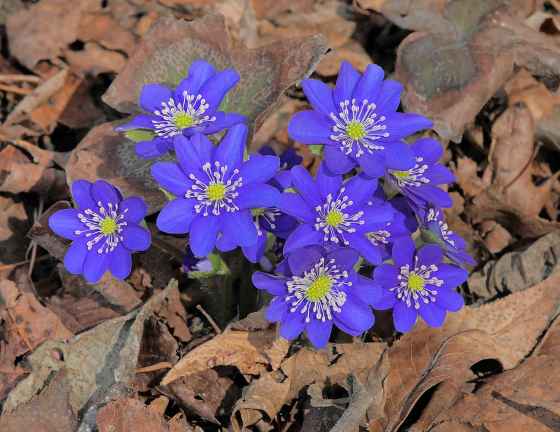
Hepatica (Marilyn Latta photo)
Latta keeps phenology records so that she has notes on the different stages of her plants such as leafing and flowering. Hepatica, which has strikingly blue flowers, has bloomed in her garden as early as the first week in April — though it waited until May last year due to the unseasonably late spring weather. Bloodroot is a member of the poppy family (Papaveraceae). It has a single, deeply lobed leaf and a white flower.
“The earliest my bloodroot blooms is usually the third week in April and last year it was the second week in May; again, because of the weather. For me, hepatica and bloodroot are my first non-bulb plants to bloom and I get so excited about them.”
Latta purchased both plants locally about 15 years ago. “When you get a new plant, you try and find the best conditions for it so I planted the bloodroot in a shadier area. It produces large seedpods that are almost as big as an acorn, but then they kind of elongate as they ripen before they split open so they are quite adept at planting themselves.”
Each flower lasts only four or five days, says Latta, but she grows several bloodroot plants in her garden — total shade, part shade, and full sun. Last year, one clump of bloodroot had at least 20 flowers.
An interesting characteristic of bloodroot is the way the single leaf protects the flower. “When bloodroot first emerges from the ground, the leaf is furled around the flower bud like a shawl. On a warm day, the flower bud starts peeking out of the top of the plant and the leaf unfurls. But if the weather turns cold again, the flower bud shrinks back inside the plant where it’s nice and warm.”

Bloodroot (Marilyn Latta photo)
One of the common names for bloodroot is red puccoon, an Indigenous name for dye. “The root of bloodroot is almost like a fleshy rhizome,” says Latta. “If the root gets damaged, it oozes what looks exactly like crimson-red blood.”
Bloodroot is native to Manitoba but hepatica is native to Ontario. Hepatica has semi-evergreen leaves and blooms around the same time as Manitoba’s native prairie crocus. “The leaves are kind of ratty-looking when it blooms in spring, but then it gets new leaves and looks more presentable for the summer,” says Latta.
“The bloodroot stands out in the garden with its white flowers but the hepatica blends in more with all the dead leaves from winter so you have to look for it. But then you spot the blue flowers! For me, it is always a race to see which one — hepatica or bloodroot — will open first in the spring.”
On May 1, Marilyn Latta is presenting a workshop, What’s That Wildflower, which will feature Manitoba wildflowers from A to Z. For more details and to register, visit naturemanitoba.ca.
ARE HOTELS ‘BEE-FRIENDLY?’
Planting a pollinator garden is one of the best ways for gardeners to help support bees and other pollinators. Cameron Ruml, curator, Living Prairie Museum, 2795 Ness Ave., says in addition to planting habitat for pollinator species, leave your garden messy.
“Don’t clean it up in the fall and don’t be in a hurry to cut your plants back in spring,” says Ruml. “Many pollinating insects overwinter in the hollow stems. We recommend waiting until the May long weekend before cutting plants back — this gives beneficial insects time to emerge.”
Close to 30 per cent of native bee species make their nests in logs or tree stumps or even in an untidy patch of long grass mixed with vegetative debris. Some homeowners build nesting boxes or bee hotels to provide nest sites for bees. Living Prairie Museum maintains an example of a small nesting box at its location, which is also home to a beautiful garden filled with pollinator-friendly plants.
“We always encourage gardeners to plant habitat first and plant native plants — but if you want to provide a nesting box for bees, good sanitation is key,” says Ruml. “If you’re not disinfecting nesting boxes properly or using materials that could become moldy, then the nesting bees can become infected with pathogens.”
It’s important, as well, says Ruml, to not build a nesting box that concentrates bees in unnaturally large numbers. Crowding may result in an infestation of parasites.
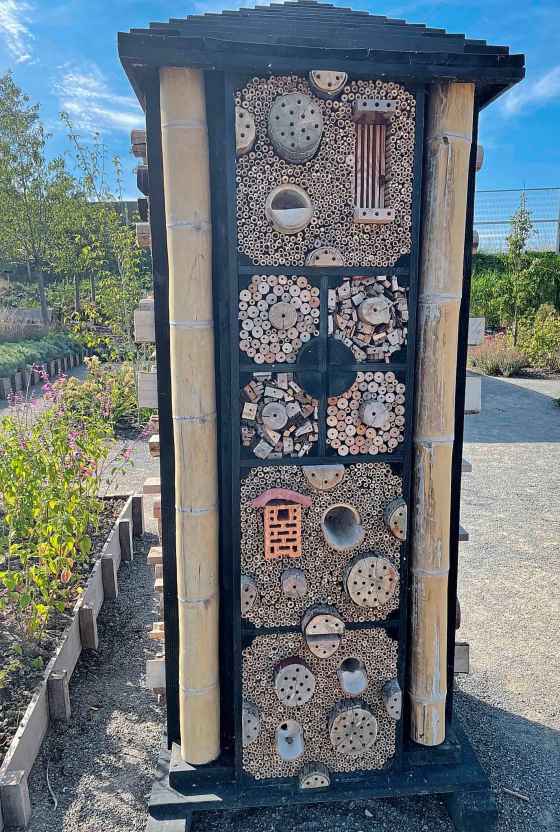
A deluxe bee hotel (Helen Lesser photo)
Drilled blocks with a variety of tunnel sizes about 2 to 12.7 mm in diameter will support a diversity of species. The holes should be smooth inside and closed at one end. Placement of your bee hotel is also important so that openings are not exposed to the hot afternoon sun or are receptacles for rainwater.
Ruml recommends reading this PDF from the Xerces Society for Invertebrate Conservation for excellent information about the design, materials, and placement of nests for native bees.
Living Prairie Museum is a great place to visit if you are looking for advice on what to plant in your garden to attract pollinators. Visit Winnipeg.ca/LivingPrairie for information on prairie planting workshops this spring.
The Friends of the Living Prairie Museum are also hosting a virtual winter speaker series via Zoom. On March 21, from 7 to 8:30 p.m., join Ash Burkowski, an avid grower of native plants and chair of the Friends of the Living Prairie Museum, for a presentation on Native Plants for Native Lawns. Burkowski will highlight low-growing native species and share practical techniques for creating your own eco-friendly yard. Register online.
READ THE FINE PRINT
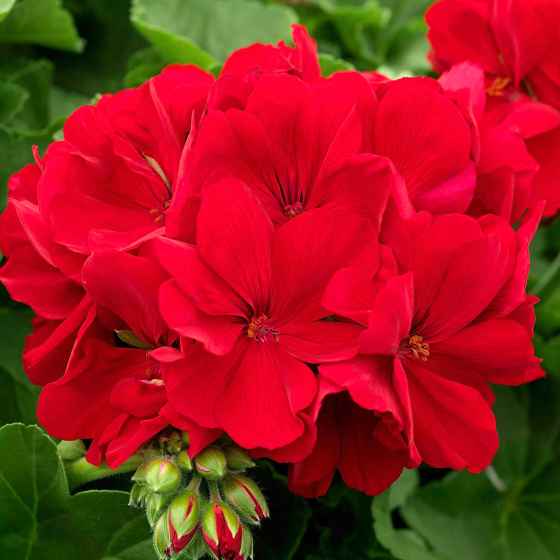
Your grandmother and great-grandmother most likely grew zonal geraniums. Indeed, zonal geraniums go back centuries to when John Tradescant, gardener to Charles I of England, brought them to Europe from South Africa in 1632. Zonal geraniums are propagated by cuttings and are easily identified by the patterns of colour on the surface of their leaves. They are easy to grow, and you can choose from a variety of colours.
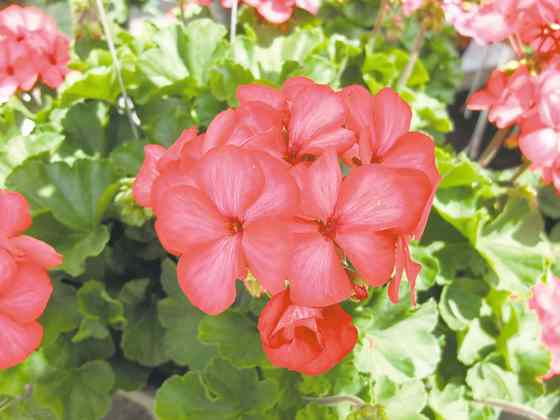
Zonal geraniums are propagated by cuttings. (Dummen Red Fox photo)
Seed-grown geraniums are shorter than zonal geraniums, usually cost less and are often sold in cell packs. Seed-grown geraniums sometimes shed their petals more easily, especially in strong winds, in a process called shattering.
Interspecific hybridization, introduced about 10 years ago, has transformed Pelargonium geranium resulting in bigger, more vigorous plants with larger flowers, and improved branching. Interspecific geraniums are a cross between zonal and ivy geraniums and they cost more.
One of the advantages of interspecific geraniums is improved heat tolerance. Interspecific varieties such as Calliope — a cascading geranium with large, semi-double flowers and a vigorous spreading habit — and Caliente — with a mounded habit and excellent rain tolerance — flower all summer long, even in high heat and humidity.
Interspecific hybridization is transforming not only geraniums but many other annual plant varieties such as dianthus and impatiens. At the garden centre, you won’t see signs that say “interspecific varieties here,” but the back of the plant’s tag will state if a plant is an interspecific hybrid.
INVASIVE ORNAMENTAL PLANTS
Invasive plant species are an increasing threat to our landscapes. They do harm to the economy, environment, and public health.
Surely invasive species wouldn’t be growing in your garden, right? It’s an uncomfortable reality for many gardeners to learn that the global trade in ornamental nursery stock is a major pathway for the introduction of invasive plants worldwide.

Himalayan balsam impatiens has exploding seedpods.
On Saturday, April 1, from 12:30 to 3 p.m. at the south campus of the Canadian Mennonite University, the Manitoba Master Gardener Association (MMGA) will host an informative presentation on invasive ornamental plants. The MMGA has assembled a panel of well-known experts who will provide information about ornamental invasive plants, why they are harmful, and what you can do to help prevent them from spreading and out-competing local, native species.
It’s true that some invasive ornamentals have tempting flowers. “There are many other options available that are non-invasive, beautiful, and benefit pollinators,” says Kristin Pingatore, weed control supervisor for the Selkirk Area Weed Control District and panelist at the presentation.
“Invasive (species) can have a particularly detrimental effect on the habitat of native pollinators or caterpillars that are dependent on specific threatened native plants.”
Dame’s Rocket, for example, has fragrant flowers in a mix of colours — but it also spreads rampantly, chokes out natural vegetation, and can harbour dangerous plant diseases. Many gardeners are familiar with common invasive plant species such as bishop’s goutweed, the dreaded creeping bellflower, or Himalayan balsam impatiens, which has exploding seedpods.
Sometimes these arrive in our gardens as volunteer plants. The MMGA presentation on April 1 is an excellent opportunity to learn about many other invasive ornamentals such as orange hawkweed (Pilosella aurantiaca), a Eurasian perennial originally brought to Canada for use in gardens. A significant threat, orange hawkweed establishes itself quickly and can completely take over roadsides, meadows, pastures, and even lawns, says Pingatore.

Orange hawkweed establishes itself quickly.
Linda Dietrick, a master gardener and interim education standards director for the MMGA, says that she has come across many situations where invasive plants have taken over whole areas in neighbourhoods, parks, and wild spaces. “Somebody somewhere thought they could contain those plants. But they got away.”
Attendees to the presentation will receive a comprehensive handout of what not to plant in Manitoba. Admission is $5. For more details, visit mgmanitoba.com.
MARK YOUR CALENDARS
• The Manitoba Orchid Society Show and Sale is March 24 to 26, at Breezy Bend Golf and Country Club, 7620 Roblin Blvd., Headingley. An annual rite of spring for many years that attracts thousands of visitors, the MOS Orchid Show returns for the first time since the start of the pandemic. Celebrating the 2023 Year of the Orchid, this event will showcase hundreds of blooming orchids. Shop for rare and unusual live orchid plants and listen to free talks by experts. MOS members will be on hand to answer your questions. Don’t forget to bring your camera! Admission is $10 and is free for children under 14. Doors open Friday, March 24 at 11 a.m. and on Saturday and Sunday, March 25 and 26, at 9 a.m.
For more details, visit manitobaorchidsociety.ca.

The MOS Orchid Show returns for the first time since the start of the pandemic. (Denise-Fortier photo)
• Nature Manitoba will host a presentation by Debbie and Stuart Innes on Monday, April 3, at 7:30 p.m., at Earl Grey Community Club, 360 Cockburn St. N. Debbie and Stuart will review lessons learned in establishing and maintaining garden beds at their neighbourhood park, Albrin Park. Their discussion will include plant selection, maintenance, and getting others involved. For more information, visit naturemanitoba.ca
• The Living Green Show is from April 7 to 9 at the Red River Exhibition Ground. This exciting event is Winnipeg’s newest show dedicated to the love of gardening! Find inspiration and expert advice. Shop with local vendors who will showcase natural products (including plants) and environmentally friendly services that will enhance your indoor and outdoor living experience. There will also be an opportunity to swap seeds and connect with other gardening enthusiasts.
Living Green Ambassadors Dorothy Dobbie and Kevin Twomey look forward to seeing you! Admission is $10, kids under 12 have free admission, and parking is free. Purchase tickets at the door or online at redriverex.com.
• Neepawa Garden Club presents Plant Diagnostics — Identifying and Managing Plant Problems, on Monday, March 13 at 7 p.m., at the Neepawa Public Library. Find out what is killing your plants and what to do.
TRENDS IN ONLINE SHOPPING
When gardeners are in search of a plant, some will cast their nets far and wide by perusing the catalogue listings of mail-order nurseries across Canada, the U.S., and as far as the U.K. Direct-to-consumer purchasing of brand name plants adds a new layer of opportunity for plant shoppers and is the next frontier in online shopping.
• Bloomin’ Easy plants are sold in garden centres throughout North America. Bloomin’ Easy plants were created by Van Belle Nursery, an award-winning, family-owned wholesale and propagation nursery in Abbotsford, BC.
In May 2022, Bloomin’ Easy announced the opening of bloomineasyplants.ca, an online store complete with direct-to-consumer purchasing of the brand’s cultivars. A spokesperson noted it’s an easy way for gardeners to find newer varieties that can be hard to find in local garden centres. For 2023, Bloomin’ Easy added a Jumbo Pint size in Canada to match the U.S. side of the store. The site also offers DIY support, including sign-ups for plant-care reminders. “We also plan to begin offering fun merchandise like shirts and socks for fans that want something extra with their plants.”
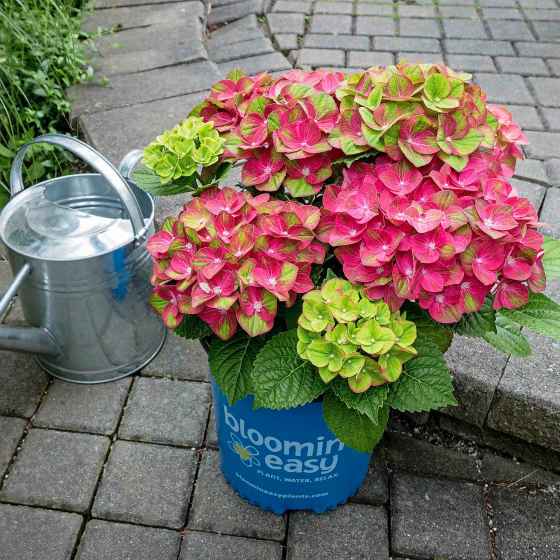
Bloomin’ Easy has opened an online store.
• Monrovia, an American company whose products are sold at garden centres throughout North America, has also moved into the online arena. But in this case, Monrovia’s online shopping is only available to customers in the U.S. A spokesperson declined to say if the company plans to make online shopping available to Canadian consumers in the future. But here’s how the innovative online-local hybrid shopping works: gardeners make their plant selections on Monrovia’s website and pick up their online orders at an independent garden centre chosen at checkout. Plants can be pre-ordered for spring and ship after the last frost date in the area where the gardener lives.
• Great Garden Plants greatgardenplants.com is another new mail-order opportunity for plant shoppers. Great Garden Plants is the daughter company of Spring Meadow Nursery, a propagation nursery based in Grand Haven, Michigan, that is also a licensee for Proven Winners woody plants and shrubs.
Last fall, Great Garden Plants announced it planned to start shipping to Canada — but the 2022 purchase experience was limited to a handful of people in Ontario and Quebec. In December, I contacted the company to inquire about their plans for 2023. A spokesperson replied that the operations team was still working out several kinks.
At the moment, Great Garden Plants is not shipping plants to any province in Canada.
We can be certain that the future of online plant shopping will continue to grow. But in the meantime, your local garden centre also stocks brand-name plants and there are no shipping charges!
THE SEARCH FOR A GREAT GARDEN PLANT
Sometimes a great plant is hard to find at garden centres if for no other reason than high consumer demand for newer plant introductions pushes an older variety off the plant shelf.
A great example is Heuchera Brandon Pink coral bells. Developed at the Morden Research Station, Brandon Pink coral bells were introduced in 1983 by Henry Marshall. At the time, Marshall and Lynn Collicutt were breeding hardy ornamentals that could survive our cold winters. So hardy and desirable is Brandon Pink coral bells that some local gardeners have been growing them in their gardens for more than 25 years.

Brandon Pink Coral Bells are surrounded by blue veronica, several varities of irises and lilac bushes. (Brenda Newton photo)
In 2003, Brenda Newton, a Brandon area gardener, paid one dollar for a large clump of Brandon Pink coral bells. “I divided it into 36 pieces, and they are still alive around the yard here and at our neighbour’s where I shared a couple of pieces.”
I searched many years for Brandon Pink coral bells until a generous gardener shared a plant division with me. Although it is still possible to come across Brandon Pink coral bells at the occasional garden centre, it is mostly through a network of dedicated gardeners and garden-club plant sales that Brandon Pink coral bells, with masses of coral-pink flowers on 50-centimetre stems, continues its wonderful legacy in our gardens.
I would love to hear from Winnipeg Gardener readers who have a great garden plant that is no longer readily available. Reply to this email to tell us about your plant — and be sure to include a photo!
SCHOLARSHIP ALERT!
All students enrolled in a two- or four-year horticulture or related program are eligible to apply for an experiential scholarship offered by the Perennial Plant Foundation. Recent graduates (within 12 months) of a two-to-four-year horticulture-related program are also eligible to apply. The 2023 PPA Foundation Scholarship recipients will receive full access to the Perennial Plant Association’s national symposium in Niagara Falls, Ontario, July 24-28, 2023, including educational sessions, tours and a trade show. The scholarship also covers accommodations, plus $1,000 to assist with transportation costs to and from the symposium.
To access the application, visit the foundation’s website by March 31, 2023. If you have any questions on eligibility, contact perennialplantfoundation@gmail.com.
“We are looking for people with an interest in perennials, to expose them to the Perennial Plant Association and all the fabulous education, people and job opportunities within our industry,” said foundation president Janet Draper.
Draper, who is the horticulturist at Smithsonian Gardens, also extended an invitation to those that don’t meet the scholarship eligibility to consider attending this year’s PPA symposium to learn more about plants.
“It is a high-octane experience hearing from top-notch speakers and leaders in our industry, then touring the best public gardens, private gardens, growers and retailers (Niagara Falls) has to offer and sometimes we go out to see plants in the wild. Every year our conference is in a different part of the U.S. or Canada, and the program is put together by a team of local volunteers who want to show off everything that makes their region special.”
Each year, the Perennial Plant Association announces the Perennial Plant of the Year. The 2023 Perennial Plant of the Year is Rudbeckia American Gold Rush.
Your questions, answered
Have a question for a gardening expert? Reply to this email with your question and we’ll seek answers from some of Manitoba’s most knowledgeable gardeners. If you’re asking about a problem with a plant or pest, please attach a photo to help our experts diagnose the issue.
Dawn asks: I have some Nonstop Mocca Cherry tuberous begonias that were in pots outside last summer. I brought them into the house and have managed to keep them going. I wanted to multiply them and thought I might put stems in water or in soil, but I have had no luck.
This is in contrast to an indoor begonia I have that is at least 55 years old. It has large, serrated leaves with red hairy stems. With that plant, I simply cut a large-ish piece that includes a growing tip, put it in soil and off it goes. But I cannot get the tuberous begonias to root. How can I propagate them?
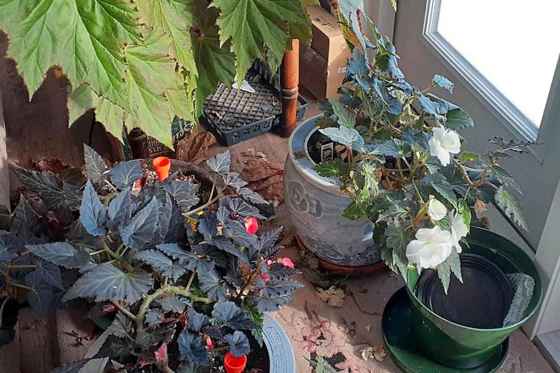
Dawn found a tag in the pot for the dark-leaved begonias at the bottom: they are Nonstop Mocca Cherry tuberous begonias. At the top are leaves from her indoor begonia, which roots whenever she puts stems into soil.
Answer: The begonia variety Nonstop Mocca Cherry is grown by nurseries from seed and is not meant to be propagated. Over several seasons, tuberous begonias like this may develop tubers that can be stored over the winter and divided into pieces. But after only one summer, the tuber will be too small for that.
It is possible to propagate tuberous begonias from stem cuttings instead, though it is trickier than for fibrous-rooted, houseplant-type begonias.
You will need rooting compound #1 for softwood cuttings. Carefully cut a non-flowering branch using a clean, sharp blade. Wet the stem end and dip it into the powder. Make a slight hole in moist seedling mix, put the cutting in, and tap the soil around it. Do not shove the stem with powder into the soil, as the rooting compound will be rubbed off and not work.
Place the pot in a plastic bag and seal, or put it into a covered, clear-lidded container, forming a mini greenhouse. Place on a warm surface or a heat mat for plants. Monitor well for humidity, occasionally releasing some by opening the bag/container for a short time. Check for root formation after about three to four weeks.
Another technique to try would be a leaf cutting, similar to what one does with African violets. Cut the leaf into pieces, lay it onto soil, and allow it to root in humid conditions as described above.
— Manitoba Master Gardener Association
“Please admire my plant!”
Got a fabulous flower? A handsome houseplant? A ravishing radish or elegant eggplant? An attractive annual or pulchritudinous perennial? We want to see it.
Reply to this email to send a picture to us and we’ll feature your gorgeous growth in future issues of this newsletter.
Please include a photo you took yourself, your name, the name of the plant and all the details your fellow readers might want to know about it.
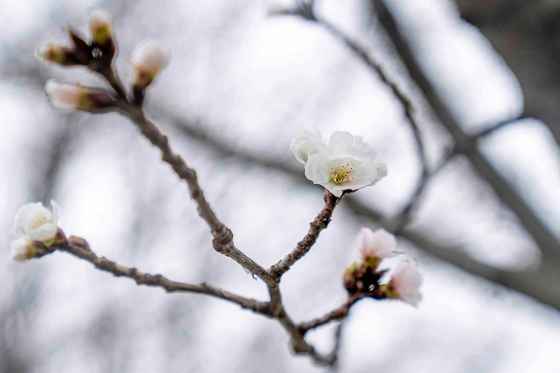
Cherry blossoms begin to bloom along Hains Point in Washington. (Andrew Harnik / The Associated Press)
|