The Sunday garden
“I love gardens,” says Erin Lebar, manager of audience engagement for news at the Free Press. But spending her free time on weeding and maintenance holds little appeal.
This year, Lebar is planning a redesign of the garden beds located on either side of the steps leading to her front entrance. Her focus is on a relaxing, easy-to-maintain garden, a top 2025 garden design trend many are now calling the Sunday Garden.
“The previous owners planted a few perennials — irises, peonies, and a small and aggressively thorny rose bush,” says Lebar.
“But we have invasive grass and weeds, plus a random tree that seemingly grew overnight. We pull and weed and try to keep it nice but then all the grass comes back so quickly.
“Enough! I need a professional!”
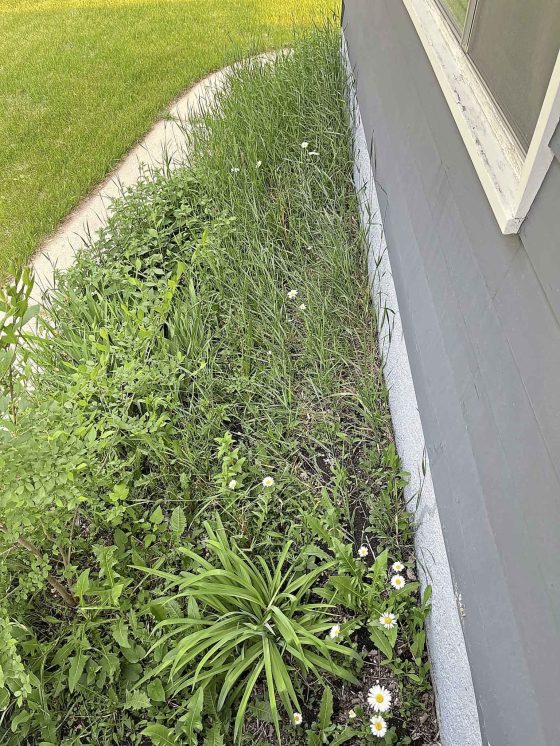
Reimagining a weedy area (Erin Lebar)
Lebar reached out to Lacoste Garden Centre, which offers landscape design services including free consultation.
Her budget for the project is $2,500.
At the onsite visit last fall, Lacoste’s Sam Greenberg and Lebar talked about including a renovation of a strip of graveled area on the south side of her house, which is currently planted with tulip bulbs.
“But that pushed the cost of the project too high,” says Lebar.
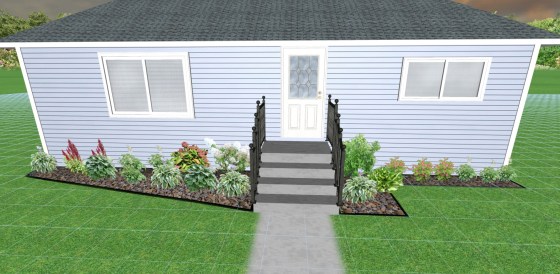
3D rendering for Erin Lebar’s outdoor space (Sam Greenberg)
Lebar shared some of her vision for how she wants the finished space to look and feel and that reflects her maintenance requirements. “I’m not picky about the types of plants and flowering bushes — I will defer to Sam’s knowledge and expertise entirely,” says Lebar. “So, it will be a bit of a surprise for me as well!”
But now, Lebar has a design sketch in hand and her excitement is building! The design includes smooth and crushed granite for a finished look in border areas. Some existing plants will be retained along with the addition of hardy groundcover plants, flowering perennials, and hydrangeas for multi-season interest.

The plant list for Erin Lebar’s landscape project from Lacoste Garden Centre (Sam Greenberg)
Winnipeg Gardener readers can follow the progress of Lebar’s front yard design project in upcoming newsletter editions.
Next month, landscape designer Sam Greenberg will share his insights on designing for functionality and low maintenance. We’ll learn more about the plant selection and layout that will complement Lebar’s home exterior and match her personal style!
New planting model at FortWhyte
Heather Skrypnyk, Farm Operations Manager at FortWhyte Alive, has been busy planning all the things that go into growing the productive food gardens at the farm.
From deciding which crops to plant where and in what quantities, Skrypnyk has also been rethinking ways to group plants.
She has designed a new model that groups plantings by harvest weeks instead of grouping them by crop.
I caught up with Skrypnyk in late February to learn more about what she has in mind.
“I’ve always organized the field planting by blocks of plant families. One reason is that it makes it easy to do crop rotation on a four-year cycle. Also, plants with similar growing habits, pests and water requirements are together so management can be concentrated,” said Skrypnyk.
“We have almost two acres of vegetable production and there are three different garden fields that are very removed from one another.”

A new planting model has been designed for the crops at FortWhyte Alive. (Joseph Visser)
FortWhyte Farms offers hands-on, sustainability-focused programming for youth. At any given time, said Skrypnyk, youth can be harvesting at different parts of the farm.
“We are trying to find a way that we could keep everyone in the same area and make the tasks more physically concentrated,” said Skrypnyk.
Skrypnyk saw a solution in grouping plantings by harvest weeks. For example, planting early season crops like radish, beets, and kohlrabi beside each other in one field.
“But once summer picks up, I have another garden field that has all the plants that are harvested for the entire growing season — tomatoes, peppers, eggplant, squash.
“It means that instead of prepping garden beds all over the place in spring, when time is limited, we’re able to start prepping in one field and get our seeds we need to harvest from first, in the ground on time,” said Skrypnyk.
“Once the crops that are planted in the beginning of the spring are harvested during the first couple of weeks in July, we’re going to pull them out of the garden.
“That will allow those same beds to get prepped and ready for fall crops. Then we’ll have crops that have a short growing time like radishes, turnips, spinach, etc.
“What I envision is a whole garden field with plants that are in the garden for the entire season and then another field that has rotational crops that are planted by harvest week. The rotational crops will rotate next year to follow the permanent crops, so we are still practising crop rotation,” said Skrypnyk.
Right now, it’s a plan that is down on paper. We’ll check back with Skrypnyk later in the season!
Sneak peek: a new daylily
Titan Skye Daylily, part of the Skye Daylily Series introduced by Monrovia, is an improved reblooming daylily that will provide summer beauty in your garden.
It was one of the many new plants for this spring featured in a presentation by Andrew Ronald of Jeffries Nurseries at the recent Grow Show hosted by the Manitoba Nursery Landscape Association.
Titan Skye has brilliant orange frilly petals with a bright yellow eye. This easy-care plant offers disease resistance and drought tolerance. It also tolerates a range of soils.

Monrovia Titan Skye Daylily (Doreen Wynja photo)
This tidy variety stays compact, growing to about 45 cm tall and wide.
A dependable perennial for the front of your garden border!
Overwintering potted plants
John Leperre enjoys growing borderline-hardy plants such as Japanese maple in his Winnipeg garden.
Leperre is the Winnipeg-based sales representative for Bylands Nurseries. He is a former trees and shrubs manager at Shelmerdine Garden Centre and is as tempted by exotic plants as many of his customers.
Leperre overwinters several potted plants in his garage. First, it must be stated that his garage is insulated.

Overwintering Sunblaze Amber Rose standard (John Leperre photo)
Currently, non-winter-hardy plants that Leperre is overwintering in his garage include Sunblaze Amber Rose standard and two types of Japanese maples — Shidare and Sango Kaku.
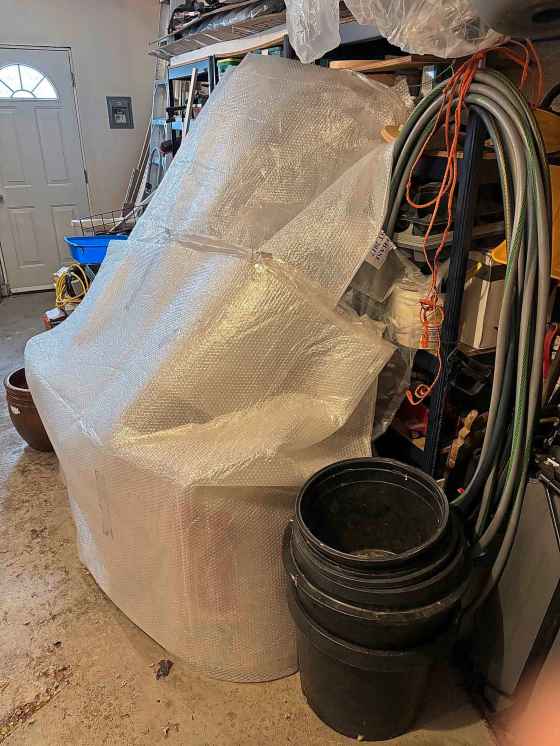
Overwintering non-hardy plants in bubble wrap (John Leperre photo)
What is Leperre’s secret?
“When I bring my plants inside the garage in late fall, I give them a drink of water. I place the potted plants on wood or cardboard so that the bottoms are not sitting directly on the cement floor,” says Leperre.
“I wrap the pots with bubble wrap then place some big sheets of cardboard around the base to keep out the cold air. But it is not sealed all the way around.
“Then I wrap the whole thing with bubble wrap all the way to the top of the plant but leave the very top open.”
Leperre’s rose standard is spending its second winter in his garage. “I’ve grown Inaba Shidare Japanese maple for five years and Sango Kaku for two years,” says Leperre.

Tender Japanese Maple in John Leperre’s Winnipeg backyard last October (now it’s overwintering in his garage) (John Leperre photo)
Award-winning landscapers
The Manitoba Nursery Landscape Association hosted its annual Grow Show on Feb. 19, at Canad Inns Destination Centre Polo Park, where awards were presented during a special luncheon.
Four projects were honoured with Awards of Excellence, the program’s highest distinction, recognizing outstanding achievement, craftsmanship and innovation in Manitoba’s nursery and landscape sector:
- Residential construction and installation: Livingstone Landscaping Ltd.
- Residential construction and installation: Geller’s Design Build Landscape
- Garden Centre award: Alternative Choice Garden Centre
- Private residence maintenance: Geller’s Design Build Landscape
There were also 16 Awards of Merit, which honour high-quality work across residential and commercial landscape categories.
In addition, Michel Touchette received the Life Membership Award in recognition of his decades of leadership and contribution to Manitoba’s nursery and landscape industry.

Michel Touchette is the 2026 recipient of the MBNLA Life Membership Award. (MBNLA)
Touchette has played a key role in rose breeding evaluation and assisting in the introduction of hardy tree and shrub varieties.
More information on the awards can be found here.
Industry news
For the first time, Jackson & Perkins roses will be available in Canada.
In January, Jackson & Perkins, an American company founded in 1872, officially launched a Canadian online store through a collaboration with Ontario-based J.C. Bakker & Sons Nurseries.
The launch includes more than 50 varieties of hybrid teas, floribundas, climbers, shrubs, and grandifloras. The curated collection will be grown and shipped from within Canada.
The selection includes a limited number of cold-hardy roses suitable for Zones 2, 3, and 4.
One intriguing variety that caught my eye is AC Navy Lady Shrub Rose which has fragrant, velvety red, semi-double flowers. Of course, it’s gorgeous to look at, but the story behind this elegant rose is even more interesting.

AC Navy Lady Shrub Rose (Jackson and Perkins)
AC Navy Lady Shrub Rose was developed in 2003 by Claude Richer, a prominent Canadian rose breeder at the Agriculture and Agri-Food Canada research station in L’Acadie, Que. She also helped develop well-known rose varieties such as Felix Leclerc, Emily Carr and Canada Blooms.
AC Navy Lady honors the contribution of the thousands of Canadian women who serve in Canada’s Navy. It was chosen by the Wren Association (Women’s Royal Canadian Naval Service) to celebrate the Canadian Naval Centennial in 2010.
But how hardy is this lovely rose shrub? Jackson and Perkins list AC Navy Lady as hardy Zone 3. The Canadian Rose Society lists it as hardy to Zone 4b. Other Canadian sources say it is hardy to Zone 4a.
If you have grown Navy Lady in your garden, please share your experience with us.
Find more details here on the full collection of roses available exclusively through the Jackson & Perkins Canadian online store.
Hold off on shrub roses — for now
It was surprising, to say the least, to spot dozens of sprouting shrub roses for sale last week on a visit to a local big box grocery store.
The tempting display of premium True Bloom rose shrubs, direct from California-based Altman Plants, is beautifully packaged.

True Bloom rose shrubs at local big box retail stores (Colleen Zacharias)
Each package includes two individually wrapped, repeat-blooming roses in one box for $24.99. The shrubs are classified as hardy to USDA Zone 4.
Several of the shrubs boast green woody canes and lush, healthy shoots. Given our current freezing temperatures, this poses some challenges.
If the roses were completely dormant, they could be kept in a cool (near-zero), humid, but well-ventilated area, says Rick Durand, who has developed many trees and plants, including roses.
But since the roses have woken up and begun pushing out leaves, Durand says that method won’t work.
“If someone did put them in a dark and damp area, the roses would probably keep growing and then you would be dealing with white-coloured growth that is so susceptible to molds and fungus.”
Instead, since spring planting is three months away, Durand suggests the following:
- Pot up the rose shrubs and place them under grow lights or on a south-facing windowsill.
- Ideally, the plants should receive a minimum of six to eight hours of direct sunlight daily.
- Water regularly, but do not overwater.
How to control weeds
Nik Friesen-Hughes owns Dogwood Landscape Design and Build. He specializes in native Manitoba wildflowers and grasses, meadows and naturalistic perennial gardens.
Here, Friesen-Hughes shares a comprehensive guide to controlling weeds. You will want to keep this helpful resource close at hand!
Every garden is a plant community. Invasive weeds are highly competitive species that take advantage of niches in the landscape often by growing quickly, producing abundant seed, and releasing chemicals that inhibit other plants from growing. Removing or limiting weeds on site is key, but you will always have weeds floating by air that you will need to defend against. Establishing a healthy and competitive plant community is the best way to prevent invasive weeds.
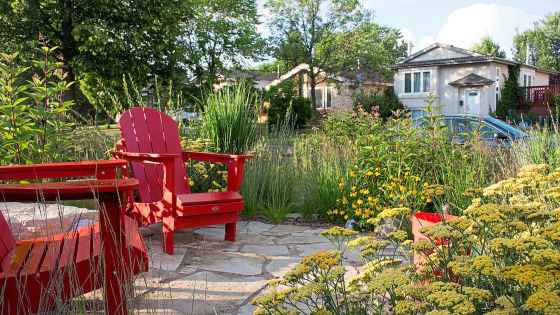
A seating area in a naturalized garden landscape design. (Nik Friesen-Hughes)
A “natural and biodiverse” garden carries different meaning for different people. Natural and biodiverse gardens can be very resistant to weeds if designed thoughtfully.
Managing weeds depends on:
- Species of weed (most commonly Creeping bellflower — Campanula rapunculoides, Dandelion — Taraxacum officinale, Quackgrass — Elymus repens, Canada thistle — Cirsium arvense).
- Extent of weed presence: weed seeds in soil, weed root presence.
- Where weeds are coming from: if weeds are emerging from within the site, then more significant weeding is needed.
- How your garden is arranged and site conditions.
- Time/resources available.
Targeted actions
- Removal by hand/tool: this is crucial for removing the weeds, seedheads and roots.
- Solarization: using a tarp to trap solar heat and cook weeds and weed seeds.
- Mow/cut existing vegetation or cursory weed prior to covering to reduce weed vigour.
- Cover area for 4-6 weeks or longer for quackgrass and bellflower. You can leave for up to a season.
- Most effective in summer; increase duration to 6-8 weeks or more if in spring or fall.
- Cover soil with cardboard and mulch: cover area between plants with non-waxy cardboard and 2-4” of natural wood chip mulch — this provides a barrier for weed seeds and roots present on site and makes it difficult for them to emerge. This is especially effective if coupled with large established perennials. Cardboard typically decomposes into soil within 6-12 months.
- Apply after area has been treated or between existing plants.
- As desirable plants grow and fill the space, mulch will become less noticeable and will break down over time. It’s useful in the early years of a planting to mitigate weeds.
- Once area has been covered for 2-3 months you can plant right into it.
- Using this approach works around existing plants but if there is significant weed root presence they will travel and emerge within existing plants. Weed thoroughly before covering.
When and how
Order:
- Remove as many weeds, including roots, as possible.
- Solarize if weed infestation is severe or has had years to build up weed seeds/roots in soil. You can skip this step if weeds are not that severe.
- Cover soil with cardboard and mulch.
Sectional management: target your efforts towards priority areas first — focus on areas with the highest concentration of weeds and work section to section, over months or years as needed. Following steps 1-3 as indicated above. For lower-priority areas, remove seedheads to prevent weeds from going to seed. Different weeds go to seed at different times.
- Prioritize weeding in the first 1-2 years of planting: weeding is most key in the first few years of establishing a garden. There will be more opportunities and less competition for weeds in the first few years. Once desired plants are large and competitive, weeding becomes much less of an issue. Effort in the early years will save you time in the long term.

A weed-free naturalized garden design with wildflowers and grasses. (Nik Friesen-Hughes photo)
Making adjustments
A garden is always in progress and you can always adjust by adding or moving plants. Weed management should always be coupled with planting or transplanting desirable plants to fill the gaps left by weeds.
If weeds have taken a foothold in your garden, this could be for several reasons: there is too much bare soil/too little groundcover (plants or mulch), existing plants are not competitive enough, or plants are not occupying all layers or ecological roles.
The goal is always to make the garden more competitive — and there are several ways to do that:
- Increase plant density: High plant density reduces space for weeds to grow and creates greater competition for resources (sun, moisture, nutrients) if they do manage to establish.
- Occupy layers: In nature, plants occupy different layers. In a meadow, grasses and small perennials form a groundcover layer and larger, longer-lived perennials rise above in another layer. Shrubs and then trees form upper layers. Every bit of soil and sun is maximized to increase competition. Most gardens have the larger perennial layer but lack the groundcover layer — this layer doesn’t have a large visual presence but is key for weed suppression.
- Adjust species selection: A healthy plant community includes plants that occupy different ecological roles. While it’s helpful to have a few short-lived species to produce seed and fill gaps, short-lived species will die out and create opportunities for weeds to infiltrate. Aim to include a higher proportion of species that are:
-
Long-lived: These plants will hold their spot over time and reduce opportunities for weeds to infiltrate
-
Clump-forming: These plants will grow slowly outward from one spot, forming a solid barrier to weeds. They can typically repair themselves more easily after damage, making them good at resisting weeds. Many ornamental grasses are clump-forming.
-
Spreading plants: These plants can move around over time and are well-suited to the groundcover layer. They are especially useful for problematic garden edge areas (such as along sidewalks) where rain will wash weed seeds into or roots will take hold. Avoid hyper-competitive spreading plants as they can take over (such as Goutweed — Aegopodium podagraria)”
— Nik Friesen Hughes, Dogwood Landscape Design and Build
A new two-year grant program
Manitoba Communities in Bloom has partnered with RBC to provide new grant opportunities.
The two-year grant program is for 2026 and 2027. It is designed to help cover participation costs.
Program registration deadline is April 30. You can learn more here.
Mark your calendars
Winnipeg Seedy Saturday — March 7
Winnipeg Seedy Saturday is once again partnering with the Millennium Library and Spence Neighbourhood Association to present Seedy Saturday 2026.
Featuring numerous events and vendors, Seedy Saturday is a great opportunity to swap seeds, talk to local experts and be inspired to grow and preserve your own food.

Winnipeg Seedy Saturday (Spence Neighbourhood Association)
Manitoba Orchid Show and Sale — March 13 to 15
This year’s event will once again be held at the Breezy Bend Country Club, 7620 Roblin Blvd. in Headingley.
The theme of this year’s show is “Orchids for the Prairie Home.”
“We have a great lineup of vendors including Everspring Orchid Nursery, Orchid Botanix and Tropicals of Winnipeg,” says Denise Fortier, one of the show’s organizers.
Out-of-town vendors include orchid specialists from Ontario and Edmonton. It’s a chance to see rare and breathtaking orchid species and incredible hybrids, says Fortier.
“Shelmerdine Garden Centre will also be at the event to assist folks who need supplies as well as live plants.”

Manitoba Orchid Society Show and Sale (Manitoba Orchid Society)
EastMan Seed Savers is holding its annual event on March 14 at St. Paul’s United Church, 630 James Ave., in Beausejour. The event runs from 10 a.m. to 2 p.m. There will be seed-trading tables, seed sales, speakers and vendors. For more details, contact treelady@mymts.net.
|