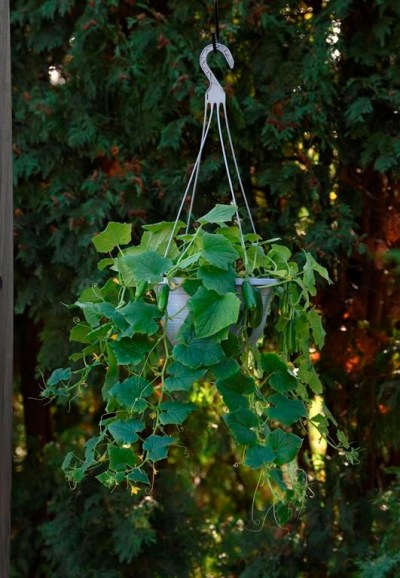
Know someone worried about the rising cost of food?
Not everyone knows how easy it is to grow their own food, or that food can be grown in even the smallest of spaces.
Recently, when I was having a manicure, a young esthetician mentioned to me how worried she is about the high cost of produce. She lives with her brother in an apartment that has a south-facing balcony (I asked).
Experienced gardeners know how easy it is to start vegetable seeds indoors — but it’s also very easy to find a vast range of seedlings at local garden centres that are ready to grow in a small patch of ground, raised beds, or patio or balcony containers. The young woman I talked with had never been to a garden centre.
This spring, introduce someone to gardening and help them experience the possibilities and joys of gardening. But remember to keep it simple.
You may have an amazing indoor garden complete with full-spectrum lights, rows of shelves, timers, fans, heat mats, and more. Think about how little you need to start out — nothing more than sunshine, a seed packet or a seedling, soil, a small container with drainage, and water.
Share your knowledge and inspire a new gardener.
Big Jim Hot Pepper has a back story you can sink your teeth into
Big Jim Hot Pepper is in production right now at Vanstone Nurseries in Portage la Prairie. It’s too soon to say how many local garden centre retailers will offer Big Jim this spring, but keep your eyes peeled for this unique variety.
It’s new for Manitoba gardeners this spring, but it’s already the stuff of legend.
Big Jim — full name NuMex Big Jim — holds the world record for largest chili pepper variety, with pods up to 11.8 inches or 30 cm long. It’s rated at 500 to 2,000 Scoville heat units, which makes it a bit milder than jalapenos. It’s an ideal pepper for stuffing, grilling, or roasting.
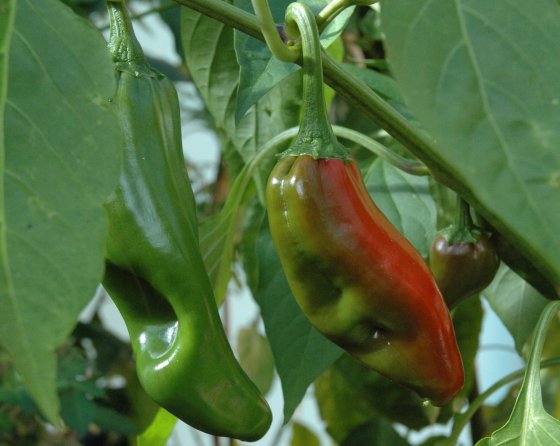
Big Jim Hot Pepper is the stuff of legends.(Wikimedia Commons)
First released by New Mexico State University in 1975, it’s a hybrid of New Mexican chilies and a Peruvian pepper. It was developed by Dr. Roy Nakayama in collaboration with Jim Lytle, for whom he named the pepper.
Nakayama was born in New Mexico to parents who emigrated from Japan. He university in New Mexico for two years before enlisting in the U.S. army when World War II started. He spent seven months in a prisoner of war camp. When he returned to the U.S., he was initially refused readmission to university until his former professors appealed on his behalf.
Nakayama’s 32 years of research in developing chile pepper varieties is credited with establishing chile peppers as a major industry in New Mexico, generating more than $10 million annually.
Troubleshooting indoor peppers
Soil: Use well-aerated soil that is free of contaminants and high in organic matter content such as compost-rich soil.
Sowing seeds: Do not crowd pepper seeds. Sow seeds very thinly to avoid fungus infections.
Light: Growing peppers indoors calls for plenty of light. A location with a bright south or east window or a full spectrum grow light supports healthy fruiting.
Temperature: For germination and seedlings, maintain daytime temperature at 21 degrees C. and night-time temperature at 18 degrees C.
When to transplant: Once pepper seedlings have four true leaves, transplant them to a small, thoroughly clean pot or cell pack that has good drainage.
Heat vents: Ensure that your plants do not have direct exposure to forced air heat vents.
Aphids and spider mites: Pests can proliferate in dry indoor air and low humidity. By giving your indoor pepper plants a vigorous rinse once a month under fast flowing fresh water, you can succeed in keeping your plants pest-free. Regularly monitor the upper leaves of pepper seedlings for the first signs of aphids or spider mites and remove pests immediately.
Good sanitation: Take the time to clean up any fallen debris on soil surfaces.
Why do you need a rain barrel?
In Winnipeg, water and sewer rates are expected to increase. A rain barrel can help you lower your water bill by reducing the amount of municipal water needed to water your garden. Rainwater is free!
According to this Government of Canada guide for homeowners, “for every one millimetre of rain that falls across a square metre catchment area (such as a roof), one litre of water can be captured.”
A typical rain shower of about half an inch (12.7 mm), when harvested from a household roof, is enough to fill a standard 220 litre or 55-gallon rain barrel.
A galvanized steel Haws watering can (may as well go with the best) holds 9 litres or 2.4 U.S. gallons. By my calculations, a typical rainfall captured in rain barrels could fill that can 24 times — enough to water a sizable number of planters.
In the event of heavy rainfall, overflow can also be collected so that not a drop of water is wasted and becomes stormwater runoff. One solution is to install an overflow hose to direct water where it is needed in your landscape. Another option is to install an underground pipe.
The Great Canadian Rain Barrel Sale
Coming this spring to a community near you!
Based in Smithville, Ont., RainBarrel.ca is a Canadian success story.
Groups across Canada and the U.S. partner with the company every year to distribute truckloads of rain barrels and raise money for worthy causes.
“We expect to be in every community this year that has at least 10,000 residents,” says Leah Pomerantz who works closely with her brother, Larry Pomerantz, president of RainBarrel.ca.
Rain barrel sales are posted on their website — new sales are being added all the time.

Repurposed food grade plastic rain barrel with Best Downspout Diverter. (RainGarden.ca)
Interested in fundraising for your organization? “Contact us this spring before June 1 and we’ll get you up and running with a sale,” says Pomerantz. Fundraising groups earn $10 from the sale of every rain barrel.
“This year our 220 litre or 55 gallon repurposed, food grade plastic rain barrels are mostly black. The prices start at $60 for our basic, ‘ugly’ barrel. People seem to love those because they cost $10 less than our other barrels.”
The barrels include a leaf filter basket, spigot/tap, overflow adaptor and overflow hose.
RainBarrel.ca also sells a range of accessories and products and are excited to introduce the “Best Downspout Diverter.” It is designed to fit all downspouts and includes two outlets and two hoses.
Pomerantz recommends pre-ordering your rain barrels. Sometimes fundraising groups or municipalities bring in extras to sell, but not always. Visit rainbarrel.ca to learn more and to find out when a truckload of barrels is coming to your community.
Help bees and other pollinators
John Russell, Red River Apiarists’ Association, wants to remind all of us that spring is a critical time of year for bees and other pollinators.
“Bees are never asleep,” says Russell, beekeeper and owner of an eponymous honey company. “People have this perception that bees hibernate. They will cluster and become dormant.”
We often hear a reference to bees waking up, but Russell says the reality is that longer days and warmer temperatures stimulate bees to shift gears from their winter mode to brood production.
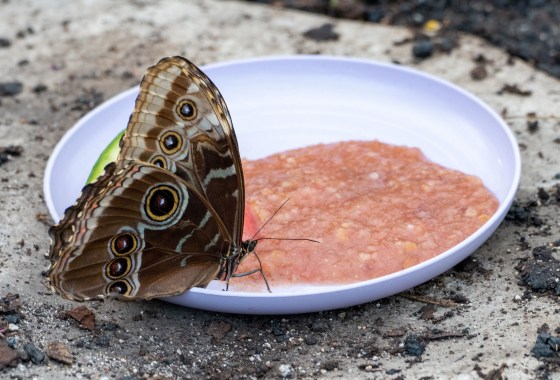
Butterfly feeding station using mashed overripe fruit. (Darlene Stack photo)
If warm temperatures arrive early this spring, it’s important to provide a food source for wild pollinating bees and other pollinators, says Russell.
“Plant bee-friendly, nectar-producing plants in your garden and make sure you are not cutting back the dried stalks of perennials too early, because leaf stalks may still be habitats for pollinators trying to complete their life cycle,” he advises.
Professional beekeepers will put pollen patties in hives if there are no flowers or pollen available for bees coming out of dormancy. “But if a homeowner puts a pollen patty in their backyard, squirrels will eat it,” he says.
Creating a watering station for pollinators such as honeybees, butterflies, moths, and other niche species is one of the best things you can do, he says.
Start with a clean, shallow dish and spread a layer of pebbles or small rocks. You can also add some colourful marbles to attract bees and butterflies. Then add just enough fresh, clean water to cover the rocks.
You can also make a fruit feeding station for pollinators such as butterflies using a shallow dish of mashed, overripe fruit such as bananas.
“The weather is changing and we have to adapt the ways that we do things,” says Russell. “Communication is a huge tool: talk to others and share your experiences.”
Types of pruners
Do you refer to your cutting tools as shears, pruners or secateurs? The word secateurs (pronounced seh-kuh-TURZ) comes from the Latin word secare, which means “cut.”
Bypass pruners have a scissor-like action, where a wider upper steel blade bypasses a narrower concave steel lower blade to make a clean cut effortlessly.
They are a practical choice for cutting back perennials and vines. They can also be used to prune the deadwood on roses and thinner-stemmed shrubs such as dogwood or hydrangea.

Anvil-style pruners use a ratcheting mechanism to cut branches. (Lee Valley Tools photo)
Anvil pruners have a distinctly different look and cutting action designed for cutting thicker woody stems. They have a sharp, straight-edged upper blade that comes down against a flat or square-edged lower anvil. There are also anvil pruners that have curved blades to make it easier to hold branches firmly and prevent them from sliding out.
Ratcheting anvil-style pruners are an affordable option that will cut branches up to three-quarters inch (1.9 cm) thick.
This type of pruner is especially useful for someone who has arthritis or small hands. A pumping action moves the blades through the wood without putting a lot of strain on your hands. Lee Valley Tools sells an anvil-style pruner that uses a ratcheting mechanism for around $20.
This amazing elephant topiary in a Fort Richmond garden was created by training Siberian elm tree seedlings which were allowed to grow and populate an area of turf. Hedge shears and bypass pruners (and a tall ladder) maintain the elephant topiary’s shape.

With help from hedge shears and bypass pruners, Siberian elm tree seedlings were trained into creating this elephant topiary in a Fort Richmond backyard. (Colleen Zacharias photo)
New petunias for 2024
The Supertunia collection from Proven Winners includes about 40 varieties that offer different colours, patterns, and flower sizes to suit every gardener. Supertunia Vista Jazzberry with electric magenta-purple flowers is Proven Winners 2024 Annual of the Year — deservedly so, because it has won more than 40 awards. Supertunia Vista Jazzberry was introduced in 2022 and is well-suited to hanging baskets.

Supertunia Vista Jazzberry is Proven Winners’ 2024 Annual of the Year. (Proven Winners photo)
Supertunia Hoopla Vivid Orchid Petunia, also new for 2024 from Proven Winners, is a picotee patterned petunia with a difference.
I’m not seeing an obvious connection to orchids, but the uniquely shaped, bright white edge that juxtaposes vibrant purple colour calls to mind components of the distinct shapes found in the four French-suited playing cards: diamonds (♦), clubs (♣), hearts (♥), and spades (♠). What do you see?
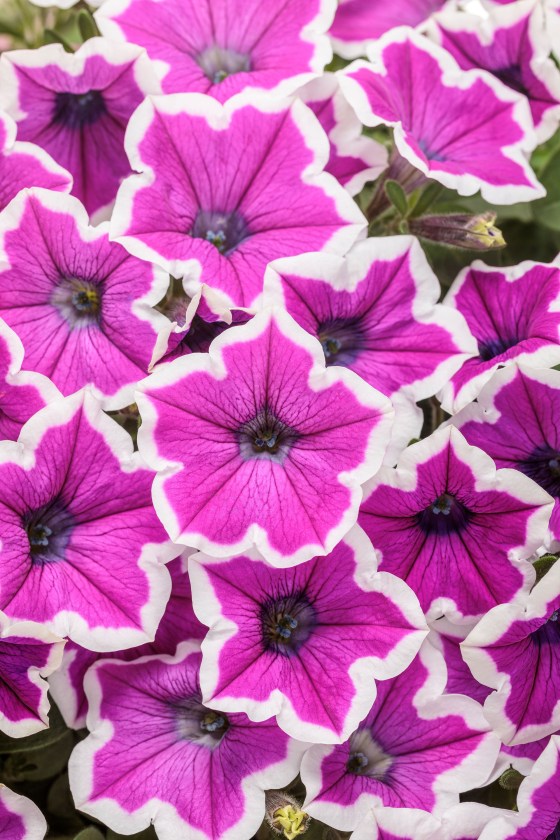
Supertunia Hoopla Vivid Orchid Petunia is new for 2024. (Proven Winners photo)
SweetSunshine Magenta Sky Petunia, new for this spring from Selecta, is the first double-flowering petunia from the Sky petunia series. The fully double magenta blooms have a white speckled pattern and a contrasting white picotee edge. A semi-trailing habit makes this new variety a great choice for hanging baskets.
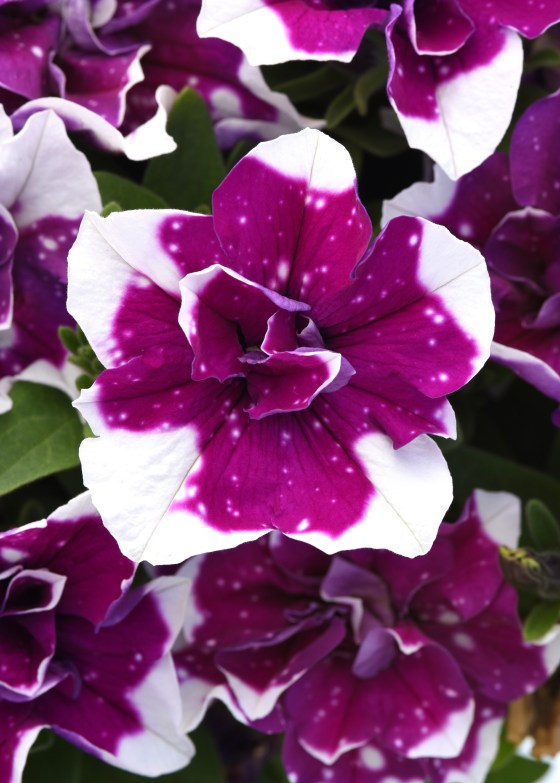
SweetSunshine Magenta Sky Petunia is the first double-flowered sky-patterned petunia. (Ball Horticultural photo)
All three of these new petunias boast durable, long-lasting performance in the garden.
New and improved fan flower
Scaevola fan flower is an excellent and undemanding filler in container designs. Sun-loving and heat tolerant, it has a spreading habit that makes it ideal for underplanting in larger containers.
By mid-summer, this fast-growing annual weaves its way through the foliage and flowers in container designs — but scaevola also benefits from the occasional trimming for a neater look. I also find there is more foliage and stem length but never enough of the oh-so-pretty fan-shaped flowers.
Enter Scala Blue Bird from Dummen Orange, a new scaevola fan flower for 2024 which offers more heat tolerance, more flowers, improved branching, and a denser habit with tight internodes. This spring, look for Scala Pink Bird, too.

New for 2024: Scaevola Scala Blue Bird fan flower from Dummen Orange. (Ball Horticultural photo)
Seedy Saturday
This year’s Seedy Saturday is presented by the Spence Neighbourhood Association and Winnipeg Public Library.
Featuring more than 30 vendors, workshops, a film festival, and the ever-popular seed swap, this year’s event is happening at the Millennium Library on Saturday, March 9, 10:30 a.m. to 3:30 p.m. Admission is free! Parking is available onsite in the underground parking lot or there is free two-hour parking available on adjacent streets.
Laura Rawluk, one of the event’s volunteer organizers, has been involved with Seedy Saturday events in Winnipeg for more than 25 years. A passionate gardener who grows most of her own food in her backyard and front yard in her Spence neighbourhood, Rawluk is bringing a lot of her own seeds that she saved from annual and biennial flowers to share at this year’s event.
There will be a huge variety of seeds on hand this year, says Rawluk, including winter squash seeds from enormous squash (15-20 lb/6.8-9.08 kg) grown last year. Rawluk is hoping that attendees at this year’s event will bring a bounty of seeds for tomatoes, chili peppers, and perennial and annual flower seeds.
Which seed varieties are you bringing for the seed swap table — or hoping to find?
Save the sweet pea
Recently I asked Erin Benzakein, owner of Floret Flowers, a family-run flower farm and seed company in Washington’s Skagit Valley, for her perspective on the global sweet pea seed shortage.
“The shortage has been happening for the last decade,” said Benzakein. “As the climate has been changing and the planet heating up, all the places where sweet peas were being produced in abundance commercially for their seed have changed so much that the growers there could no longer produce healthy, viable crops. But also, many sweet pea seed growers have retired and no one has picked up the torch.”
Home gardeners and flower farmers can make a difference by saving the seed from their favourite sweet pea varieties. “There is a good chance that we could lose those varieties if we don’t keep that seed going,” said Benzakein. “It’s going to be very lean over the next couple of years.”
Benzakein’s hope is that there is so much demand for sweet peas that new growers and businesses will pop up in more suitable climates.
“I think there is an incredible opportunity for small farmers to get into the sweet pea seed business.”
Watch Floret Farms’ free tutorial on how to save sweet pea seed.
Red-flowered delphinium 70 years ago?
Like so many other gardeners last spring, I couldn’t wait to get my hands on Red Lark Delphinium. Touted as a one-of-a-kind delphinium bringing a rare coral-red colour to the genus, Red Lark has generated a lot of interest and excitement since its recent introduction in 2023 by Darwin Perennials.
Leanne Dowd, a Neepawa gardener, was fascinated to discover recently that Ed Robinson, a Manitoba nurseryman, prolific hybridizer, and lily pioneer who lived in Wawanesa, grew a red delphinium called Legros in his garden. “This would have been in the 1950s, long before the introduction of Red Lark Delphinium!”
Dowd is the author of Canadian Lily Hybridizers and Their Lilies: A Working Garden Reference (Pegasus Publications, 2023). She has a passion for the history of horticulture in Canada and the many men and women who bred and introduced countless plant varieties to Canadian gardens.
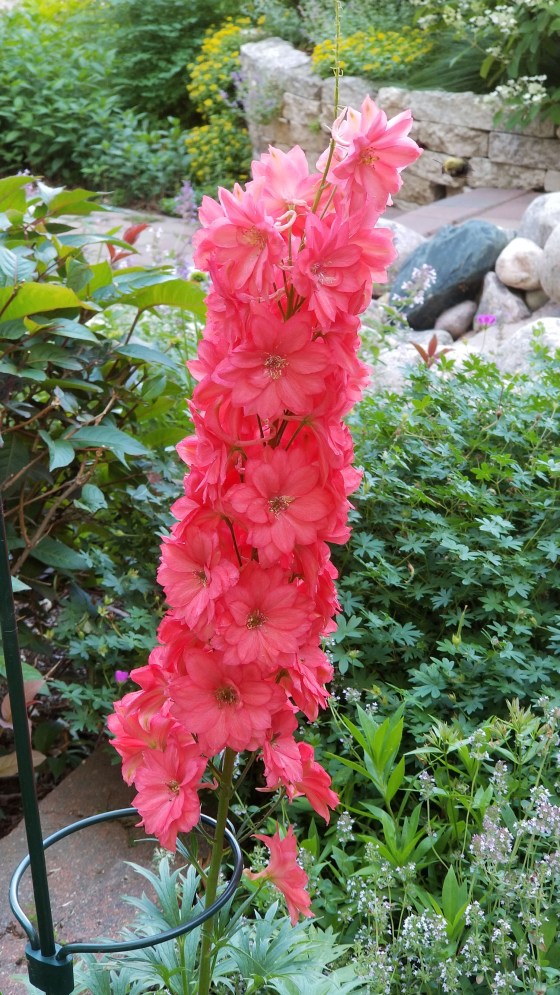
A Delphinium Red Lark in early July 2023. (Colleen Zacharias photo)
“Unless we keep a dialogue going about the history of horticulture in Canada, the push for discovery and preservation of the works of past hybridizers will fade away,” she says.
You can read more about Manitoba hybridizer Ed Robinson and see a rare photo of Legros here.
But an extra word about Red Lark Delphinium: it is a sterile hybrid that will not reseed in the garden. It has a one-to-two-year lifespan and is listed as hardy to Zone 5a.
Despite its lack of cold hardiness, local gardeners have been eager to grow Red Lark as an annual because it has incredible first-year flower power. And then there is that startling, extraordinary coral-red colour that few other flowers in the garden exhibit.
Gardeners like me who planted Red Lark last year will be checking this spring to see if it made through the winter. Given the flimsy snow blanket this winter, I’m not optimistic — but I do plan to plant Red Lark again.
A leafy space for garden clubs
Calling all garden clubs and hort societies! Bookings for small events (up to 60 people) are now available in the lush tropical greenhouse at St. Mary’s Nursery & Garden Centre, 2901 St. Mary’s Rd.
To inquire about rates and availability, email Carla Hrycyna, co-owner of St. Mary’s Nursery, at carla.hrycyna@stmarysnursery.com or phone 204-255-7353.
Flower-farming job
Are you looking to try out flower farming this summer? Marianne Bergmann, owner of Garden Path Flowers on Highway 75 has part-time positions open for morning or evening shifts. This short-term outdoor adventure starts in June and ends in October. Duties include planting, seeding, weeding, garden maintenance, harvesting, processing, bunching, labelling, etc.
Interested applicants can send inquiries to marianne@thegardenpathflowers.com.

Garden Path Flowers flower farm (Marianne Bergmann photo)
New shop-and-go flower bar opens at Oakridge Garden Centre
The indoor experience at Oakridge Garden Centre in Steinbach now includes a newly opened Flower Bar. Located in Oakridge’s tropical house, which is heated all winter, the Flower Bar will offer a selection of curated grab-and-go hand-tied flower bouquets.
“We want to make it easy for our customers to find everything they need and to see what’s fresh and new in cut flowers,” says Monika Carriere, Oakridge’s new floral designer. “We’re not the place for a dozen roses with baby’s-breath! Each week we bring in different small-batch bouquets of flowers. Neutral colours with blush tones are very popular and so are purples with dark reds. There is a lot of interest, too, in white flowers.”
When you take home your bouquet, leave the tie on, shorten the flower stems as needed to fit your vase, and you are good to go, says Carriere.

Monika Carriere, floral designer for new Flower Bar at Oakridge Garden Centre (Nicole Carson photo)
MARK YOUR CALENDARS
Winnipeg Seedy Saturday, in partnership with the Millennium Library and Spence Neighbourhood Association, will host its annual event on March 9 from 10:30 a.m. to 3:30 p.m. at the Millennium Library, 251 Donald Street. Admission is free.
On March 13, Charleswood Garden Club presents award-winning nature and landscape photographer, Hans Arnold, on how to photograph flowers and trees using your iPhone. Doors open at 7 p.m. at 5006 Roblin Blvd. Admission is free.
On March 14, join Michael Benarroch, University of Manitoba president, in conversation with Dr. Julienne Stroeve as they speak candidly about climate change. 6 to 9 p.m. Room 343 at the Drake Centre, 181 Freedman Crescent, Fort Garry Campus. Admission is free. To reserve your spot, RSVP by March 8.
On March 15 to 17, the Manitoba Orchid Society presents its annual show and sale. Featuring beautiful displays of hundreds of orchids, this is an opportunity to admire and buy rare and unusual live orchid plants. Experts will be on hand to answer all your orchid questions. Breezy Bend Country Club, 7620 Roblin Blvd., Headingley. Friday noon to 4:30 p.m., Saturday and Sunday 9 a.m. to 4:30 p.m. Admission is $10, children under 14 free.
On March 18, the Herb Society of Manitoba hosts a presentation on Horticultural Therapy by Melissa Scouten at the Canadian Mennonite University, South Campus, Conference Room A01, 600 Shaftesbury Blvd. (south of Grant). 7 to 8:30 p.m. Admission is $5.
On March 20, the Transcona Garden Club hosts Linda Dietrick for a presentation on Gardening in the Shade. 7 to 9p.m., 328 Whittier Ave. West, Transcona.
On March 23, the Manitoba Master Gardener Association presents a Zoom webinar event “Growing Under Cover” featuring Niki Jabbour, award-winning Canadian author and veggie gardening guru. Learn tips and techniques to help you extend your gardening season. 11:00 a.m. to 12:30 p.m. Registration is $15.00. Visit www.mgmanitoba.com.
On April 6, the Manitoba Giant Growers Association will host a seminar about the intricacies of growing giant pumpkins. 1 to 3 p.m. at the Microtel Inn and Suites, 5100 Crescent Rd. West, Portage la Prairie. For further information contact Art Cameron at artcam@mymts.net.
On April 6, the 37th Annual Gardening Saturday takes place from 7:45 a.m. to 4:15 p.m. at the Alerus Center, 1200 42nd South, in Grand Forks, N.D. Free parking. Registration fee is US$50 and includes lunch and breaks. Preregistration for workshops and keynote presentations is required. Register online at gardeningsaturday.info. Registration closes at 5 p.m. on March 14.
On April 7, the Ontario Regional Lily Society will host a Zoom speaker session featuring Judith Freeman who will answer your lily questions. Send your questions and register at membership@ontariolilysociety.ca.
|