Can you identify this plant?
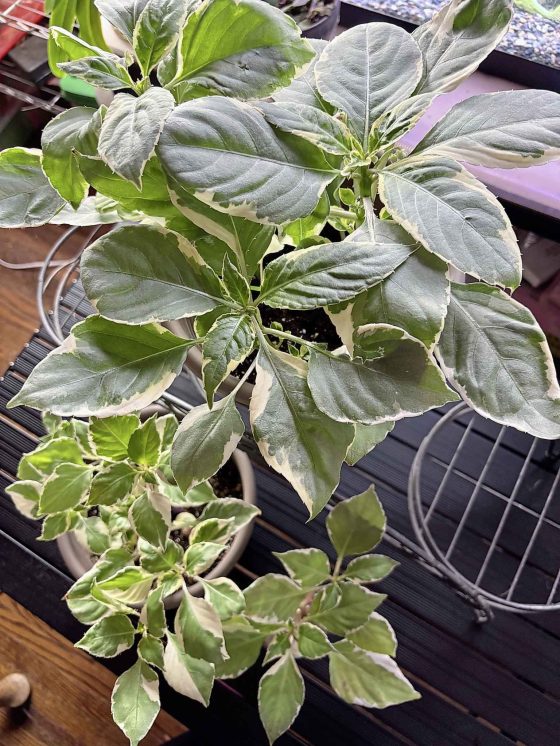
Can you name this plant? (Linda Wall photo)
The answer is at the end of this newsletter.
Rabbit damage
Recently I snapped a photo of a severely damaged hydrangea tree form in a St. Vital front yard. It had only been planted last year. The homeowner took care to wrap the trunk last fall to prevent rabbits from girdling the tree or stripping the bark during winter.
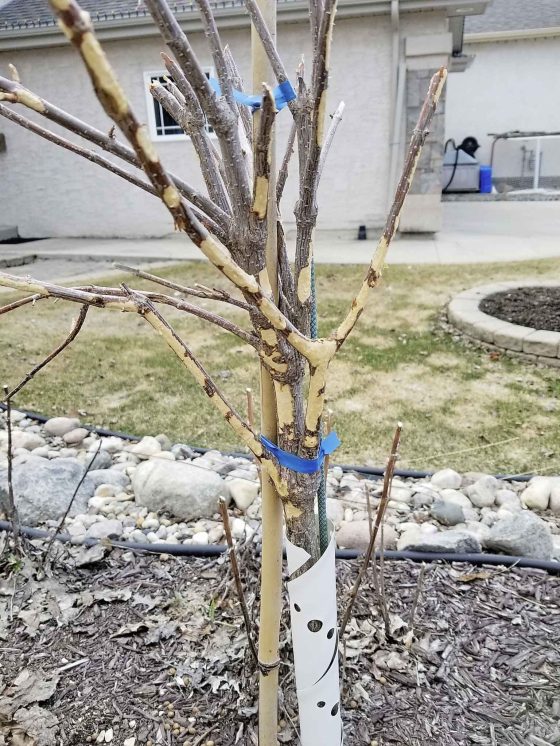
This Hydrangea tree form suffered from damage and stripped bark thanks to rabbits. (Colleen Zacharias photo)
As snow accumulated around the small tree, however, rabbits gained easy access to the unprotected branches of the tree canopy. From close observation, I could see the majority of the branches were stripped of most of their bark, but mostly on just one side of the branches.
Hydrangea shrubs and tree forms are highly susceptible to winter damage by rabbits and voles.
If any of your hydrangea tree forms or shrubs suffered similar damage, check to see if the damage extends to the circumference of the injured branch. If the damage is all the way around, then the flow of nutrients in the branch will be cut off and the branch will die. But if the damage is restricted to one side, there is hope.
I reached out to Joel Kosa, a Winnipeg-based ISA certified arborist and owner of Boreal Tree Solutions, and asked him if he thought the hydrangea might recover and what he would recommend.
“The image of the hydrangea tree shows a significant amount of wounding,” said Kosa. He directed my attention to the blue tape that is just above the white tree wrap.
“To the left of the tape there is a branch and then there is the central leader and on the right of the tape, there is another branch. It appears that it is the branch on the left and the branch on the right where there is the most damage,” said Kosa.
“The main leader is not as severely damaged. There are two ways to go about this. Being patient and waiting to see if there are signs of growth is a great option. So long as the damage is not on all sides of the branch, in which case the damage is too severe, then it might be worthwhile to prune off one of the branches.
“Every time a branch is pruned and removed — especially at this time of year when a tree has stored up all its energy and it is ready to start growing — it causes a little bit of stress in the tree, and it is then going to try and spur on some new growth to compensate for that loss.
“If the homeowner were to remove one of those damaged branches, that could spur on some other suckering growth throughout the canopy. It’s a bit of a last-chance effort. Removing the tree and replanting is an immediate solution when there is severe damage, but pruning and waiting to see if the tree will survive is also an option.”
Whether the hydrangea tree survives and thrives or if the homeowner ends up replacing it with another hydrangea tree, Kosa recommends placing a ring of hardware cloth fencing around the tree in late fall, extending it from the ground to the top of the tree.
A better shade garden
Are you looking to create more impact in your shade garden this year? Shady plantings can be made more interesting by combining substantial plants that have large leaves with finer textured plants. Contrast dark plants with plants that have golden or chartreuse foliage.
Another useful tool is to draw the eye upwards by adding the element of height with tall perennials or shrubs. Statuary or a tall container placed within a garden bed can also serve as a beautiful vertical focal point.
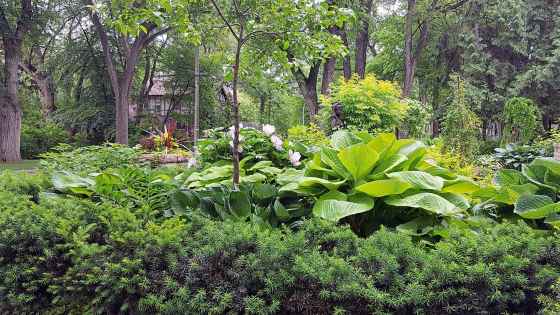
An example of design elements in a Winnipeg shade garden. (Colleen Zacharias photo)
Melva Widdicombe is a Winnipeg artist, dancer and costumer whose garden is a stunning example of shade plantings that combine beautiful texture and the elements of height and depth for visual interest.
Look closely and you will see a low border of clipped yew evergreen hedge (Taxus cuspidata Morden yew). Note that the inner layer has been planted with giant hostas. The eye is also drawn to pops of bright chartreuse colour and vertical elements, including statuary and shrubs that have been trained into small trees.
This spring, look for Hosta Shadowland Sound of Music and Hosta Shadowland Gigantosaurus, two new giant hostas for 2025. Both grow to a height of 76 cm and have an expansive width of more than 150 cm.

Giant hostas make a big impact, like this Hosta Shadowland Gigantosaurus. (Walters Gardens Inc.)
For brilliant colour that will brighten your shade garden, consider Aralia Sun King, a Zone-3-hardy foliage perennial that has heart-shaped chartreuse leaves and grows to a height and width of about 90 cm.

The Aralia Sun King (right) brings a pop of colour to the garden. (Colleen Zacharias photo)
Geranium Solera containers
My April 26 column featured geraniums, including Interspecific Geranium Solera, which is new for 2025.
A cross between an ivy geranium and a zonal geranium, Solera has large double-flowered umbels that bloom all summer long, even during the hottest periods. Solera comes in a range of colours and is suitable for containers or hanging baskets.
Here are two recipes that feature Geranium Solera:
For a hanging basket, combine Geranium Solera with new Coleus FlameThrower Adobo Pink and add Lysimachia Goldilocks as the trailer.

This hanging basket features the Geranium Solera Coleus FlameThrower Adobo Pink Lysimachia Goldilock. (Ball Horticultural)
For a patio pot, combine Geranium Solera with Bacopa MegaCopa White with new Lobelia Heatopia Dark Blue and Ipomoea Spotlight Lime Heart sweet potato vine.
Geranium Solera containers, including Interspecific Geranium Solera, which is new for 2025.
A cross between an ivy geranium and a zonal geranium, Solera has large double-flowered umbels that bloom all summer long, even during the hottest periods. Solera comes in a range of colours and is suitable for containers or hanging baskets.

This patio planter shows off the Bacopa Mega Copa White Lobelia Heatopia Dark Blue Ipomoea Spotlight Lime Heart. (Ball Horticultural)
Under-tree plantings
I was recently asked for advice on what to do about dry soil in a shade bed under trees. The gardener said it was a challenge to provide enough moisture for the plants growing in her shade bed.
Large trees compete with plants for both moisture and nutrients. Indeed, plants that grow beneath the shady canopy of large trees can be left struggling for moisture even when it rains.
Broad, leafy canopies capture rain on leaves and stems, and some of that rain evaporates back into the atmosphere before it ever reaches the ground.
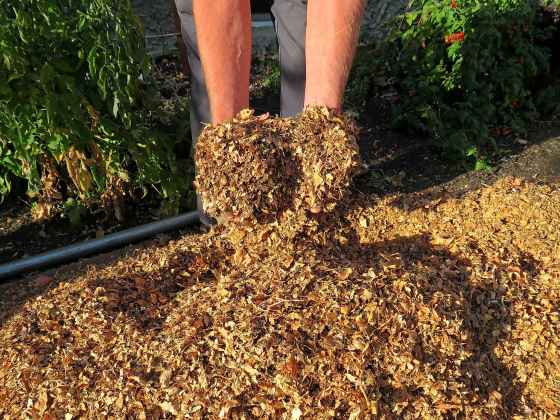
Not enough can be said about the importance of mulch. (Colleen Zacharias photo)
Here are a few solutions for enhancing moisture retention for garden plants in dry soil.
- Use a soil moisture probe or small trowel to check the soil moisture. A screwdriver works, too. When the soil is dry 5 to 7 cm below the surface, it is time to water.
- Avoid frequent, shallow waterings. A deep watering once a week during the active growing season is more efficient at delivering moisture to where it is needed — the root zone of plants.
- To water deeply, lay a hose near the dripline of the tree that shades your garden bed; that’s the area beneath the outer edge of the tree’s branches. The rule of thumb is to allow water to trickle slowly into the ground to a depth of at least 15 cm. Again, use a soil probe or a long screwdriver to check. My usual method for slow watering is to let the hose trickle for at least a couple of hours. Move the hose to a couple of different areas of the dripline to ensure even distribution.
- Mulch, mulch, mulch. Not enough can be said about the importance of mulch. Moisture evaporates quickly from bare soil. Mulch improves drainage and assists in retaining moisture. Organic mulch includes wood chips, straw or shredded leaves. Apply a 5 to 7 cm layer of organic wood mulch to the soil surface. The smaller the surface area of the wood mulch that you use — shredded is ideal — the quicker the mulch will decompose over time and feed your soil. Top it up each year with a 3.8 cm layer of fresh wood mulch.
Test your soil
Dmitri Ermak is the laboratory operational manager at Farmers Edge Laboratories on Dugald Road, which provides science-based soil testing services to farmers and homeowners. Ermak, who is a graduate of the University of Winnipeg, has a background in biochemistry and biotechnology.
I asked Ermak why it is a good idea to do a soil test.
“First of all, what we see based on the data and tests we conducted in the last couple of years on residential gardens and lawns, is overapplication of fertilizer,” said Ermak. “We found that the levels of certain elements were extremely high, especially phosphorus. And all of it probably comes from incorrect applications of manure or compost.
“As you know, phosphorus leaches down into the soil where it reaches the groundwater and lakes such as Lake Winnipeg and results in booming populations of algal blooms.”
At this point in our conversation, I admit to feeling somewhat astonished. Why? Because it’s easy to assume that as gardeners, we feel we are doing something good when we use an organic fertilizer such as compost or manure.
But elevated levels of phosphorus are not the only risk when we use too much compost. “Too much potassium, as well, results from excessive applications of compost or manure,” said Ermak.
As for additions of crushed eggshells to the soil, these too can pose a problem for optimum nutrient balances.
“Many homeowners believe that crushed eggshells are good for adding calcium to the soil but in Manitoba, there is already a lot of calcium in the soil,” said Ermak. “We have calcareous soil here. You don’t need to apply eggshells for more calcium.”
Then there is the use of Epsom salt in the garden to add magnesium to the soil. “But if all those elements you are adding to the soil — phosphorus, potassium, calcium, magnesium — are not in equilibrium, they can impact the nutrient uptake of other elements in the soil. It’s important to have a balanced approach to soil nutrients.
Ermack says he often sees a deficiency in nitrogen in tested soil samples. High levels of salinity in compost or nitrogen can also adversely affect the healthy growth of plants. “If you aren’t sure of the origins of the compost or manure you are using, it is better to test it before you apply it,” he says.
Applications of well-rotted manure or aged compost are a good thing for the soil, said Ermak, but support its application with good data.
“A soil test will not tell you everything about your garden soil, but it is a very good start and is a sustainable and responsible step towards the environment. At the same time, you spend less money on fertilizer.”
To test your garden soil, start by following these steps:
- Collect several samples at a depth ranging from the surface to 15 cm from several areas of your garden or lawn.
- Mix the samples together in a clean container or bucket.
- Take about 450 grams into a plastic bag. Label the bag with your name and address.
- Ship the sample to Farmers Edge Laboratories with the submission form, which is available online, or drop it off in person. The cost is $41 plus tax.
Organic weed control
Remember all the rain that gardens received last spring? Everything grew in leaps and bounds, especially weeds in lawns.
Weeds are unsightly and they compete aggressively with turf grass for light, nutrients and water. But keep in mind that turf is also habitat for many beneficial pollinators. Do you really want to spray that lawn with chemicals or is there a viable organic option for weed control?
Recently I chatted on the phone with Sheldon Gesell, a soil scientist and owner of Dirt n’ Grow, a family-owned business based in Stonewall that manufactures the popular Evolve product line of organic fertilizers in Manitoba.
Gesell worked as an agronomist for more than 20 years and recommended chemicals, herbicides, and synthetic fertilizers to farmers. He realized that a better way was needed and began developing organic alternatives.
“First,” says Gesell, “understand how a chemical-based product works on weeds and why you need to spray three or five times a year in order to get 80 per cent control at best. The way the chemical works is that it needs an active leaf growing surface with which to come into contact. The chemical moves within the plant from the roots upwards.

Evolve Corn Gluten Lawn Fertilizer is recommended to prevent weed growth and feed your lawn at the same time. (Evolve Dirt n’ Grow)
“Because there is the need for the herbicide to come into contact with the leaf surface, there are multiple flushes of seeds sitting in the ground waiting for optimal soil temperature and optimal sunlight. So, in a three-spray program, a weed control service typically sprays weeds in May and comes back in July to spray again. Well, those seeds that didn’t get sprayed or happen to blow into your yard and don’t have a leaf will emerge by the end of May and produce a viable plant and then the cycle is repeated in June as more weed seeds germinate.
“The second spraying in July sets the weeds back but only by 20 percent and another application is required. You are never going to get ahead by spraying because you are going to have multiple flushes of seeds.”
Gesell recommends Evolve Corn Gluten Lawn Fertilizer to prevent weed growth and feed your lawn at the same time.
“The way that corn gluten works is that it does not allow weed seeds to produce a viable plant,” says Gesell. “Once you have built up a residual with one or two applications, corn gluten also prevents weed seeds that blow into your yard from producing a viable plant. At the same time, corn gluten acts as a fertilizer. You are essentially putting on gluten but you are also adding nitrogen. Evolve Corn Gluten also includes kelp and clay buster, two ingredients that will make your ground nice and soft instead of rock-hard clay and gives you a lush green lawn. It increases the porosity in your soil.”
That said, corn gluten needs to be applied now — in early spring — if it is to be effective, says Gesell. “Because if corn gluten is applied after dandelion fluff has had a chance to seed and establish itself as a weed with a primary root and a primary shoot, corn gluten does nothing, it actually fertilizes the weed!”
Gesell admits that this discourages people — but that is why it is important to apply corn gluten to your lawn now. “Because not until the second application will you have maximum 80 per cent control of those weed seeds.”
Evolve Corn Gluten is available in a pail or a 9 kg bag. Evolve Organic products are sold at garden centres throughout Manitoba.
DIY rain barrel
A couple of weeks ago, Winnipeg gardener George Nytepchuk moved all his tomato and hot pepper seedlings and overwintered geraniums into a small greenhouse purchased this spring.
At the same time, he set up his rain barrels so that he could start collecting rainwater at the first opportunity.
“You can buy a rain barrel at a big box store for $120 or $150 or more, but when you consider what we pay for a cubic metre of city water, you would have to fill up your rain barrels quite a bit to recoup what you are spending,” says Nytepchuk.
“I like repurposing things. There is a place in St. James — Canada Compound, 900 Bradford Street — that caters to hunters and sells meat mixers, extruders, and everything you need for curing, smoking and sausage-making. The warehouse is so aromatic!
“On my visit, I was shown huge barrels for holding sheep intestines and those were used for sausage casing. At the time, I was able to purchase two of the barrels for $10 each.
“I drilled a hole in each of the barrels and added spigots. I decided to purchase more barrels but by that time, there was a waiting list for the barrels, and they cost me more. Now I have four barrels which have a storage capacity of about 800 litres of rainwater.”
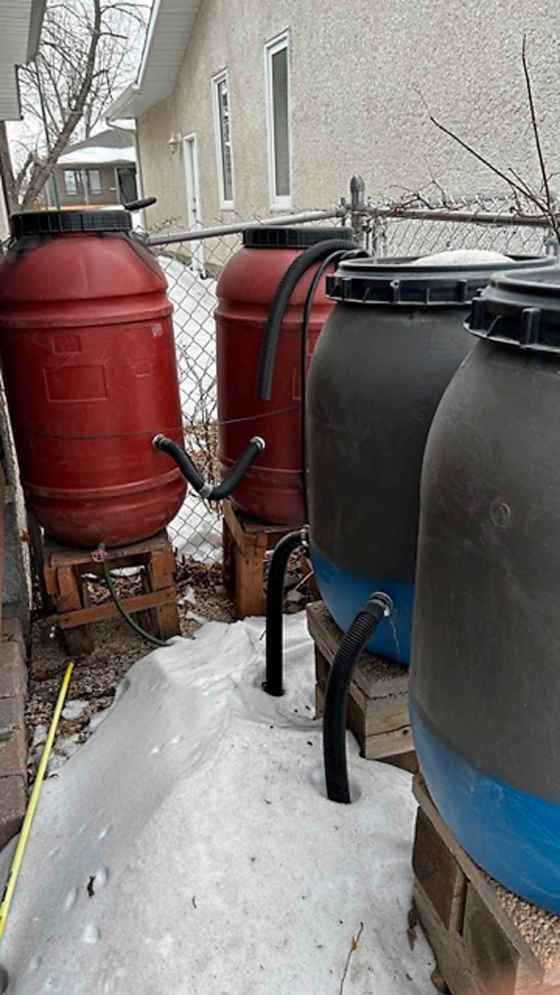
Winnipeg gardener George Nytepchuk’s repurposed rain barrels. (George Nytepchuk photo)
Nytepchuk has connected his multiple rain barrels in a line — like a daisy chain. “As one fills up, the overflow fills up the other three.”
Nytepchuk stores his rain barrels outside year-round because they have twist-off lids, which he uses as covers for the winter. In the fall, he empties the barrels and uses an old curling broom to clean them on the inside.
Since the first bit of rainwater that comes off the roof in the springtime contains dust and debris, Nytepchuk adds it to his compost bin. “After that, the water is cleaner. I like to use some of the water I collect for bird baths. I buy some splatter screens from a dollar store which I put under the downspout to screen out finer debris before adding the water to bird baths.”
Last year’s timely rains were instrumental in filling up Nytepchuk’s rain barrels so that he only needed to use city water twice to water his food garden. With a forecast for drought-like conditions this summer, rain barrels will be a very useful source of water.
Fun fact: when George Nytepchuk is not tending his numerous tomato and pepper plants, he is singing — not in the rain — but as an accomplished tenor and chorus member with the Manitoba Opera.
New books
They’ve done it again: that dynamic duo of Canadian authors, Janet Melrose and Sheryl Normandeau, have released another two new books in their popular ongoing series, Guides for the Prairie Gardener.
Staying Alive: The Go-to Guide for Houseplants and The Houseplanter: Your Go-To Growing Journal (TouchWood Editions, 2025) are both in hardcover format and under 200 pages each.
Staying Alive (fantastic title) shares information on all the basics of raising and caring for a diverse range of houseplants in a crisp, conversational Q-and-A format.
One of the questions the book poses is, “Should I consider using neem oil to get rid of houseplant pests? Is it legal to use in Canada?” This is a great question and the authors tackle this sticky issue with aplomb.

Staying Alive and The Houseplanter are available now. (Colleen Zacharias photo)
Neem oil was removed from the market by Health Canada in 2012, but unfortunately some usually reliable websites still recommend its use to Canadian gardeners for treating insect pests on houseplants.
What alternative products could you use? They’ve got that covered, too.
I would not have thought to put a houseplant journal on my must-have list, but Melrose and Normandeau have crafted one that makes it easy to record the essential facts and observations to keep your plant care on track. The Houseplanter also includes useful tips and tidbits of history, nomenclature, and folklore.
Staying Alive and The Houseplanter are available at Chapters and McNally Robinson for $24.
Coming soon: Dr. Diana Bizecki Robson, curator of botany at the Manitoba Museum, 190 Rupert Ave., conducts research on rare prairie plants and prairie pollination. She is currently working on a new Manitoba Flora publication to share her research and knowledge on the diversity of plants in our province.
A.P. Stevenson award
On Sunday, April 27, the Manitoba Horticultural Society presented the 2025 A.P. Stevenson Memorial Commemorative Award to Rick Durand at a garden party event held by the MHA at the Meyers Norris Penny Exhibition Building in Portage la Prairie’s Island Park.
The A.P. Stevenson Award, first given out in 1932, is the highest honour from the Manitoba Horticultural Association. It’s given to people who have made a significant impact on horticulture in Manitoba by developing, introducing, or propagating new plant varieties. The award was instituted in memory of Alexander Patterson Stevenson (1854-1922) of the Pine Grove Nursery in Morden, known as the “Apple King.”
Rick Durand, a tree researcher and breeder of prairie-hardy plants, grew up in Dauphin. He has been involved in the introduction of more than 50 cultivars including Discovery Elm, Silver Cloud Silver Maple, Gladiator Rosybloom Crabapple, Amber Jubilee Ninebark and Top Gun Bur Oak.

Rick Durand is the recipient of the 2025 A.P. Stevenson Commemorative Award. From left, Hugh Skinner, Rick Durand, Wilbert Ronald. (Teresa Lopata photo)
A former research and development manager at Jeffries Nurseries in Portage la Prairie and plant development coordinator at Bylands Nurseries in Kelowna, Durand has also served as project leader of the Western Nursery Growers Group. Today, Durand continues his plant breeding journey with several new future plant introductions that prairie gardeners can look forward to.
Congratulations, Rick!
A new compact clematis
Raymond Evison is the world’s foremost breeder of clematis, a genus of flowering vines. At The Royal Horticultural Society’s Chelsea Flower Show last year, visitors were wowed by the his company’s display, and Evison was awarded his 34th gold medal.
At this year’s show, Raymond Evison Clematis will debut Clematis Elpis, a stunning new compact (90-120 cm) clematis that has deep red flowers with golden anthers. It’s is hardy to Zone 4.
Will we see this new compact clematis on this side of the pond in the near future? It could happen.

Raymond Evison shows off his compact Clematis Elpis. (Plantipp photo)
Consider, for example, that at the 2018 RHS Chelsea Flower Show, Hydrangea Runaway Bride was a runaway sensation. This spring, we’ll see this unique cascading hydrangea at select garden centres, albeit by a different name — Fairytrail Bride Cascade Hydrangea.
Fairytrail Bride Cascade is a Zone 5a hydrangea that has white lacecap blooms. This elegant hydrangea is meant to be grown as an annual in a patio pot or hanging basket.

The Fairytrail Bride Cascade Hydrangea is a hit for patio pots or hanging baskets. (Proven Winners)
Also making its debut at the 2025 RHS Chelsea Flower Show is See You Tomorrow Daylily — but here’s where it gets exciting: it is also making its debut in Manitoba this spring. Jeffries Nurseries, a wholesale grower in Portage la Prairie, says it will only be available in very limited quantities at a select number of garden centres.
What makes See You Tomorrow Daylily so unusual is that it is the first ever daylily to produce flowers that last four to five days, rather than just a single day!
Bred in the Netherlands, the flowers of See You Tomorrow Daylily last up to a week in warmer climates such as California. Another unique feature of this breakthrough breeding is the colour transition from greenish yellow to golden yellow.

The See You Tomorrow Daylily’s colour transition. (ThinkPlants)
See You Tomorrow Daylily is available this spring at the garden centres — but hurry!
- Morden Nurseries, 12151 Rd. 24W Thornhill, Morden
- Sadler’s Creekside Greenhouse, 147 6 Ave. W., Souris
- Secord-Crowe Greenhouses, 725 Whitmore Ave. E., Dauphin
Monarchs and milkweed
In Canada, the Monarch butterfly was listed as an endangered species under the federal Species at Risk Act in December 2023.
The U.S. Fish and Wildlife Service has proposed listing the Monarch butterfly as a threatened species under the Endangered Species Act (ESA).
Currently, the USFWS is soliciting public input on the proposal through a comment period that was initially scheduled to end on March 12, but has been extended to May 19. It will be interesting to see what the ultimate decision by the USFWS will be.
Although Monarch butterflies drink nectar from a variety of flowers, Asclepias (commonly known as milkweed) is the only food eaten by Monarch caterpillars. The National Garden Bureau has designated 2025 as the Year of the Asclepias.
Local garden centres carry several varieties of milkweed in a range of sizes. If you would like to grow a compact milkweed that is native to Manitoba, Prairie Flora Greenhouse will have Dwarf Milkweed plugs available this spring.

Dwarf Milkweed is native to Manitoba. The National Garden Bureau has designated 2025 as the Year of the Asclepias. (Wikimedia Commons photo)
Most milkweeds grow to a height of one metre or more; however, Dwarf Milkweed, just 30 cm tall, is considered one of the most compact milkweeds.
“Dwarf Milkweed (Asclepias ovalifolia) is a beautiful, well-behaved plant in the garden,” says Aimee McDonald, co-owner of Prairie Flora.
“It has loads of ecological value! It is one of the earlier blooming milkweeds. Its strong fragrance attracts many different pollinators and because it produces vast amounts of nectar, it is of special value to native bees and enjoyed by the occasional hummingbird.
“Birds will enjoy the insects this plant attracts, and some will use its plant fibre and seedpod silk to construct their nests… just to name a few things!”
Plant Dwarf Milkweed in a sunny border in a location that has medium to moist soil.
Prairie Flora will be hosting plant sales at the following locations:
- Living Prairie Museum, 2795 Ness Ave. on Sunday, May 25 from 10 a.m. to 4 p.m.
- Mary Jane’s Cooking School, 252 Arlington St., on Saturday, May 24 from 10 a.m. to 3 p.m.
- South Winnipeg Community Centre, 666 Silverstone Ave., on Sunday, June 1 from noon to 3 p.m.
The road to RHS Garden Wisley
RHS Garden Wisley is home to one of the largest plant collections in the world. It’s making headlines these days, however, for difficulties in accessing the famous garden due to an extensive national highways road construction project which has led to significant visitor declines.
The Royal Horticultural Society reported earlier this year that 350,000 fewer people visited in 2024, resulting in financial losses of £6 million ($11 million) so far.
RHS says that the loss in income has significantly reduced funding for scientific research that is focused on finding nature-based solutions for environmental challenges.

The terraced rock gardens at RHS Garden Wisley. (Mick Manfield photo)
Mick Manfield is a local gardener who has been influenced by the beauty and learning spaces of RHS Garden Wisley from his early childhood. Prior to emigrating in 1999 from the U.K. to Canada, Manfield visited the garden countless times.
“I would accompany my father and grandfather, who were both avid gardeners who had allotments and greenhouses,” says Manfield.
In the late 1990s, after serving with the British Army, Manfield volunteered at Wisley and had the opportunity to volunteer at the 1999 RHS Chelsea Flower Show.
“After settling in Canada, I always made a point of visiting RHS Wisley whenever I visited the U.K.,” says Manfield, who today is a skilled square-foot gardener and a dedicated community volunteer. He gives many presentations about his overseas garden visits to local clubs and horticulture societies.
Manfield’s last visit to RHS Wisley was in 2023. “I was accompanied by my daughter Stephanie and her husband Dan, who saw the gardens for the first time.”
Manfield encountered some changes to the garden but was pleased to see that the two oldest gardens — the terraced rock garden and Canal with Loggia — were still there.
“We spent an hour in the gift shop where I bought some Japanese secateurs and my daughter and son-in-law purchased a mystery box of houseplants. These boxes contain a minimum of seven distressed houseplants and retail for £20 (approx. $40 Canadian). When we unboxed the plants at home, there were nine plants worth around $250. An absolute bargain!”
Manfield encourages anyone who is planning to visit the U.K. to visit one of the RHS gardens.
“My preference will always be RHS Wisley but there are four other RHS gardens — RHS Harlow Carr in Yorkshire, RHS Hyde Hall in Essex, RHS Rosemoor in Devon and their newest garden, RHS Bridgewater in Greater Manchester.”
Food waste drop-off update
Last October, the City of Winnipeg and Compost Winnipeg partnered to launch 15 food waste drop-off stations across the city.
The benefits of the program are threefold:
- All the organic waste brought to the drop-off stations is turned into compost.
- The amount of organic waste that ends up in the landfill and produces harmful emissions is dramatically reduced.
- Since the organic waste collected at the drop-off stations is composted at an industrial-scale composting facility that uses very high temperatures, the program can accept a much wider range of materials (see a list here in PDF format) than can be added to a backyard composter.
How much of a difference has the food waste drop-off program made in just six months since it was launched? No less than 155 tonnes of food waste have been composted, says Karrie Blackburn at Compost Winnipeg.
“According to a compost pilot study down by the City of Winnipeg,” says Blackburn, “we know that food waste produced from single-family dwellings is approximately 121,000 tonnes annually. If you look at that in the emissions context — the CO2e or carbon dioxide equivalent — that number translates to 109,000 tonnes.
“You may ask, what does that number even mean? I like to frame it in the context of the emissions of a typical passenger vehicle. Emissions in the amount of 109,000 tonnes is the equivalent of a car driving 474,000 km or 11 road trips around the globe.
“So, the amount of emissions from food waste going into one single landfill is quite significant. There is a lot we can do in our day-to-day lives to reduce landfill emissions and it is as simple as introducing a third waste stream into your daily life: organic waste that is separate from recyclables and the materials that can go into your backyard compost bin.”
With spring cleanup underway, many homeowners will be adding carbon-rich materials like dried leaves and woody debris along with nitrogen-rich materials like grass clippings and kitchen scraps to their backyard compost bins. When the finished compost is added to garden beds, it enhances the soil and provides nutrient-rich humus for plants.
But if we also take organic waste such as cooled bacon grease, pizza boxes, meat, fish and bones, or the remains of baked goods and desserts to the city’s food waste drop-off locations, we will be doing even more to keep methane-producing organic waste out of the landfill.
Compost Winnipeg and the City of Winnipeg are looking to expand the number of food waste drop-off stations, says Blackburn.
“We are in contact with community centres to see who would like to partner with us. Also, there have been requests by residents to expand the program to specific areas.”
If you would like a food waste drop off station expanded to a particular location or would like to share feedback, Blackburn invites you to contact 311 or email foodwastecollection@winnipeg.ca.
A map of current food waste drop-off stations is available on the city’s website.
Mark your calendars
The Can-West Iris Society is holding its 14th annual Iris Show on Sunday, June 8 at the South Transcona Community Centre, 124 Borden Ave., from 2 p.m. to 4 p.m. The event will feature beautiful iris displays and unique iris rhizomes will be available for purchase. Admission is free.
It’s annual plant sale season! Here’s a selection of upcoming sales:
- Beausejour Daylily Gardens: Saturday May 24, 9 a.m. to noon. A large assortment of hardy perennial plants, raspberry canes, and annual bedding plants will be available.
- East Kildonan Garden Club: Wednesday, May 28 at Holy Eucharist Parish Centre, 460 Munroe Ave., 6 p.m. Veggie seedlings, native plants, annuals and perennials.
- Selkirk District & Horticultural Society: Friday May 30, Selkirk Memorial Hall, 368 Jemima St., 6 p.m. to 8 p.m. Locally grown vegetable seedlings, succulents, perennials, annuals, houseplants, fruit shrubs, trees and more. There will also be a specialty plant table featuring horse chestnut seedlings and pollinator plants. All plants donated by SDHS members. Cash only. Free admission and free parking. There will also be a silent auction and a 50-50 draw. Wheelchair accessible.
- West Kildonan Hort Society: Saturday May 31, Seven Oaks Arboretum, 430 Partridge Ave., 10 a.m. to 2 p.m. A selection of tomato plants, well-established perennials including hosta plants from members’ gardens, herbs, a bake sale, and a gardening table with tools and books for sale.
Manitoba Master Gardener Association: Saturday, June 7, 9 a.m. to 2 p.m., Bronx Park Community Club, 720 Henderson Hwy. A wide variety of plants including herbs from Sage Garden Greenhouses and native prairie plants, vegetable seedlings and annuals.
What was that plant?
If you attended the Manitoba Horticultural Association’s first annual Garden Party held in Portage la Prairie on April 27, you may already know that the plant shown at the beginning of this newsletter is a unique Variegated Impatiens (Impatiens walleriana Variegata).
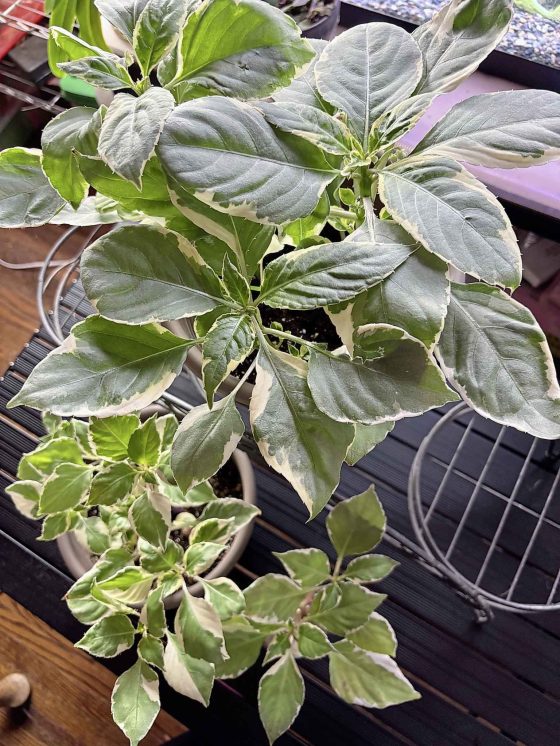
The answer is: Variegated Impatiens (Linda Wall photo)
Donated by MHA president Linda Wall, this lovely plant was one of the many prizes given out at the party.
Wall received a cutting several years ago from Judy Olmstead, president of Westman Gardeners in Brandon.
Olmstead was given the original plant cutting in 2011 by a woman whose garden she visited one year. Every year since, Olmstead has grown the variegated impatiens on a step on the north side of her house, where it receives morning sun.
“It gets to be a very large plant outside but loses leaves when I bring it indoors for the winter,” says Olmstead. “I also grow several slips indoors year-round just to make sure I always have some living stock and don’t lose the plant.”
The variegated impatiens has bloomed indoors some years. A bright sunny room provides adequate light.
As temperatures warm outside, both Wall and Olmstead gradually move their plants outdoors. No doubt, the winner at the MHS garden party will share cuttings with others and this unusual plant will continue to live on in many different parts of the province.
|