FIVE STORIES ON TURTLE ISLAND
The CFL’s Grey Cup championship game will be co-hosted for the very first time by Indigenous nations.
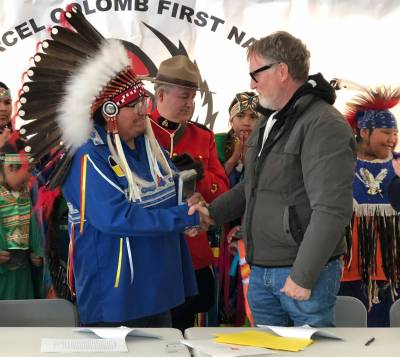
In a much-anticipated announcement this week, Winnipeg Football Club CEO and president Wade Miller announced an agreement with the Manitoba Métis Federation and seven Treaty One First Nations to co-sponsor and co-host the 112th Grey Cup and its related festival.
The partnership means that visitors to Grey Cup week in Winnipeg this November 10 to 16 will experience local Indigenous cultures, traditions and languages and witness Indigenous musicians, artisans, and contributions throughout all aspects of the festival. Dignitaries from both the MMF and Treaty One will be a part of the game’s opening ceremonies on Grey Cup Sunday.
“We’re proud of our football team, and as Red River Métis, we want to do our part to support the Blue Bombers,” said Manitoba Metis Federation President David Chartrand. “We’re not only a partner and financial supporter, but proud Manitobans.”
Millions of people will be watching and cheering their favorite U.S. college basketball team in the NCAA “March Madness” tournament — but fans of Haskell Indian Nations University had a particular reason to root for their underdog Fighting Lady Indians.
The team’s head coach, Adam Strom, was one of 40 employees laid off in early February as part of massive funding cuts by U.S. President Donald Trump’s administration and Elon Musk’s Department of Government Efficiency.
The layoffs led to lobbying, lawsuits, and demands by supporters of Haskell for the federal government to fulfill their legal obligations to fund the university and honour obligations to Indian tribes.
Despite the layoff, Strom stayed on as a volunteer coach and ended the season with a 13-13 record and a rare entry to the March NAIA tournament.
On March 14, the Lady Indians played in the first round against a powerhouse Dordt University squad and, despite a valiant effort, lost 95-80, ending their season.
But: just before that game, Strom learned that he was one of 15 Haskell employees who had been rehired.
Moments before Prime Minister Mark Carney dropped the writ to spark the 2025 federal election, Indigenous Services Minister Patty Hajdu announced the federal government would continue to fund the Jordan’s Principle program and support First Nations children through 2026.
The principle ensures that status Indian children receive health, social or educational services on par with Canadian children. It’s named after Jordan River Anderson, a young man from Norway House Cree Nation who died while waiting for governments to determine who would pay for the health supports he required.
In early 2025, Hajdu announced a pause in funding for the principle and a review of what qualified as “supports” under the program. With this resumption of funding, applications made in 2024-25 will still be considered for funding.
In another announcement just before dropping the writ, the federal government announced $11 million in funding for projects in 15 Indigenous communities in an effort to transition from powering their homes and infrastructure from diesel to clean, sustainable energy solutions.
Indigenous communities — mostly in the North — used nearly 700 million tonnes of diesel to fuel their energy needs, according to 2020 statistics. Relying on diesel costs six to 10 times more than other Canadians pay for energy. Diesel engines also produce up to 100 times more particle matter than gasoline engines and create environmental damage and health problems.
Funded through the federal Clean Energy for Rural and Remote Communities (CERRC) program, communities in Nunavut, the Northwest Territories, Ontario, British Columbia, Saskatchewan and Quebec will soon require fewer energy supports and subsidies as they convert to wood pellet-burning power systems, solar energy and apply efficiency upgrades to reduce energy costs.
Last month, York University in southern Ontario announced massive restructuring and an abrupt suspension of enrolment to their five-year old Indigenous Studies program. The move shocked faculty and students and effectively cancelled many of the university’s commitments to reconciliation and implementation of the Truth and Reconciliation Commission’s calls to action.
Also cut were the departments of Gender, Sexuality and Women’s Studies, Envionmental Biology, Jewish Studies, East Asian Studies and 15 other programs. Critics say the change comes as York university’s administration and salaries have increased.
Brock Pitawanakwat, coordinator of the Indigenous Studies program, questioned why the program, which had been experiencing record enrolments, was suddenly cut: “It’s not going to grow the university,” Pitawanakwat told media. “It’s not going to increase our reputation, and it’s certainly not going to lead to better outcomes for our students going forward.”
RECONCILI-ACTION OF THE WEEK
Every week I highlight an action, moment, or milestone forwarding reconciliation, illustrating how far Canada has come – and how far the country has yet to go.
This week’s reconciliaction goes to the inspiring students at École Guyot School in the Louis Riel School Division, who are writing local businesses asking them to use the new name for the former Bishop Grandin Boulevard: Abinooji Mikanah.
Their teacher tells me: “In our classroom, we are engaged in ongoing learning about truth and reconciliation, currently with a particular focus on the City of Winnipeg’s decision to rename Bishop Grandin Blvd to Abinojii Mikanah.
“As part of this continued learning, a small group of students prepared a letter to local businesses asking them to use the new name in their signage and in advertisements in your newspaper.”

Part of a letter École Guyot School students sent to local businesses. (Supplied)
In 2023, Winnipeg city council passed a motion to change the name of Bishop Grandin, named after one of the architects of Canada’s residential school system, to Abinojii Mikanah (a-bin-oh-jee mee-kin-ah), which means “Child’s Way/Road” in Anishinaabemowin/Ojibwe.
|