|
Is it too late to talk about The Odyssey?
I mean, I guess we’ve been talking about it in some form or another for millennia, but I’m referring to the blockbuster Christopher Nolan adaptation, which inspired both rapturous reviews and withering pans upon its July release.
Coincidentally, this year I read Madeline Miller’s Circe and The Song of Achilles, and watched Shakespeare in the Ruins’ production of An Iliad, so I was pretty steeped in Homeric lore by the time The Odyssey rolled around and that certainly shaped my reaction to the movie. (I have also read the poem, but it was a thousand years ago and all I really remember is a whole lotta wine-dark seas.)
What is notable about all these other adaptations is that they take the stories told by Homer in new directions, thereby sidestepping any accusations of lack of fealty to the text while pulling fresh observations or modern interpretations out of familiar mythology.
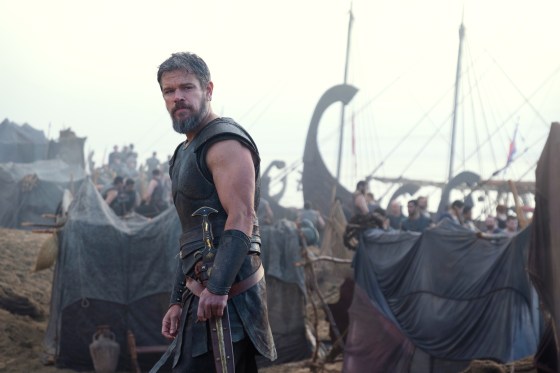
This image released by Universal Pictures shows Matt Damon as Odysseus in a scene from “The Odyssey.” (Melinda Sue Gordon/Universal Pictures via AP)
Of course, there’s nothing wrong with a straight retelling of The Odyssey, especially in glorious IMAX format. And I will say that I found it visually stunning; Nolan’s adherence to practical effects is both admirable and effective.
But it was also oddly … boring, I guess? No, not boring, but somehow tedious. Just one thing after another, with barely a pause to let a moment land or examine the fallout of an action.
I did not care about any of the characters — other than the Cyclops, portrayed to great sympathetic effect by actor/clown Bill Irwin (please enjoy his performance in the music video for Bobby McFerrin’s Don’t Worry Be Happy), who is blinded by Odysseus.
(There now is a whole cottage industry of memes and reels showing the poor, doomed Cyclops in happier times, braiding his sheep’s hair and enjoying placid swims in the Mediterranean; they are often far more touching than anything in the movie.)
Actually, scratch that: I also care about Circe, but the film spends so little time with her (the brilliant Samantha Morton), giving short shrift to her character (Nolan is notoriously just not interested in women) and also erasing her role as Odysseus’s lover.
We needn’t burden our too decent hero with unfaithfulness — unless he’s under the spell of the lotus flower.
Advertisement

When Odysseus returns home, he is greeted by his ancient hunting dog Argus who (yes, I’m spoiler-alerting a 2,000-year-old plot point) promptly dies upon seeing his former master.
My boyfriend, who loves catching me weeping at sappy moments, immediately looked over at me in the theatre, but I was dry-eyed.
To be fair, I knew it was coming because I know the story, but I also knew it was coming because it was telegraphed in the most ham-fisted, obvious way. I will allow myself to be manipulated, but I’m not going to cry about it.
However, what’s honestly most interesting to me about the ongoing discourse is that we are having it at all.
Any movie based on a beloved source material is going to inspire dialogue and criticism, but isn’t it kind of amazing that this ancient tale is still making people have big emotions, from the deeply dumb (racist takes on who can play Helen of Troy) to the informed and erudite (translator Emily Wilson’s takedown in the London Review of Books)?
It’s what I love about critical writing and why I continue to champion its inclusion in the pages of the Free Press.
The Odyssey can be approached from the perspective of a classicist or a revisionist, a Nolan fan or a Nolan foe, a film buff or a casual viewer. All responses are valid if we remain open to others’ ideas; it’s the conversation that matters.
|