|
There’s been a lot of talk this week, on the 25th anniversary of 9/11, about how the generation born long after Sept. 11, 2001, is sometimes confused about the tremendous weight it continues to hold in the public consciousness.
It’s very difficult to explain to people who do not and have never turned to network television for their news the iron grip this story had on us and the consistent way the information was presented. Yes, there were (and are) conspiracy theories about the event, but as soon as one network had an update, so did all the others. The talking heads were different, but they were all saying the same thing.
I was in Toronto for TIFF on 9/11, and I spent the day in a Bloor Street pub with my then-boyfriend and a friend, getting drunk and crying with strangers as we all watched the footage of the United Airlines plane flying into the South Tower, the buildings collapsing spectacularly to the ground, over and over and over on a nightmare loop on the bar televisions.
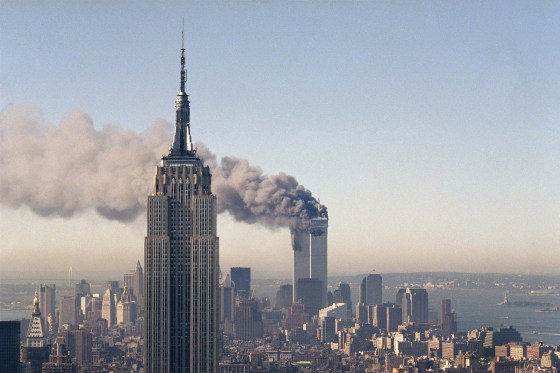
The twin towers of the World Trade Center burn behind the Empire State Building in New York after the terrorist attack on Sept. 11, 2001. (Marty Lederhandler / The Associated Press files)
In our newsroom, we’ve obviously been talking a lot about 9/11 this week — a lot of “where were you when”-style reminiscing, as well as remembering the different way news was covered then compared with now, the way the public relied so heavily on us to bring them information — and to keep information from them, gatekeeping the more horrific images. (See this brilliant Tom Junod Esquire story about the infamous “Falling Man” photo.)
It’s a shift I find endlessly fascinating. For example, Thursday was the one-year anniversary of the shooting of right-wing political activist Charlie Kirk.
In no way am I equating the two events, but it is notable that there were people in our newsroom — smart, informed people who follow the news for a living — who did not know who Kirk was until he was killed, despite his huge influence on the election of Donald Trump to a second term as U.S. president and his massive social media presence. But if they wanted to see full, unedited footage of his death, it was easy to find, instantly.
It’s a clear indication of the way our experience of the world has become increasingly siloed and driven by algorithms.
If you asked 100 Canadians today where they were when Kirk was killed, it’s quite likely a majority would not remember. The same cannot be said for, say, Princess Diana.
Even though the experience of Sept. 11 was traumatic, there was something comforting about the sense we were all in it together, even if what we were in was horrible and confusing and terrifying.
Advertisement

This was demonstrated in a lighter way this week by another newsroom conversation, this one about the fact that even The Young and the Restless has included a storyline about artificial intelligence. I am not a Y&R watcher; in fact, I have probably seen less than 30 minutes total of the long-running soap (I was a Days of Our Lives girl myself).
But if you say “Victor Newman,” I know you’re talking about the character played by Eric Braeden, who has married and remarried former stripper Nikki Reed multiple times on the show. He also cheated on her with Ashley Abbott, who has a brother named Jack with whom she runs Jabot Cosmetics.
This is not unusual knowledge for someone of my vintage (although frankly I wish it would leave my brain so I can perhaps remember the name of the person I am currently being introduced to). In fact, being able to share these facts is a sure sign I’m interacting with someone of my generation: this vast swath of common trivia, this shorthand of communication.
Increasingly over the past decade, I have received major concert announcements for musical acts I have never heard of, let alone heard. My usual reaction is, “Wow, this makes me feel old,” but maybe what I really mean is, “This makes me feel lonely.”
It’s really wonderful that everyone can find their niche — the music they love, the movies that thrill them, the communities that support them — so easily these days. But there’s something to be said for the erstwhile monolith of popular media, and I miss it a bit.
Speaking of things my algorithm feeds me a lot, I love this advice from Edmonton actor Nathan Fillion — gleaned from his time on All My Children — on how to act with your face during the long camera zooms on soap operas.
|