|
Janet MacKenzie was a nurse who helped many patients in the North, including passengers who survived a plane crash.
Janet, who was 78 when she died on May 7, was working in Gods Lake Narrows in 1972 when a plane carrying American fishermen crashed at the nearby Elk Island landing strip.
Janet, one of two nurses at the community’s nursing station, rushed to the site and began helping people until a medevac plane could arrive to take the injured for treatment in Winnipeg.
Advertisement

Her family says “she managed to apply medical aid as best she could as there were broken bones and burns to the passengers of the aircraft.
“Among her belongings, we found letters from the injured passengers that took great lengths to track down the nurse who provided assistance, thanking her for her critical emergency care as they believed their loved ones would not have made it without her immediate medical assistance.”
Janet was born in Morden and went to school in Minnedosa before she moved with her parents to Flin Flon and then Brandon where she finished high school.
She moved to Winnipeg to go to the then-Misericordia General Hospital’s School of Nursing, graduating in 1968.
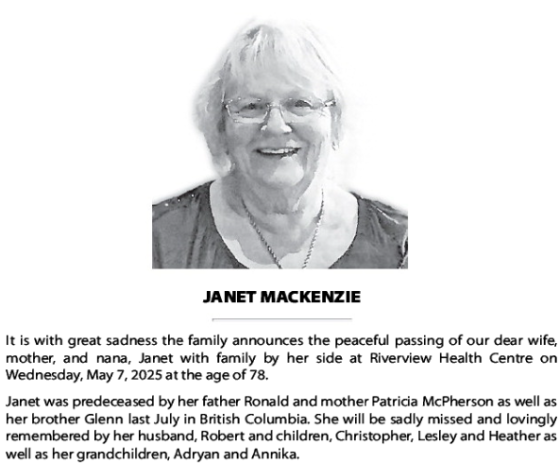
Her first nursing job was in Fisher River before she “made a bold move” to be part of a two-nurse nursing station in Aklavik in the Northwest Territories.
Not only did Janet treat people in the remote community, it’s also where she met her husband, Robert.
The couple married at her parents’ residence in Brandon in 1970, before flying to the United Kingdom for their honeymoon and to have a second marriage ceremony with his parents in Scotland.
When they returned, Robert took on a manager position with the Hudson’s Bay Company at Gods Lake Narrows while she worked as a nurse there, including on the fateful day of the plane crash.
Janet went on to work as a nurse in various positions in northern Manitoba and Saskatchewan before the couple moved to Winnipeg in the late 1970s.
In Winnipeg, Janet worked at various units in the Health Sciences Centre, including the spinal cord injuries department, lung transplant, and the burn care unit. She retired in 2010.
But Janet never forgot her decade working up North.
“Janet enjoyed the freedom and independence she found herself with making medical assessments and decisions with little resources and support,” her obituary said.
“Janet loved learning and applying her skills to treat those in need as well as sharing her knowledge with others in the communities she lived and worked in.”
Janet is survived by her husband, three children and two grandchildren.
Read more about Janet.
How They Lived
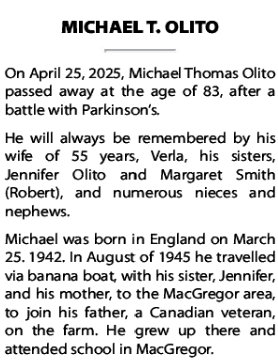
Michael Olito was a teacher first and an artist second.
Michael, who was 83 when he died on April 25, attended teachers’ college but after a few years in the classroom, he decided to go back to university and become an artist.
Michael had a one-man show at the Winnipeg Art Gallery, and through the years, his art included “flying” a wooden helicopter from the legislative building to the WAG, and building a ferry across the LaSalle River.
Read more about Michael.
Lillian Krutish was an artist who wasn’t afraid to push her art into people’s laps — including a prime minister.
Lillian, who died on May 6 at 87, studied art at the University of Manitoba.
She went on to work as an art illustrator at the Manitoba Museum.
Lillian made the news in 1968 when she suddenly put one of her paintings on then-prime minister Pierre Elliott Trudeau’s lap when he was driving a convertible.
Read more about Lillian.

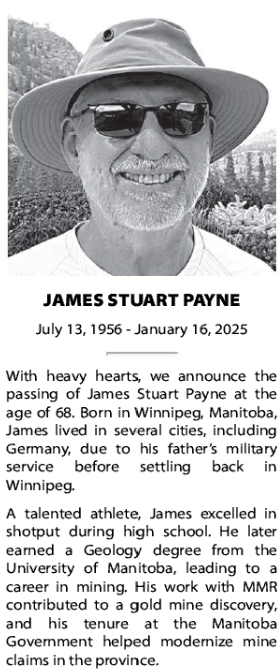
James Payne helped find a gold mine — but it didn’t make him rich.
James, who was 68 when he died on Jan. 16, spent his career in mining and helped find the mine while working for a drilling company.
He also helped modernize mine claims when he was with Manitoba Mineral Resources.
Read more about James.
Computers are everywhere now — even on our phones — but it wasn’t so long ago they weren’t.
Sylvia Chernichan, who died on Jan. 6 at the age of 90, worked as a data process operator at IBM, Canada Packers and the University of Winnipeg.
When Sylvia worked at IBM, she helped implement the first computer at the Canadian Wheat Board.
Read more about Sylvia.

A Life’s Story
Dr. Norman Goldberg not only treated children for their illnesses, he protected them from monsters.
That’s because Norman, who was 76 when he died earlier this year, was a pediatrician who came up with his signature “monster spray” which kids could use to fight back against monsters under their beds or in their closets. In reality, it was diluted mouthwash — but the kids didn’t know.

Norman Goldberg holding his infant grandson, Isaac, in 2010. (Supplied)
“He went above and beyond in his profession,” said his wife Marilyn. “Sometimes he’d visit people at home who couldn’t get out of the house for reasons related to health or poverty. He didn’t advertise or talk about it, but he’d stop by their house.”
Read more about Norman’s life here.
Until next time, I hope you continue to write your own life’s story.
|