Passages
Winnipeg Free Press Logo
 

On missing familiar faces

You know you’re getting older when you realize you have talked numerous times with four of the people staring out at you from our Passages pages.

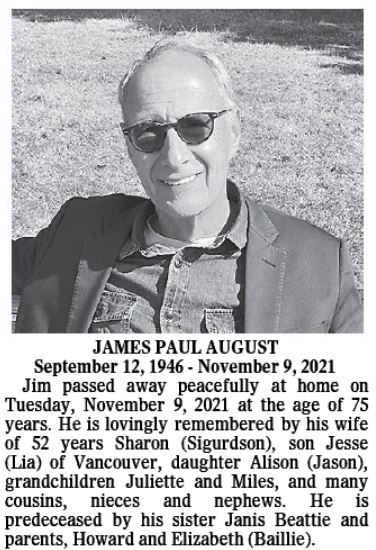
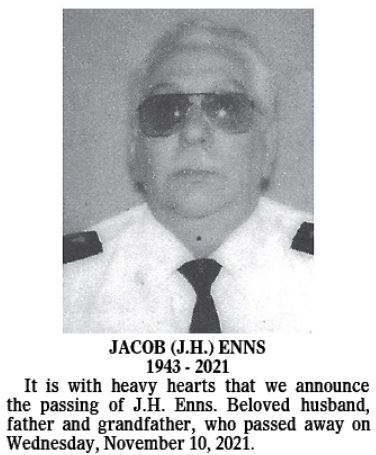
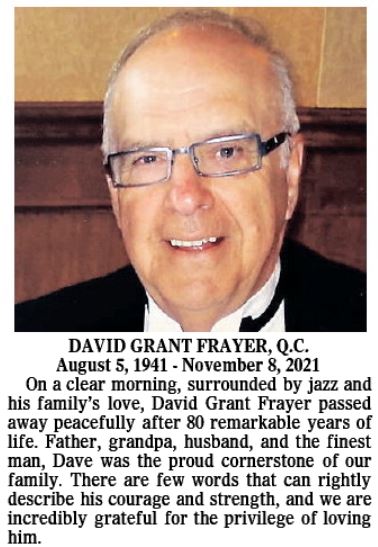
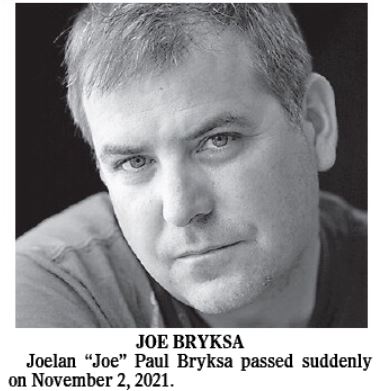
Along with the numerous obituaries in last Saturday’s obituary section, there were four that especially caught my eye and which left me sad: Jim August, Jake Enns, David Frayer, and Joe Bryksa. 

I first met August when I was the city hall reporter for the Winnipeg Sun way back in the mid-1980s and funding from the $400-million Winnipeg Core Area Initiative, which he headed, was preparing to knock down buildings on the north side of Portage Avenue to make way for what eventually became Portage Place, the multi-unit housing behind it, and the skywalk connections across the street. I also spoke with him many times in the years ahead with the purchase of the CN Rail yards, its conversion into what is now The Forks, and his work leading that site.

Advertisement

Jill Wilson Applause sent Thursdays A weekly look at what's happening in Winnipeg's arts and entertainment scene.


I found August to be honest, knowledgeable and extremely helpful to a rookie reporter recently transplanted here from Ontario — all qualities we ink-stained scribes value. Read more about Jim. 

It was also around the same era that I met Enns, who was director of emergency medical services. In other words, the head of the city’s ambulances. Once again, Enns was once again a person you could rely on to give you the facts about what was happening. One time, he was able to organize having a photographer and myself on an overnight tour of the city from an ambulance attendant’s point of view. It’s the fastest I’ve been able to go from one end of the city to the other. Read more about Jake. 

While I spoke to the first two early in my career, I spoke to Frayer many times through the years almost to the present day. I first met him when he was a federal prosecutor, prosecuting drug cases.

As a journalist covering the Law Courts beat, Frayer was invaluable for telling me in the morning whether what he was working on was worth me sticking around, or looking elsewhere for a story. Most of the time it was the latter, but there were other times I got great stories when he told me to stay.

Fast forward several years and Frayer was instrumental with me being honoured with a National Newspaper Award, the industry’s highest honour, for a feature I wrote on what was happening in the emergency room during the days Brian Sinclair went there for treatment and eventually died still sitting in his wheelchair in the waiting room expecting help which never came. I am forever grateful for David’s help in getting me the information I needed to make the story as successful as it was and to help bring change to procedures in emergency rooms across the province. Read more about David. 

And then there was Bryksa, an award winning photographer at the Free Press who I was paired with numerous times through two decades to cover stories.

A favourite of mine was the time we were able to get a story and photos of the flood fight at the former Breezy Point cottage community area north of Selkirk.

Perched perilously along the Red River, this community was on flood watch every spring when the ice broke and plugged up somewhere further downstream, quickly rising river levels and cutting off the only road into it.

On this particular day, the road was already underwater, with ice flows sweeping over it and by.

But did that stop Joe? Nope. He popped open the trunk and there were two sets of hip waders which we put on and gingerly began walking into the water. We could see, in a straight line several hundred metres in front of us the road emerge from the waters, but we still had to push away some errant ice flows.

That’s about when I noticed my hip waders had a slow leak in them. Joe looked over and grinned “why do you think I have two?” Read more about Joe. 

Mortality is different when you’re early in your career. The years ahead of you seem limitless with great possibilities in future.

But as the years go by, you realize whether it is musicians you first listened to decades ago, or movie or TV stars, or colleagues or interview subjects around you, people age.

It’s why you always have to value their time, their help, and their friendship when they are around you.

And that’s why I say once again, as I told them several times through the years, thank you Jim, Jake, David and Joe. You will all be missed. 


Kevin Rollason, Reporter


If you enjoy my newsletter, please consider forwarding it to others. They can sign up for free here.

The Free Press also offers other free newsletters you might enjoy. Dish sees arts writers Ben Sigurdson and Eva Wasney cover the latest in food and drink in the city, or sign up for Jill Wilson’s weekly Applause newsletter about the local arts and entertainment scene.

You can browse all of our newsletters here.


Advertisement

What's next in Manitoba arts, life and pop culture - curated by Jen Zoratti. Get the newsletter sent weekly.
 

How They Lived

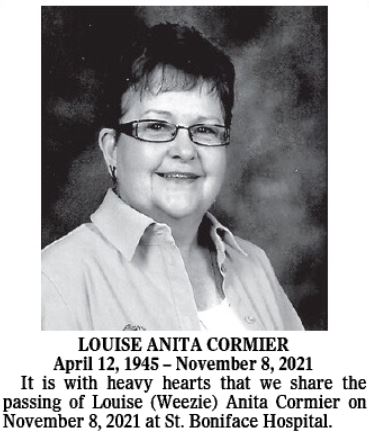
Louise Cormier helped treat many people during her career as a nurse.

Cormier, who was 76 when she died on Nov. 8, lived on a farm near La Salle before moving to Winnipeg and later becoming a LPN at St. Boniface Hospital.

But Cormier didn’t just help people at the bedside: she helped many people during the worst times of their lives. She was disaster manager at the Canadian Red Cross.

Cormier was honoured for her life’s work and caring with the Queen’s Jubilee medal in 2003 and the Distinguished Service Award in 2013. Read more about Louise.


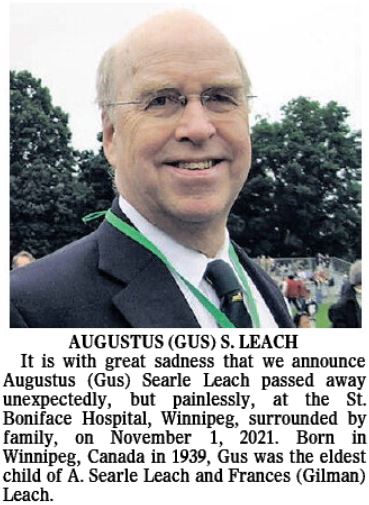
Gus Leach had a three-decade working career at Federal Industries, but people might know him more for what he did after work.

Leach, who died on Nov. 1 at 82, sat on the board of both the Winnipeg Art Gallery and the Manitoba Museum, becoming president of both organizations.

He also was on the board of directors of the Winnipeg Blue Bombers.

And Leach didn’t just help here. He also was a member of the board of the National Art Gallery in Ottawa. Read more about Gus. 


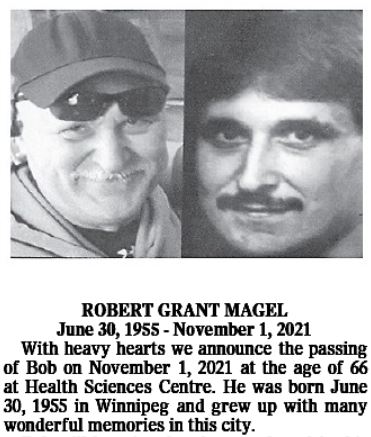
Bob Magel played basketball in high school and never graduated from the sport.

Magel, who died on Nov. 1 at 66, was a star in both high school and university. He played for the Spartans at Sisler High School and was on the undefeated team which won the provincial championship in 1972-73. That team was inducted into the MHSAA Hall of Fame in 2011.

Magel then went to the University of Winnipeg where he played with the Wesmen and won numerous honours including being selected as an all Canadian in 1979-80, and Wesmen Athlete of the Year.

And, after Magel stopped shooting hoops, he began a long career in officiating, becoming a well respected basketball official. Read more about Bob. 


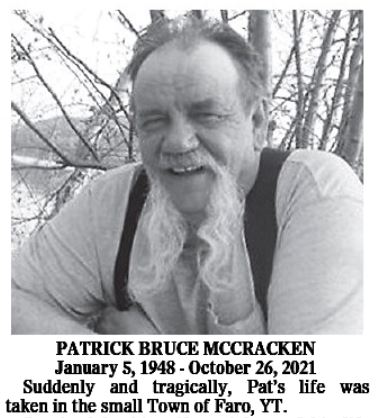
Pat McCracken’s hometown may have been Winnipeg, but his heart was in the north.

McCracken, who died on Oct. 26 at 73, went to the Yukon for a mining opportunity in 1975 and never left.

McCracken fell in love with the town of Faro and through the years he was town foreman and a town councillor, but also worked numerous jobs including mechanic, miner, and hunting guide.

Tragically, McCracken was one of three victims of a gunman in the community, and was one of the two who died. Read more about Pat. 


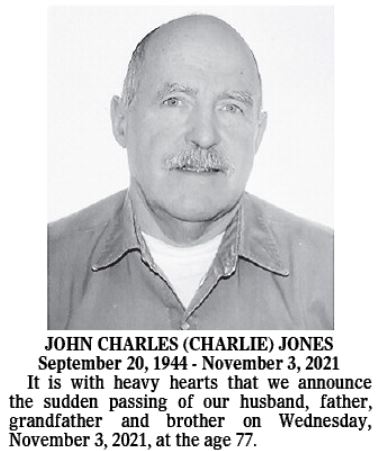
Charlie Jones fought in a war he didn’t have to.

Jones, who was 77 when he died on Nov. 3, was born in New Brunswick but joined the US Marine Corps when he was young and served in the Vietnam War.

Later, Jones came to Winnipeg with his family in the early 1970s and played both softball and and handball. He was so good at the former he was inducted into the Manitoba Softball Hall of Fame in 2013.

Jones also became known for his relentless pursuit of collecting aluminum pop can tabs so children living with disabilities could get wheelchairs. Read more about Charlie. 


A Life’s Story

Maria Lee might not have known exactly when she was born, but she lived a long life.

Lee, whose life was profiled by Geoff Kirbyson in our popular feature on the front page of a recent Passages section, was orphaned in the Soviet Union and was old enough to be taken by the German Army to a work camp during the Second World War.

Lee’s family says she survived mainly because she was fluent in five languages.
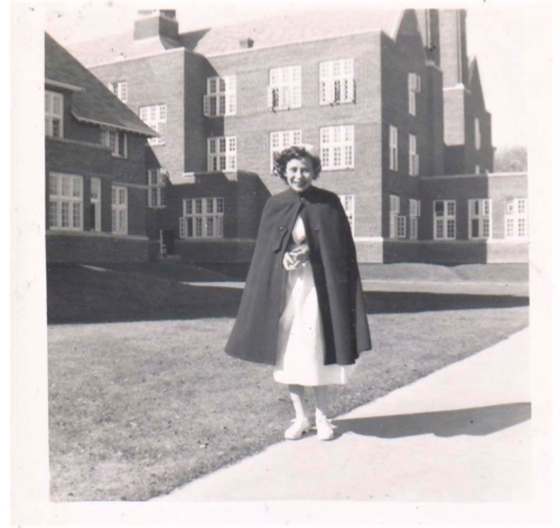
Maria Lee attended the School of Psychiatric Nursing at the Selkirk Mental Health Center. (Supplied)

Maria Lee attended the School of Psychiatric Nursing at the Selkirk Mental Health Center. (Supplied)

“That gave her an advantage,” said her daughter Michelle Lee. “She told us stories about sleeping on hay bales in barns. People were taken away from the barns constantly and disappeared, but she was never taken away.”

Lee, who died in August, never knew her exact age. Her birth date was chosen by Allied officers, after the labour camp was liberated, who looked at the survivors and arbitrarily came up with the date.

Lee later came to Selkirk, worked at the Selkirk Mental Health Centre, and married into the family which owned a local Chinese restaurant. Read more about Maria. 


I hope you continue to write your own life’s story.


Share:


Download our News Break app