|
Long before the “elbows-up era,” Canada had plenty of reasons to rethink how it spent federal taxpayers’ money on advertising.
The debate over the Online News Act — designed to have large digital platforms compensate news publishers for the use of their content — made abundantly clear how little tech overlords care about this country and how much of the advertising market they were hoovering up with the ongoing flex of monopolistic muscle.
They didn’t think they should be regulated. They assumed Canada couldn’t do without them. They believed the scope of their scale conferred impunity.
And when Ottawa wouldn’t budge, Meta announced in August 2023 that it would block news content on Facebook and Instagram in Canada.
That ban remains in place today; it’s why you can’t see or share Free Press articles on those platforms.
Given all that, did Ottawa make any adjustments to its advertising strategy?
Turns out, Meta raked in even more after unfriending news.
A new federal report on Ottawa’s advertising activities breaks down the degree to which U.S. digital platforms trump the spend on Canadian media properties.
Of the $64 million spent via Ottawa’s agency of record in fiscal year 2024-25, only $222,000 landed in Canadian newspapers.
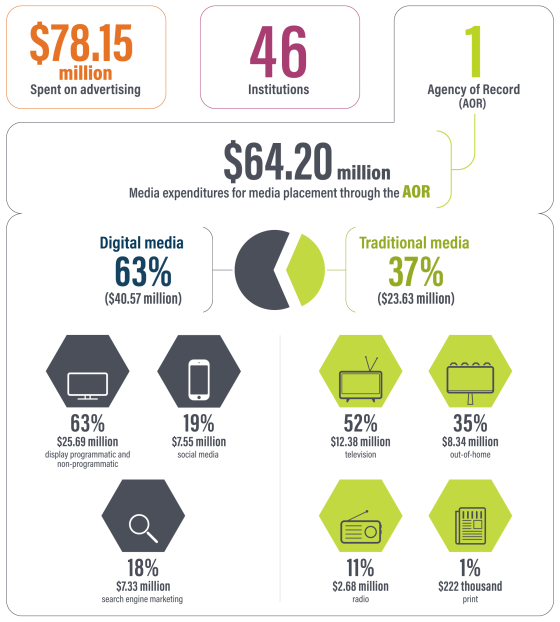
The federal government spent $7.55 million in advertising dollars on social media platforms in 2024/25 and just $222,000 in newspapers. (Report on Government of Canada advertising activities)
By comparison, social media spending alone saw $1.4 million flow to Meta, up from $476,271 the prior year.

The federal government spent $1.4 million advertising on Facebook and Instagram in 2024/25, up from $476,000 the previous year. (Report on Government of Canada advertising activities)

The federal government spent just $222,000 on print advertising across Canada in 2024/25, down from $1.3 million the previous year. (Report on Government of Canada advertising activities)
Each day, newspapers like the Free Press publish a perishable commodity known as news. Newspapers put accuracy ahead of engagement, a rather quaint notion given the realities of what’s driving profits in the digital space.
Moreover, news ain’t cheap to produce and it doesn’t “scale” in the way that made the likes of Mark Zuckerberg one of the richest men on the planet.
That’s why whatever share of the advertising pie newspapers receive is critical if the federal government wants Canadians to have trusted journalism in their communities.
That’s why it’s so puzzling Ottawa found ways to spend even less on newspapers while funneling more to news-blocking Meta.
That’s why reading this report left me feeling far from “elbows up” — and more like I just took an elbow to the head.
|