|
“Won’t someone please think of the children?”
— Helen Lovejoy, The Simpsons
The governing bodies of hockey have decided the female players in Manitoba should play less hockey. In whose interest was this decision made?
Advertisement

The Macro
It was with some concern that I read of the decision by Hockey Manitoba to end the practice of allowing top female hockey players to double-roster.
Prior to its decision, female hockey players in any level of youth hockey — including the upper tiers of AAA — could also suit up for teams in the Manitoba Women’s High School Hockey League. That practice has ended in part thanks to a decision initially by Hockey Winnipeg, which decided, after years of allowing the double rostering, to prohibit players from participating in sanctioned AAA teams and teams in “non-sanctioned leagues” like the MWHSHL.
OK — some important background will be needed to understand the administrative perversity of the situation.
“Sanctioned” hockey refers to teams playing in leagues that operate under the Hockey Canada banner. “Unsanctioned” refers to teams playing in leagues that are not affiliated with the national hockey governing organization.
Although most kids play hockey in affiliated leagues, rogue hockey organizations (most operating as private businesses) have sprung up over the years. For the most part, Hockey Canada has not sought to punish players in these leagues. But in 2023, it issued a new policy that banned any player in a non-sanctioned league from participating in “any sanctioned hockey team that competes for a national championship for the remainder of the season.”
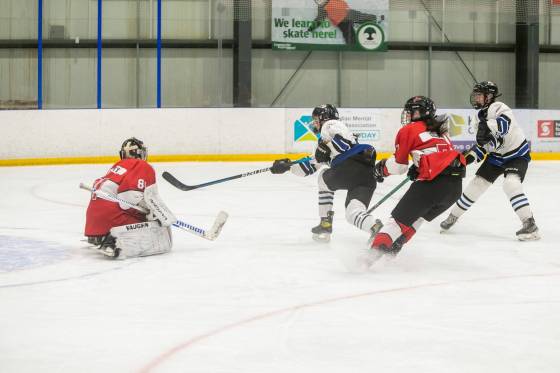
Six programs in the Manitoba Women’s High School Hockey League folded before the start of the 2026-27 season once the Hockey Manitoba U18 AAA ban took effect. (Brook Jones / Free Press files)
Hockey Winnipeg cited this policy when it tried to unilaterally ban female hockey players from rostering on both AAA teams and high school teams.
The policy only affected female hockey players because the MWHSHL has, for reasons that are not entirely clear, also operated as a non-sanctioned league. And because the boys’ Winnipeg High School Hockey League, which is sanctioned, has never allowed players to double-roster.
The result has been four women’s high school hockey programs — Westwood, Churchill, Warren and Léo-Rémillard — have ceased operations for this season and, perhaps, beyond. The new policy only affected 10 players currently rostered on AAA teams, but nearly two dozen other players on those affected teams have no school team to play for.
How is taking hockey away from any child a worthy cause?
I have gathered deep behind-the-scenes background as a journalist and as an on-ice official who worked both the regular minor hockey system and high school hockey.
Some observations:
Hockey Manitoba and Hockey Winnipeg claimed this change in policy was made in the interest of “team commitment, roster integrity,” and “player workload.” In other words, we’re doing this for the welfare of the players.
Translated: this is about ensuring the best hockey players remain solely in the traditional Hockey Canada-sanctioned youth system and aren’t tempted to leave to play in non-sanctioned leagues or non-sanctioned private hockey academies.
This administrative bullying really started years earlier, when the total number of hockey players was dropping and there was a fear minor hockey would become non-viable. Hockey Winnipeg in particular has always viewed high school hockey and academies as “competition” and does as much as it can to discourage players from choosing high school over AA or AAA.
This discouragement is often doled out by coaches and league officials who warn parents their budding NHL stars will never reach their true potential playing high school hockey. That is, of course, ridiculous, given the very best players in high school often go to play junior and university hockey.
Good AAA female players want to play for their schools as well because it’s a different type of hockey, with less intensity (at least until the latter stages of playoffs) and a schedule (early-morning practices, mid-afternoon games) that allows them time for school and other athletic pursuits. And because representing your school is a cool experience.
If Hockey Winnipeg is that worried about player workload, would they also seek to ban AAA players from participating on their school basketball and volleyball teams, the seasons for which directly overlap with hockey? And what of the AAA players who are good enough to make Team Manitoba and play in national competitions like the winter games? Is that too much hockey?
It all goes to reinforce a sad but true fact of hockey life: far too many of the people who run hockey are more concerned about protecting their organizations than they are about protecting players.
|