|
Good morning, folks.
I don’t recall the exact day — sometime in the fall of 1991. But I will always remember the call.
The voice on the other end of the line asked for Steve Lyons. He said he’d got my name and number from someone who told him I was the guy to talk to about all things CFL. To this day, I still think he phoned the wrong Steve.
Advertisement

The caller was Lonie Glieberman — at the time an early-20s kid from Detroit who loved the three-down game and was interested in finding out everything he could about the CFL. He told me he wanted to try to bring an expansion team to Michigan.
Say what?!
For a few months, Lonie would call me every day to talk football. We would talk for hours. He had followed the league his whole life and he wanted to be part of it. His father, Bernie, was a real estate mogul, and Lonie had his blessing to pursue an interest in the CFL.
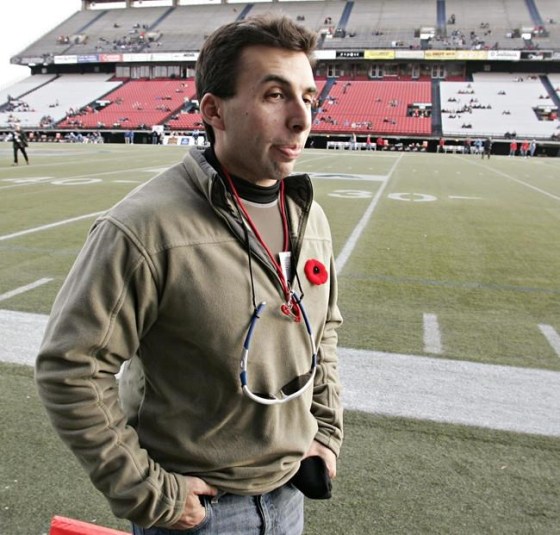
Ottawa Renegades president Lonie Glieberman stands on the sidelines prior to their final game of the season against the Toronto Argonauts in Ottawa Saturday Nov. 5, 2005. Glieberman is no longer the most loathed sports figure in Ottawa. Glieberman secured the crown for his unique management style as president of the Ottawa Rough Riders (1992-93) and then the Ottawa Renegades (2005-06). THE CANADIAN PRESS/Tom Hanson
With the U.S. expansion idea barely a mustard seed, Lonie decided if he couldn’t bring the CFL to Detroit, he’d come to the CFL. Later that year, the Gliebermans purchased the Ottawa Roughriders from the league for $1, along with assuming $1 million in debt. The league had been running the franchise — poorly, I might add — after the previous owners had bailed.
I won’t rehash here all the events of the Gliebermans’ first tenure as owners in the nation’s capital. Lots of us will recall the controversial signing of banned NFL player Dexter Manley, the firing of GM Dan Rambo, the attempt to hire Mike Ditka as coach and of course, the infamous X-rated Mardi Gras promotion.
Lonie took plenty of shots for his missteps: mostly he was labelled a spoiled rich kid, who didn’t know what he was doing.
But, I’ll tell you what — I chatted with him many, many times, and while his youthful exhuberance caused him to make a mistake here and there, the kid had some moxie. As proof, he later went on to develop Mount Bohemia, an extreme skiing desitination in Michigan’s Upper Peninsula on the shores of Lake Superior that consistently ranks near the top of polls for best ski resorts in the States.
And let’s keep in mind, the Gliebermans twice bailed out the Ottawa franchise when nobody else would. They also took over the Renegades in 2005, after a season in which the league had financed the team.
The early-90s were a wild time in the CFL. It was not only the Gliebermans — we also had Bruce McNall, Wayne Gretzky and John Candy in Toronto; Larry Ryckman in Calgary and Murray Pezim in B.C. There was no shortage of big ideas!
And the grandest one of all was the brainstorm to expand the league to America.
It was the summer of 1992, while I was in Ottawa to cover a game between the Rough Riders and the Bombers, Lonie invited me to his office to show me plans the CFL’s board of governors had come up with to take the league south of the border.
Still the best scoop on my resumé.
The seed had sprouted and in January of 1993, the league approved franchises in Sacramento and San Antonio by a vote of 7–1, with Winnipeg dissenting. Cal Murphy was not a fan of the idea.
The San Antonio franchise folded without ever playing a down when its owner ran out of money and was forced to withdraw.
In 1994, the Gold Miners were joined by three other American teams: the Las Vegas Posse, the Baltimore CFL Colts — later the Stallions — and the Shreveport Pirates, owned by the Gliebermans. Lonie was finally getting his U.S. expansion team.
The Memphis Mad Dogs were announced in November 1994, followed by the Birmingham Barracudas in January 1995.
The Baltimore Stallions, with Don Matthews as coach, Tracy Ham as QB and Mike Pringle in the backfield, became the only American-based team to win the Grey Cup championship in 1995.
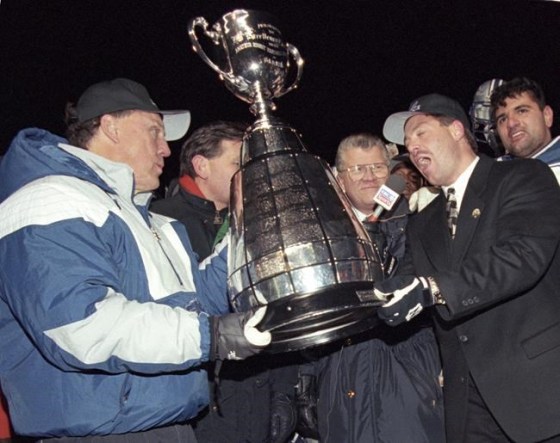
Baltimore Stallions’ Don Matthews and Jim Speros hold the Grey Cup after Baltimore beat the Calgary Stampeders 37-20 during the 83rd Grey Cup in Regina on Nov. 19, 1995. THE CANADIAN PRESS/Joe Bryksa
But on that somewhat high note, things started to unravel. There were many issues facing the expansion plan in 1995: internal bickering over rules; dwindling attendance in Canadian markets; little interest from U.S. football fans; McNall’s finances collapsing in the midst of revelations of financial wrongdoing; and then the death knell was when the NFL Cleveland Browns announced they were moving to Baltimore.
Against this backdrop, league meetings were held on Feb. 2, 1996 and all five remaining American franchises, including the Stallions, were formally shut down.
The end.
Or is it?
The subject of expansion to the USA came up again this week, when the CFL announced it had entered an alignment with the fledgling XFL.
The XFL is partly owned by entertainment megastar Dwayne (The Rock) Johnson, and Wednesday’s news certainly created some buzz for the CFL.
Commissioner Randy Ambrosie was of course effusive in his excitement about the alignment, saying this is exactly the type of thing that can help energize the league’s fan base.
I’d suggest some games this season would be the first and best step at this point to re-energizing the CFL’s fan base, but I’ll park my skepticism for a moment to see what — if anything — develops from this latest venture.
Hey, I loved every single storyline the ’90s produced, and while the league has a multitude of issues, some good old-fashioned glitz would defintely help, particularly in the Toronto and Vancouver markets.
The Rock is as glitzy as they get.
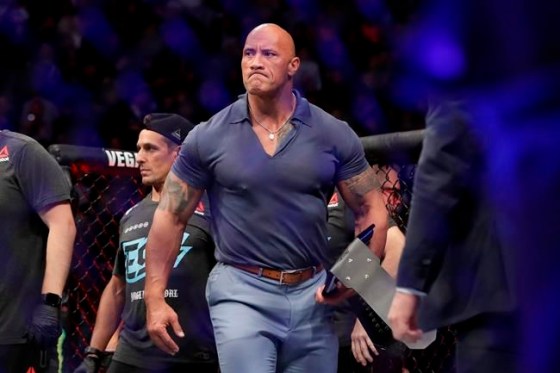
Dwayne (The Rock) Johnson reacts after a welterweight mixed martial arts bout between Nate Diaz and Jorge Masvidal at UFC 244 early Sunday, Nov. 3, 2019, in New York. THE CANADIAN PRESS/AP/Frank Franklin II
But as much as the CFL could use an infusion of glitz, it is perhaps just as much in need of an influx of cash, so I’m curious to see where XFL partner RedBird Capital comes into play here.
A principal investment firm that provides capital to businesses, RedBird launched a Special Purpose Acquisition Company called Redball this past year to build a base of sports properties and assets. They’ve been on a bit of a buying spree ever since and are reportedly in advanced negotiations to spend $750 million to get a 10 per cent stake in Fenway Sports Group, which includes Liverpool Football Club, the Boston Red Sox, Rousch Fenway Racing, and the New England Sports Network broadcasting company.
Maybe they’ll just buy the CFL — and put The Rock in charge.
A move I’m sure Lonie and that ’90s gang would surely approve of.
As always folks, you can reach me by replying to this mailing or by sending me an email here.
|