FIVE STORIES ON TURTLE ISLAND
1. It’s the fifth anniversary of the announcement of anomalies that suggest hundreds of unmarked graves at the former Kamloops residential school.
The search for these lost relations will take a generation, yet there are those who continue to spread falsehoods, sow division, and sickeningly demand to see “bodies” of residential school children — ignoring science and the exhaustive, empathic and nearly impossible work searching for century old graves is.
That said, the story of what happened to tens of thousands of residential school children continues — with First Nations leaders even this week stating they have discovered more evidence of what happened to their community’s children.
This story of unmarked graves and lost residential school children is a story that will continue to be told — denying the truth is nothing but a distraction.

A rainbow is seen above the former Kamloops Indian Residential School. (Darryl Dyck / The Canadian Press files)
2. Alberta premier Danielle Smith may not care much that Indigenous rights are the primary “hurdle” standing in the way of a question on provincial separatism – but scholars and constitutional experts are spending a lot of time debating the merits of her proposed Oct. 19 referendum question on whether a referendum on separation should take place.
Relationships between First Nations and the Alberta premier are at a historic low since the majority of the province’s chiefs called on members of the legislature to hold a non-confidence vote against Smith’s government, in part for how it has handled the budding separatist movement.
Smith, in the meantime, intends to bring up the idea of provincial premiers reviewing Section 35 of the constitution, using the argument that recent court decisions regarding the “duty to consult” First Nations have forced overreach and this is “not the Alberta way.”
According to Smith, therefore, ignoring Canada’s constitution and Indigenous rights is the “Alberta way.”
3. In the wake of a CBC report alleging that singer Buffy Sainte-Marie is not Indigenous, the University of Toronto this week revoked the honorary degree bestowed to the performer in 2019.
Sainte-Marie has already an Order of Canada appointment revoked and she was also stripped of a Polaris Music Prize, multiple Juno Awards, and an induction into the Canadian Music Hall of Fame.
4. There is a big push going on right now by some Indigenous leaders for energy sovereignty and equity ownership in Canada’s national electricity networks.
In April 2024, the First Nations Major Projects Coalition (FNMPC) presented the National Indigenous Electrification Strategy, positioning First Nations as structural partners in the decarbonization and expansion of Canada’s generation, transmission, and distribution systems.
As Canada looks to double its electricity capacity, Indigenous leaders are pushing to secure ownership, consent, and partnership in the major new infrastructure and transmission projects such as the Wataynikaneyap Transmission Line, which expands grid service in northwestern Ontario to 17 First Nations.
5. With a burgeoning crisis over Indigenous rights in the West, sex discrimination in laws impacting Indigenous culture and identity in the centre, and conflicts over cannabis to the east, the Assembly of First Nations has warned the federal government that a majority government should mean Indigenous and treaty rights are more respected, not less.
IN PICTURES
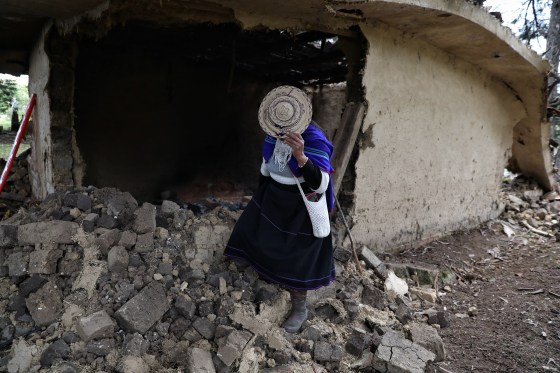
A Misak Indigenous woman stands amid the ruins of a house torn down during clashes with the Nasa community over a land dispute in Silvia, Colombia, Friday, May 22. (Santiago Saldarriaga / The Associated Press)
RECONCILI-ACTION OF THE WEEK
Every week I highlight an action, moment, or milestone forwarding reconciliation, illustrating how far Canada has come — and how far the country has yet to go.
The reconcili-action of the week (I hope) is the appointment of a new Indigenous advisory circle for Manitoba Hydro.
Co-chaired by Robert Wavey, a former chief and CEO with Fox Lake Cree Nation, and former Treaty Commissioner for Manitoba and current chair of the Manitoba Hydro Board Jamie Wilson, the provincial government has tasked advisory council members for Manitoba Hydro to keep Manitoba Hydro publicly owned, rebubild relationships with Indigenous communities, maintain affordable engery rates, and support economic Indigenous-led development.
I’ve already commented on how much work Manitoba Hydro has to do to repair the Crown corporation’s relationships with the PMO and the country at large, so let’s send best wishes to hope for the best.
|