|
I was at a Free Press Patron event last weekend, where readers who have joined our patron program enjoy special perks, in this case, tickets to a Prairie Theatre Exchange matinee and a wine-pairing seminar from drinks writer Ben Sigurdson, featuring wine from the Winehouse and snacks from Sharecuterie.
I was pleased, as I always am at these events, to connect in person with readers who love the newspaper, appreciate what we do and trust us as experts.
I was reminded of the strength of this connection when I read of Marion Warhaft’s death on Feb. 28. Despite never being pictured in the paper or revealing her identity to restaurants, the venerable Free Press restaurant critic — who wrote a weekly column for 37 years, well into her 80s — was a local celebrity, feared and revered in equal measure.
Advertisement

She wielded immense power and she took it very seriously. She knew legions of Winnipeggers based their dinner plans on her recommendations and she strove to be unbiased but unflinchingly honest. When she loved something, she raved, but she tempered her passion with critical judgement based on a lifetime of eating out all over the world.
The days of the incognito critic are long gone. Restaurant reviewers for today’s major daily papers judge food contests and post to Instagram; they’re certainly identifiable when they dine out.
And while it can be argued that a restaurant can’t suddenly improve its food when a critic visits, I don’t think the current slide toward “influencer”-style reviews is doing real food fans a service.
I do not dispute the hard work that goes into being an influencer, but let’s never forget that it’s marketing, not journalism. When goods or services are being provided free of charge with the hopes of exposure or a good review, the resulting content is ethically compromised.
Being unrecognized meant Marion never received preferential treatment, free food, or special chef’s menus. No one could try to curry favour with her (although I suspect many women who were NOT Marion had their meals comped, judging from the misconception many restaurateurs had about her appearance).
It meant she didn’t need to pull any punches; she wasn’t afraid to dole out scathing reviews. But she was never mean for the fun of it (or for the equivalent of “clicks”).
I was lucky enough to be her editor for several years, and I remember accompanying her to a very middling new restaurant in the West End: unexceptional food served in bland surroundings by indifferent staff. I was almost looking forward to her withering review, but instead she said, “I’m not going to write about this place, because it will be closed in six months.”
She was absolutely right; it shuttered four months later. Her negative review would have been entertaining, no doubt, but also a waste of both her time and readers’ time.
Looking through the archives of her articles, I stumbled upon a quarter-page ad from a long since shuttered restaurant called Jayson’s. “Marion Warhaft is entitled to her personal opinion. These are personal opinions of some of Jayson’s customers,” read the black-and-white ad, followed by a list of testimonials (“A great dining experience.” IZZY ASPER, Q.C.).
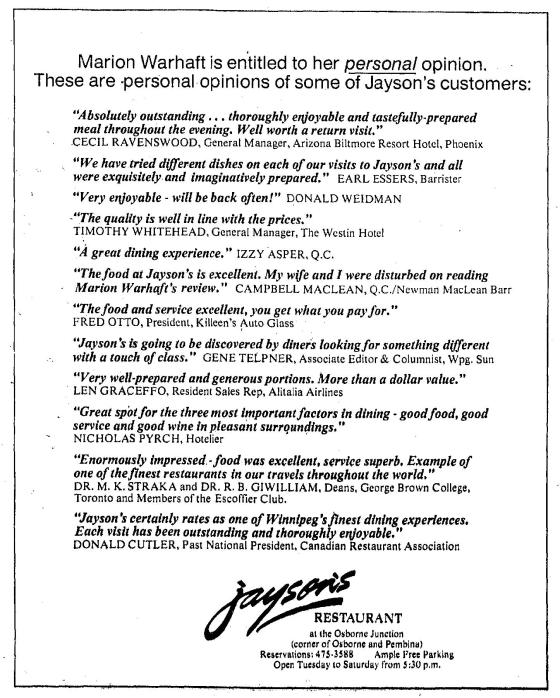
An advertisement published on Oct. 9, 1981 in response to Marion Warhaft’s review. (Free Press archives)
I was unable to find the review of Jayson’s that precipitated such a response, but was I was struck by the form of rebuttal — a kind of precursor to the online comment section, but restricted from trolls and loons.
It’s tough to imagine any business taking out an ad to refute a review these days, but it is a nice reminder of the power of the press and a testament to the importance Marion Warhaft had in the local food scene as a true independent critic. We won’t see her kind again, and that’s really too bad.
|