|
Hi, hello, I am back.
Almost three weeks ago, I had a 6 cm ovarian cyst removed, as well as a laparoscopic bilateral salpingectomy (or bisalp), which is the removal of both fallopian tubes. I have been dealing with polycystic ovarian syndrome (or PCOS) for years. Now, as it turns out, I also have endometriosis.
This whole saga began almost a year ago when I went to emergency with a burst hemorrhagic ovarian cyst (or “chocolate cyst,” as they are called, which is, frankly, so much more disgusting). I’ve had ultrasounds and an MRI and was referred to a gynecologist and, finally, had surgery.
And my saga with this isn’t over, especially since I have a new diagnosis to manage, as confirmed by this laparoscopy, which, not-so-fun-fact, is the only way to definitively diagnose endometriosis.
But while a year seems like a long time, I believe I got to this point in my journey faster than many other women, based on conversations I’ve had both in my life as well as part of our Silenced Symptoms series.
I can owe that to the fact I have an excellent care team who has believed my pain and didn’t send me away with “heavy bleeding is normal in a woman your age” and an Advil.
(Can I also just say that it’s weird that you are not automatically hooked up with a gyne the day you get your period? I appreciate that GPs can navigate some of this stuff, but the fact that I saw an actual gynecologist for the first time at 39 years old is wild to me.)
Bisalp is actually a pretty common permanent birth control option; instead of tubal ligation, the tubes are removed entirely. That feature is just a bonus for me: I actually opted for a bisalp for cancer prevention. Because of my PCOS and family history, I am at a higher risk for ovarian cancer, and many ovarian cancers actually originate in the tubes.
Removal of my fallopian tubes reduces my lifetime risk of developing ovarian cancer by 50 per cent.
I’m sharing this with you because so many other women have bravely shared their stories with the Free Press, and I am so grateful to them. These kinds of reproductive conditions affect huge numbers of us. It does no good to keep them shrouded in mystery.
I am also so thankful that this surgery was an option for me — that I live in a country where I have reproductive autonomy and a care team that saw, clearly and without question, that further investigation into my pain was necessary. Pelvic pain isn’t normal. We can no longer accept that it is.
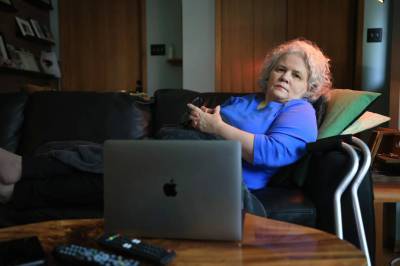
So, anyway, that’s what’s been cookin’ over here. I’ve been watching a lot of TV and walking when I can and sleeping more than I ever have. Healing requires rest. Radical rest. More than I think I realized. Three weeks out and I’m struggling to make it past 9 p.m.
I’m trying to take care of myself, but I’m also trying to allow others to take care of me, too. Like my bestie Carly, who singlehandedly made sure I ate that first week by stocking my fridge with meal prep.
When I had to take a short leave in 2023 when my parents had their fire, this was one of the reflections I shared with you:
Asking for and accepting help is hard, but good. I’m a pretty self-sufficient person and I don’t like being a burden or an inconvenience in any way, but this whole experience has really snapped into focus for me that relentless self-sufficiency is not a great way to live.
Accepting help can be hard if you also have some icks around being vulnerable (hi), but like any muscle, it’s one you have to work.
I am realizing more and more that my own discomfort with being “a burden or an inconvenience in any way” is a double-edged sword, because it also affects how I show up for other people when they are in need.
Advertisement

I end up massively overthinking things. Is dropping off food annoying? What if I make something they hate? Oh my god, what if I give them food poisoning somehow? Am I checking in too much? Too little? Is it weird and invasive if I come over and clean something?
Then I just freeze and say, “let me know if you need anything.”
No slight to people who say that, or who have said that to me. I say it, too! It’s a well-meaning phrase. Its heart is in the right place.
But most people — at least in my experience — don’t let you know if they need anything.
It’s worth unpacking why that is. Is it because people don’t want to feel, like I do sometimes, like yet another to-do on someone’s overflowing list? Is it because we increasingly don’t have IRL communities — or “villages” — on which to lean?
Is it because we feel like we “should” be able to handle things ourselves? Is it because everyone’s lives have returned to their pre-pandemic levels of busy? Is it because we’ve internalized the social-media ideal that we need to “have it all together,” which means we don’t want people to see us/our homes/whatever when we don’t have it all together?
Maybe we need to give each other more credit. I don’t love my friends and family because their houses are immaculate or because they are never sick; I love them no matter what.
We don’t need to apologize for our bodies or our homes or anything else.
Maybe it’s easier to show up for each other if we all just come as we are.
|