|
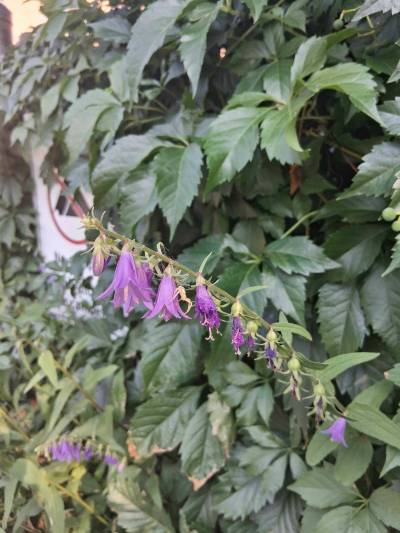
Can you name this perennial plant with its strange-looking flower pods? Hint: it flowers in September. Scroll down for the answer.
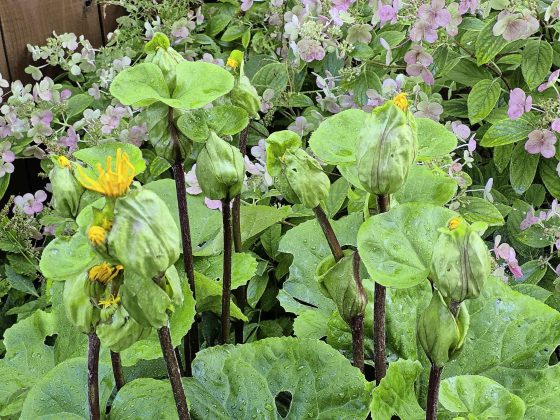
Name this plant with its strange looking flower pods (hint: blooms in September) (Colleen Zacharias photo)
Ticks in our backyards
In last month’s Winnipeg Gardener, I provided an incorrect video link in my story about ticks in Manitoba.
The correct video is here.
The video features Dr. Kateryn Rochon, an associate professor in the Department of Entomology at the University of Manitoba, explaining how to properly remove a tick.
Awareness of ticks is important. Ticks can be in our backyards, even in the city, says Dr. Rochon.
“Blacklegged ticks are responsible for transmitting many human pathogens, including those causing Lyme disease and human granulocytic anaplasmosis.
“What few people realize is that adult blacklegged ticks are active in the fall when ticks are not so much on our minds. As a result, people don’t think of checking for ticks, and they become at risk for tick-borne diseases,” says Rochon.
eTick is a public platform for image-based identification and population monitoring. This useful resource provides information on prevention.
“There is also a map feature to visualize where (images of) ticks have been submitted from,” says Rochon. “All the submissions to eTick are vetted and identified by real people.”
In fact, submissions from Manitoba are sent to Dr. Rochon and her team!
Mandevilla or dipladenia?
Why is mandevilla sometimes called dipladenia?
Mandevilla is an annual, twining vine with trumpet-shaped flowers. Some types can climb to great heights — three metres or more.
But there is also the bush-type mandevilla — sometimes called dipladenia — which has smaller leaves and a much more compact size, well suited as a patio plant.
It may surprise you to learn that the genus Dipladenia was formally reclassified into the genus Mandevilla back in 1933! So really, the name dipladenia should no longer appear in commercial plant labelling.
Expect the name dipladenia to stick around, however. Fernlea Flowers in Ontario, for example, supplies a line called Rio Dipladenia to Home Depot and RONA stores. But the Rio series is a compact series specifically bred for a shrub-like habit.
A new series from Selecta One clears up the confusion by using a key word — “compact” — in its name.

Divina Compact Red (Colleen Zacharias photo)
Divina Compact Mandevilla Series is a mounded, bush-type mandevilla. The series offers three vibrant colours of blooms — red, pink, and white — on a non-tangling, compact bush habit. Beautiful trumpet-shaped blooms. No trellis needed!
What’s the easiest way to distinguish between a compact, bush-form mandevilla and a vigorous climbing mandevilla vine? Look at the leaves. A bush-form mandevilla has small, satin-smooth leaves with pointed tips. A tall-growing mandevilla climbing vine has large paddle-shaped leaves with horizontal ridges.
Few other flowering annuals like bush-type mandevilla sail through weeks of summer’s dry, scorching heat and still look fresh as a daisy in June.
A new shrub for 2027
Diervilla lonicera, commonly known as northern bush honeysuckle, is native to eastern and central North America. It can be found across Canada from Newfoundland to Saskatchewan.
In the wild, it is a low-growing deciduous shrub that forms loose, mounding thickets.
High-Viz Diervilla is a richly colourful native selection shrub that is new for 2027. But first, in real terms, what does “native selection” mean? Yes, it differs from a purely native plant.
A native selection shrub is one that has been specifically bred for distinct traits — basically, tamed or improved, if you will, for the urban landscape.
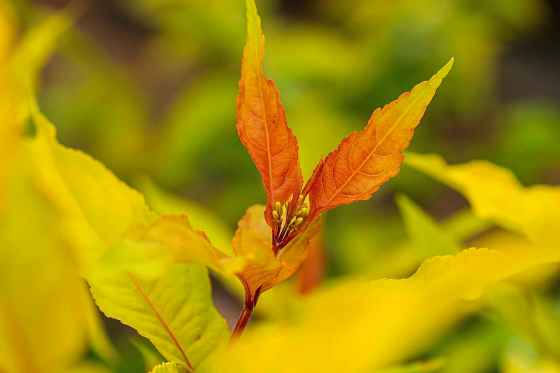
High-Viz Diervilla — colourful new shrub for 2027 (First Editions photo)
Bred by Bailey Innovations, a plant breeding division of Bailey Nurseries which is headquartered in Minnesota, High-Viz Diervilla is a high-visibility shrub with standout transitional colour from spring through to fall.
In spring, new growth emerges with a soft apricot-peach tint, maturing to bright chartreuse foliage in summer. Small yellow flowers attract pollinators.
But in fall, High-Viz turns up the colour with leaves that turn orange and red.
High-Viz is hardy to Zone 3. It is said to be deer-resistant and is tolerant of drought and wet soil conditions. Suitable for full sun to part shade locations. Height and spread is around 120 cm.
For the most part, the Diervilla genus is a well-behaved plant, but some suckering growth is to be expected. Unwanted growth pulls out quite easily — just stay on top of it. The unique, colourful foliage and all-season interest make this plant a worthwhile addition to the garden.
Interesting fact: diervilla is named after M. Diereville, a French surgeon, botanist and travel writer who travelled in Acadia in 1699. He introduced the bush honeysuckle plant to Europe.
Russian sage: stop the flop
When the airy cloud of lavender blue flowers on the silver-blue stems of Russian sage stays upright, there really is nothing else like it in the late summer and early fall garden.
But when the stems fall over, the vision collapses. What’s the problem? Too few hours of direct sunlight or soil that is too rich or too moist? That could explain it.
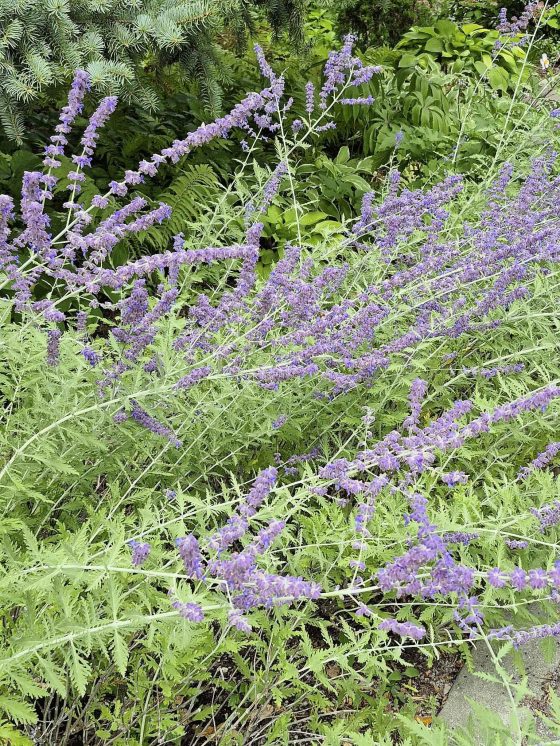
Russian sage: flopping stems (Colleen Zacharias photo)
But if conditions are close to ideal, here are some tips for next year to encourage your plant to produce more side shoots for a bushier habit.
- In early spring, cut the stems back to 15 to 30 cm above the ground.
- When the stems begin producing new leafy growth — early to mid-June, for example — pinch off the top 7 to 8 cm of the stems just above a leaf node.
This could result in a delay of blooms, but your patience should be rewarded with a neater, sturdier plant that won’t fall over.
A cheeky (but honest) question
Should we really promote Heliopsis without mentioning the Uroleucon aphid?
Heliopsis helianthoides, commonly known as false sunflower, flowers prolifically from midsummer to fall. With an abundance of daisy-like flowers in shades of yellow, golden-yellow, rusty orange, or red-orange, this hardy perennial puts on a beautiful show, especially from a distance.
But if you think the flowers are prolific, wait until you see the aphids.
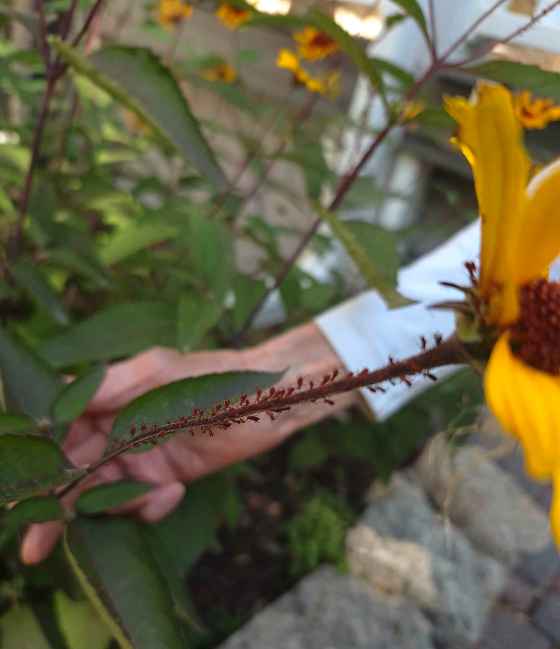
Red Uroleucon aphid on stems of Heliopsis false sunflower (Colleen Zacharias photo)
What unsuspecting gardeners should know about Heliopsis false sunflower is that it is a host plant for the red Uroleucon aphid.
The red aphids congregate in masses on the stems and can also be found on the undersides of petals. Blasting the stems with a strong spray of water from a garden hose has limited success, especially in the case of mature plants which have dozens of stems.
The rate of reproduction for the red Uroleucon aphid is astounding. You can learn more in the July 2023 issue of Winnipeg Gardener.
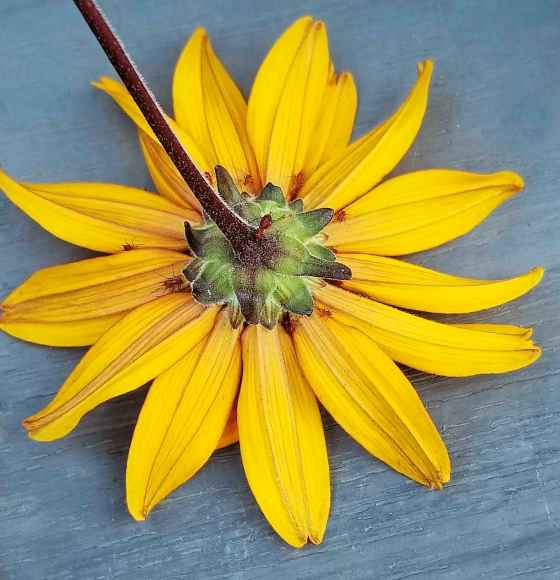
Red Uroleucon aphids on underside of false sunflower petals (Colleen Zacharias photo)
So, here is my question: why is there no mention whatsoever of the Uroleucon aphid in consumer marketing? After all, milkweed is universally marketed as the host plant for the monarch butterfly.
Granted, there is a difference. The monarch butterfly is a beloved, essential pollinator while the red aphid is a sap-sucking pest. But gardeners still deserve to know.
One more reason to read Winnipeg Gardener newsletter: there will be no sugar-coating!
Carboard in the garden
Should cardboard, unbleached kraft paper, or shredded paper be used as a mulch in the garden?
Depending on your perspective, the use of cardboard, kraft paper or shredded paper as a garden mulch to suppress weedy or invasive growth is a good idea or a very bad idea.
I used paper yard waste bags made of biodegradable and compostable kraft paper to rid myself of Lysimachia ciliata firecracker, which had overtaken a swath of my garden.
Native to southern Manitoba, Lysimachia ciliata can be found growing on local riverbanks and damp wooded plots like La Barriere Park.
Lysimachia ciliata is not listed as a noxious weed on the Manitoba Noxious Weeds list. However, it spreads aggressively via underground rhizomes.
Lysimachia ciliata firecracker, also known as firecracker loosestrife (but not to be confused with highly invasive purple loosestrife), can be found at garden centres. It features handsome bronze-burgundy foliage and nodding yellow flowers and grows to a height of 60 cm tall.
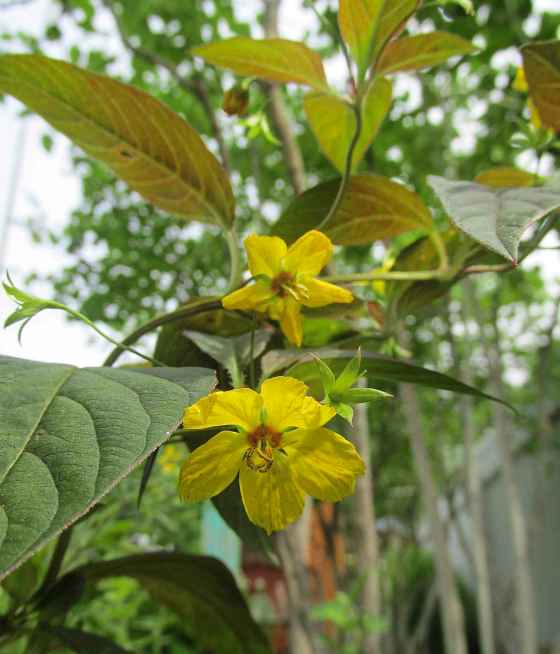
Lysimachia ciliata: tough to get rid of (Wikimedia)
I planted one Lysimachia firecracker in my garden about 15 years ago in what I thought was a relatively contained area. Over time it became a rampant thicket. When I had enough, I tried pulling it out, but it grew back even more vigorously.
Finally, I resorted to putting down a layer of paper yard-waste bags, watered the paper layer thoroughly with my garden hose, then covered the bags with a 10-cm layer of wood chips.
On the surface, the method worked. The Lysimachia firecracker was finally stopped in its tracks.
But despite the choice of biodegradable paper yard-waste bags as an eco-friendly alternative to cardboard which can contain synthetic adhesives, was this method in the best interest of the soil and its beneficial microorganisms that lie beneath?
Martha Stewart recently suggested using shredded paper as a mulch in the garden, provided it is the “right” kind of paper.
But Linda Chalker-Scott, a Washington State University Extension urban horticulturist and one of the acclaimed Garden Professors, a popular science-based home garden and landscape discussion group, is adamant that cardboard or paper-sheet mulches do not belong on soil. Period.
Bottom line: gardening is hard work. Soil structure, beneficial microbes and fungal networks deserve to be protected. Quick fixes can create longer-term issues.
Weeding pavers
How well do long-handled crack weeder tools work to remove weeds growing between pavers?
I’ve tried flame weeding and boiling water. But flame weeding with a propane torch is a smelly job, and boiling water only works on weeds with shallow roots — plus there is the risk of damaging nearby garden plants in the case of splashes.
The obvious benefit of long-handled crack weeder tools is the job can be done while standing up.

Long-handled crack weeder tools (Colleen Zacharias photo)
Lee Valley sells a telescoping crack weeder that extends to 1.16 metres (or 46 inches). It was reasonably priced at $28.50.
It has an aluminum handle which twists and locks into place and a stainless-steel blade which is advertised to “slice through grass and weeds rooted between paving stones.”
My experience? It might slice through butter, but it did not work on the weeds between my paving stones.
Next, I purchased a Fiskars brand Telescopic Sidewalk Crack Weeder for $40.
The telescoping handle extends to 1.67 metres (66 inches). It comes with a stainless steel blade, steel shaft, and twist lock handle.
It’s only slightly more effective at removing the shallowest of weeds — after repeated slicing — than the telescoping tool from Lee Valley.
Bottom line: the extended handle may be easy on the knees, but it’s also easy on the weeds.
Lee Valley’s surefire, short-handled crack weeder with beechwood handle for $42.50 gets the job done every time. Use a thick kneeling pad to protect your knees.
Canadian-made organic plant food
Oberland Agriscience is a Halifax-based company that uses bio-driven technology to transform black soldier fly larvae (BSFL) into eco-friendly products.
One of those products is called 2nd Nature Organic Plant Food. At Cultivate ’26, a major event for the green industry that is held each year in Columbus, Ohio, 2nd Nature Organic Plant Food was one of 15 products to receive a Retailers’ Choice Award.
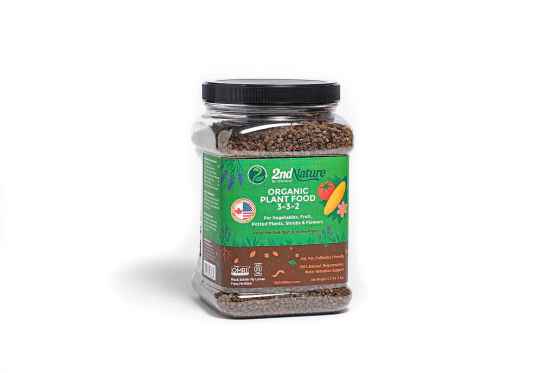
2nd Nature Organic Plant Food, made in Canada, future launch planned by Oberland Agriscience Inc. (Supplied)
The black soldier fly was first described scientifically by Charles Linnaeus in 1758. Oberland Agriscience sees huge potential in black soldier fly larvae (BSFL) to support soil and plant health. The company also uses BSFL to make a protein supplement for chickens and pets.
Currently 2nd Nature Organic Plant Food is only available in the United States.
In response to my inquiry as to why this new product was not yet available for sale in Canada, a company spokesperson said, “We are actively working towards having it on the shelves by early spring next year, in time for seeding and planting season. We also anticipate receiving CFIA (Canadian Food Inspection Agency) certification soon.”
Learn more about BSFL and Oberland’s innovative products here.
Name this plant
Answer: Ligularia othello.
With its prominent, alien-looking flower pods that open to bright, golden-yellow daisy-like flowers atop thick, dark purple stems and extra-large foliage, Ligularia othello lends drama to the September garden.

Ligularia othello blooms in September (Colleen Zacharias photo)
Mark your calendars
On Saturday, Sept. 12, plan to take in the Honey, Garlic and Maple Syrup Festival at the Manitou Fair Grounds, 212 Carrie St., in Manitou.
Enjoy fresh, local honey, garlic and maple syrup at this popular event. Talk to local artisans and growers and listen to great music by local performers.
You can find delicious recipes that use honey, garlic or maple syrup in the summer edition of Savour Manitoba.
Experience the Manitoba Fibre Festival on Sept. 11 and 12 at Red River Exhibition Place, featuring artisans, makers and demonstrations.
Check out my Sept. 5 column for an interview with Bethany Booy, a local artist and gardener who creates a range of textiles and other products from plants she grows in her garden. Find out more at the event website.
On Sept. 20 starting at 10 a.m., the South Interlake Garden Club will host a fall plant auction at the Red Barn and Shed, located at Road 75 North and Highway 236, south of Stonewall. For more details, visit South Interlake Garden Club’s Facebook page or email southinterlakegardenclub@gmail.com.
The Manitoba Regional Lily Society will hold its annual fall lily bulb sale on Saturday, Oct. 10 at the St. Vital Shopping Centre, open 10 a.m. to 4 p.m.
A curated selection of heritage and historic varieties of lilies from a new Canadian supplier will be available to purchase. There will also be a selection of unregistered lilies from the breeding programs of Fred Fellner and Alex Burnet, well known Canadian lily breeders. MRLS members will be on hand to answer all your lily questions.
Prices range from $5 to $25. Pay by credit or debit card, cheque or e-transfer.

Snow bunting Asiatic lily, in white, is a hardy lily bred in Manitoba by pioneer hybridizer Ed Robinson. (Deborah Petrie photo)
The best time to plant lily bulbs is in the fall. Here’s what you can do now:
- Decide where you would like to grow lilies in your garden.
- Pre-dig planting holes while the soil is still warm. This makes planting easier in October’s cooler temperatures — just drop your newly purchased lily bulbs into the ready-to-go planting hole. Pre-digging also helps to loosen any compacted soil in the planting hole by exposing it to air and moisture.
|