|
“Think of the intelligence of the average person, and then considerhalf of them are stupider than that.”
— George Carlin
It seems every day, some Winnipeg drivers are out to prove George Carlin, the late comedian, correct.
It’s something that’s good for business: body shops don’t care who is at fault, they just appreciate the work. It’s bad, however, for mental health.
A guy who admits he didn’t obey a stop sign because “I was excited to be leaving work,” is the reason for my latest trip to a body shop.
Advertisement

My first thought was if you’re that excited to be leaving work, perhaps you need a better job. Just sayin’.
I’m happy to say the last time I had an at-fault collision — I refuse to call them accidents — Brian Mulroney was prime minister. I’ve also been able to avoid several dingers thanks to good brakes, roving vision or general anticipation. For this one, however, a low coefficient of traction combined with no other good option meant… crunch.
A feature, or perhaps bug, of the insurance industry is this: if you’re not involved in the collision, you cannot be held responsible for it. So, if you’re going to hit a car anyway, it may as well be the at-fault driver’s car. If you swerve to avoid the would-be at-fault driver and take out a light post or hit another car, the person at fault is the one looking back at you in the mirror.
Avoiding fault is valuable: you don’t pay your deductible, he does. If you need a replacement vehicle while yours is in the shop, her insurance, not yours, pays for it. The collision doesn’t affect your insurance premium and doesn’t affect your driving record. If you’re avoiding hitting the at-fault driver’s car to save a life, all those considerations are moot. Save the life.
The damage to either car isn’t bad and the other driver was completely apologetic, but thanks to damage to the front fascia, an LED headlight, the hood and a quarter panel, I’m expecting the bill to MPI to be a few thousand.
Most importantly, nobody was hurt.
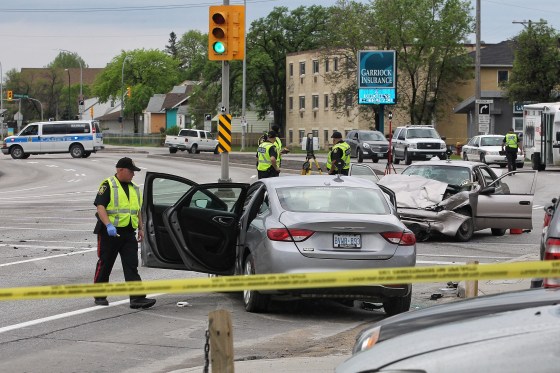
Traffic collisions are a billion-dollar business in Manitoba. (Mike Deal / Free Press Files)
According to MPI’s annual report, more than $1.2 billion was paid out in claims in 2024: of that, $981.7 million was paid on property damage. On an average basis, every business day 1,121 claims were reported. Staggering numbers. Let’s look at how some of those occur, based entirely on my observations.
Stop signs are not optional. That you believe you can get away without stopping doesn’t mean you’re entitled to just roll through.
You’re entitled to take the first available lane when turning.
Winter tires work. They’re not magic, but you do get more control than with all-season tires.
Stay off your phone.
Only the first car in line to turn left is allowed to exit the intersection, if the driver was smart enough to enter it, on a yellow/red light.
Green means you may go: it’s up to you to decide if you should.
The longest you’re ever going to wait at most intersections, if you miss the green, is a couple of minutes. You don’t need to race to try to beat the yellow, particularly if it means you’re entering on red.
You should have no expectation of being able to squeeze past a car beside you if your lane is dying. It’s nobody’s job to make allowances for your mistakes other than you.
Pay attention. You’re driving a 1,700-kilogram-or-heavier weapon. If you can’t be bothered to keep your attention on the road, to look out for threats or to anticipate you need to start slowing down now… you need a bus pass, not a driver’s licence.
If you want to be the safest, most courteous driver on the road, simply do what is expected of you. If it’s your turn at a four-way stop sign, take it. You’ll spend more time trying to be generous than it would take for you to go. If you’re expected to take the first available lane — such as at intersections where more than one lane can turn at once — just do it. Figure out lane changes if you need afterwards.
Driving is a community activity. It shouldn’t be a selfish one.
|