|
Good evening, and thank you for the opportunity to speak with you about the future of local journalism.
My name is Christian Panson, and I am the vice-president of digital and technology with the Free Press, The Brandon Sun, Free Press Community Review and The Carillon in Steinbach.
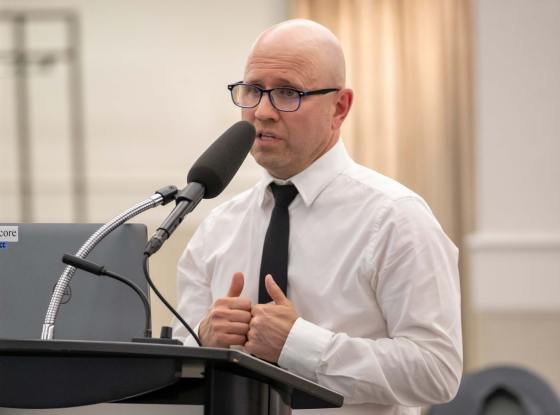
Christian Panson speaking to the Manitoba government’s all-party journalism committee on July 2. (Brook Jones / Free Press)
Though I represent publications that have been a major contributor to community journalism in this province for 152 years, I am not here to speak about them or the well-documented decline of the traditional newspaper industry.
Nor will I extensively detail the profound challenges facing local media – the stark reality of foreign media platforms vacuuming up 95 cents of every advertising dollar, or the impact of Facebook and Instagram blocking news.
These unfortunate realities have been documented in numerous studies over the past decade and particularly highlighted in the Shattered Mirror report by the Public Policy forum, and are sadly “old news.” (Although if you have not read it, and their recent reflection on it five years on, please do.)
Instead, I want to talk about journalism itself — as an essential public good. I want to talk about the hundreds of Manitoban journalists who live, work, and serve in our communities.
These are the writers who cover our local sports teams, celebrate our successes, and hold power to account. We employ more than 90 journalists across multiple communities, but my focus today is on all journalists in this province, working in both small and, at times, very significant ways.
Let’s consider a powerful question: What if our province’s stories were never told?
And perhaps more importantly, what if the verified information they contain never reached the public?
I mention this last point as the thought of a future where a foreign media platform’s algorithms are the only source of information to my children is, frankly, ominously dystopian.
Let me give you a few examples of reporting that shows the critical role of local journalism, and I hope you will reflect on the consequences of stories like this not being told in the future.
Building Blocks, Crumbling Foundation was a winner of both the McGillivray Award for investigative journalism and the top written news award from the Canadian Association of Journalists. This six-part investigation into the state of childcare in Manitoba examined the underlying issues that put kids and families at risk. One of the stories detailed the challenges facing parents in the North.
Thompson has lost two of its news sources in the last three years: the Nickel Belt News and Thompson Citizen. Without the Free Press investing the time to have a reporter in Thompson, would the cold, harsh reality facing northern child-care centres have been put on the public’s radar?

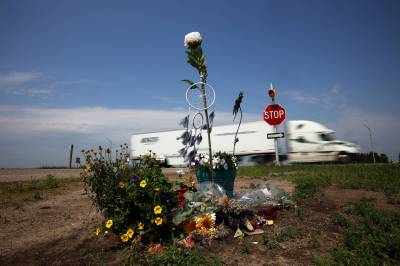
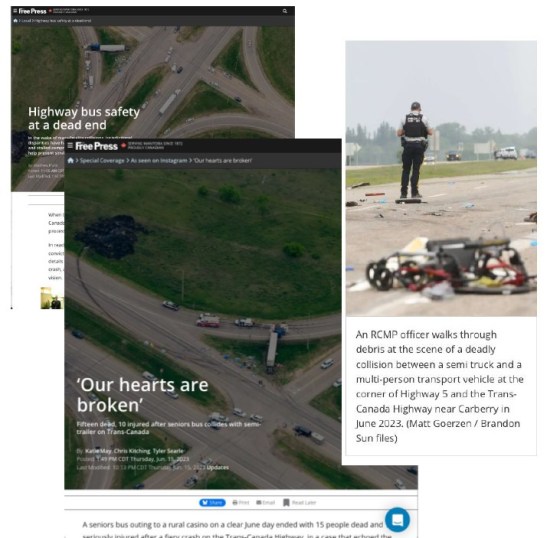
When a crash on the Trans-Canada near Carberry killed 17 seniors, joint reporting efforts by the Free Press and The Brandon Sun delivered real-time, verified reports and captured aerial imagery illustrating the extent of the tragedy. National outlets did cover this story, but either from afar or many hours later.
Manitobans’ understanding of the event would have been filtered through a national, rather than local, lens. Follow-up coverage on topics like highway safety, infrastructure improvements and the impact the crash has had on people in Dauphin and Carberry, would be few and far between.
During the height of the pandemic, our journalists were on the ground providing daily, factual updates on Manitoba public health briefings. They translated complex medical information into understandable terms and held officials to account for their decisions.
Our newsroom launched a nightly briefing on the pandemic to keep people up to date on the daily situation. We sent more than 500 briefings to as many as 200,000 readers, sending more than 500 million informative emails over the course of the pandemic.
Without this vital service, how much more misinformation would have spread unchecked? What would our vaccine uptake have looked like? How many more Manitobans could have died?

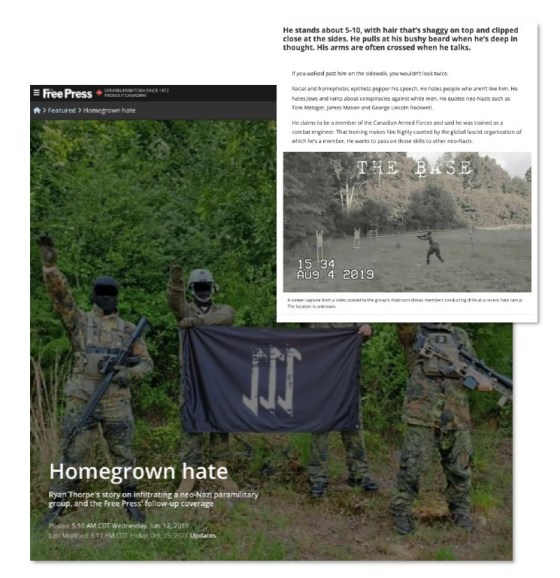
Our investigative series Homegrown Hate exposed a burgeoning neo-Nazi group operating right here in our province. It brought to light alarming activities and plans.
Without this reporting, would this group have grown in the shadows? Would they now be established, would they have executed their plans while the public remained unaware and unprotected?
These are just four examples of the kind of accountability and public service that local journalism provides. This work is happening every day in newsrooms across Manitoba, where reporters uncover fraud, celebrate community heroes and cover government meetings not unlike this one.
There was a day once when four or five media outlets would be in a meeting like this. Today there is likely one.
So, the question before us is this: How do we ensure the continued, healthy flow of news and information that is vital to our democracy?
What are the least intrusive and most effective ways for government to design and deliver policies that ensure this public good continues to serve and enlighten our communities?

We have three specific calls to action for this committee’s consideration:
1. Advertising Reallocation: We ask the province and its Crown corporations to direct their advertising spending away from foreign-owned mega-platforms and back to local Manitoba media.
These platforms do not reinvest in our communities; we do.
2. Local Advertising Tax Credit: We ask the province to enact a tax credit for local businesses that advertise with qualified Manitoba media companies.
This would be a powerful incentive for businesses to support the local news outlets that serve their communities.
3. Journalism Support Programs: We seek government support to create programs that fund the hiring of journalists to cover communities that are currently underserved.
This includes rural areas and cultural or linguistic groups that exist in what we call “news deserts.” These communities deserve to have their stories told.
Thank you.
COMING UP
It was a seminal moment 40 years ago — the biggest bands from around the world gathered for Live-Aid, a global concert phenomenon that raised billions of dollars to address starvation in Africa.
John Longhurst talks to the Winnipeg pilot who played a pivotal role in bringing Ethiopia’s plight to the masses.
Feature writer AV Kitching profiles Interlake artist LeVerne Tucker, who salvages discarded sheep hides and transforms them into works of art and pieces of comfort.
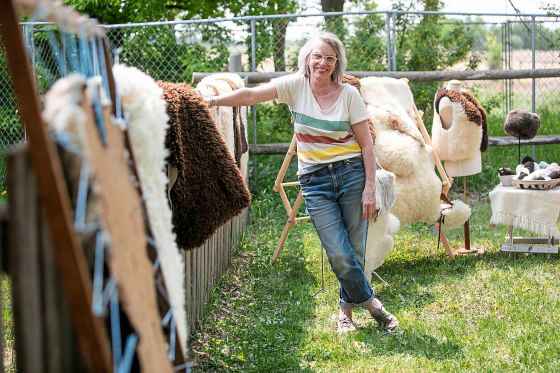
LeVerne Tucker with sheep hides on her farm near Teulon. (Mikaela MacKenzie / Free Press)
As the Goldeyes battle for positioning before the all-star break, Taylor Allen and Zoe Pierce bring you the action as the Fish wrap up their series against the Sioux Falls Canaries Thursday and start up their weekend series against the Kansas City Monarchs Friday at Blue Cross Park.
On the gridiron, Joshua Frey-Sam tees up the rematch coming out of Winnipeg’s bye week as the Blue Bombers prepare to host Calgary after the Stampeders handed the Blue and Gold their first loss of the season. And Jeff Hamilton is set to analyze all things Week 6 from around the three-down loop in his weekly CFL Rundown.
ONE GREAT PHOTO

Artist Mike Zastre creates one of several murals along a four-block stretch of Graham Avenue Tuesday morning. (Mike Deal / Free Press)
|