FIVE STORIES ON TURTLE ISLAND
Speaking of Danielle Smith, the Alberta premier this week gave an exclusive interview to The National Post.
Smith floated the idea that instead of working with First Nations in northern B.C. who have said no to a pipeline through their territories, Alberta could ship oil through the U.S. states of Montana, Idaho, Washington or Oregon.
Um, I have some news for Smith: Native American tribes in Montana, Washington, and Oregon don’t like pipelines, either.
The Indigenous social media world was abuzz this week about a much-attended and much-viewed conference in Sault Ste. Marie, Ont., which examined the controversial and conflicted claims by the Métis Nation of Ontario (MNO) over what they claim to be six Métis communities in the province.
Featuring 20 high-profile Anishinaabe scholars and leaders and other academics, the sold-out conference, called the “(Un)Making of Métis Claims in Ontario Forum,” was broadcast to more than 1,000 people online.
Presenters offered research that disputed Métis people existed in any of those MNO communities. The MNO called the conference “anti-Métis” and said it was based on “identity-based attacks emerging from Ontario to Alberta.”
The MNO has obtained nearly a billion dollars in federal funding based on their claims, while legitimate, historical First Nations and Métis governments — including the Red River Métis, where virtually all Métis history emerges — say the MNO is misrepresenting a large portion of their membership.
The MNO is also making land claims over First Nations territories in Ontario, and taking on the role of “Indigenous consultation” with the private industry regarding resource development.
Another fascinating conflict has emerged in Regina, where elders who worked at the Paul Dojack Youth Centre — a detention facility — are claiming they were fired as an act of “retaliation” because they “defended cultural protocols” while working with young Indigenous men.
This wasn’t a case of racism or ageism, but primarily over menstruation.
Many Indigenous traditional people say that women on their “moon time” should be given special spaces to “rest and renew” and should not participate in ceremonies.
The elders at the detention centre are accused of ostracizing and insulting a staff member who participated in the ceremony while menstruating and “throwing out” the moose meat she had brought for the feast.
Now, the youth at the Dojack Centre — many of whom are Indigenous — have no elders on staff.
Indigenous leaders across the country — and particularly in B.C. — are celebrating the political meltdown of former B.C. Conservative Party MLA and OneBC leader Dallas Brodie after she was ousted as party leader this past week.
Brodie has been regularly accused by Indigenous leaders of spreading anti-Indigenous rhetoric and perpetuating misinformation about residential schools and trying to pass bills repealing the National Day for Truth and Reconciliation.
Native American citizens of the Prairie Band of Potawatomi Nation in Kansas were furious this week to find out their government had negotiated a $30-million deal with the Trump administration to open up an Immigration and Customs Enforcement (ICE) detention centre in their territories.
It’s well known the radical increase in violence and all-too-often illegal arrests and incarcerations of immigrants — and even Native Americans — taking place in the United States by the Trump administration (who ordered “quotas”).
The irony is the Potawatomi people in Kansas were themselves removed from their traditional territories in the 1830 by U.S. officials.
IN PICTURES
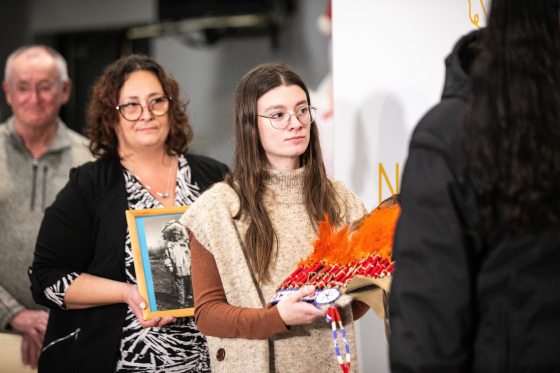
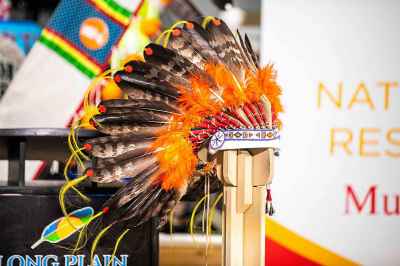
Fort la Reine Museum representative Caitlin Post carries the headdress in the grand entrance procession during a repatriation ceremony at Long Plain First Nation urban reserve in Portage la Prairie on Tuesday, Dec. 16. (Mikaela MacKenzie / Free Press)
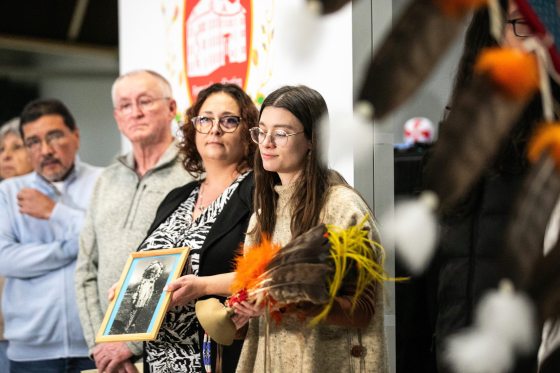
Fort la Reine Museum representative Caitlin Post carries the headdress in the grand entrance procession during the repatriation ceremony. (Mikaela MacKenzie / Free Press)
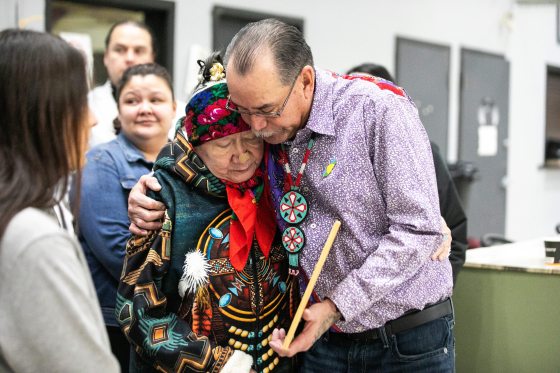
Maxine Walker-Merrick (left) and Randy Merrick embrace after the headdress repatriation ceremony. (Mikaela MacKenzie / Free Press)
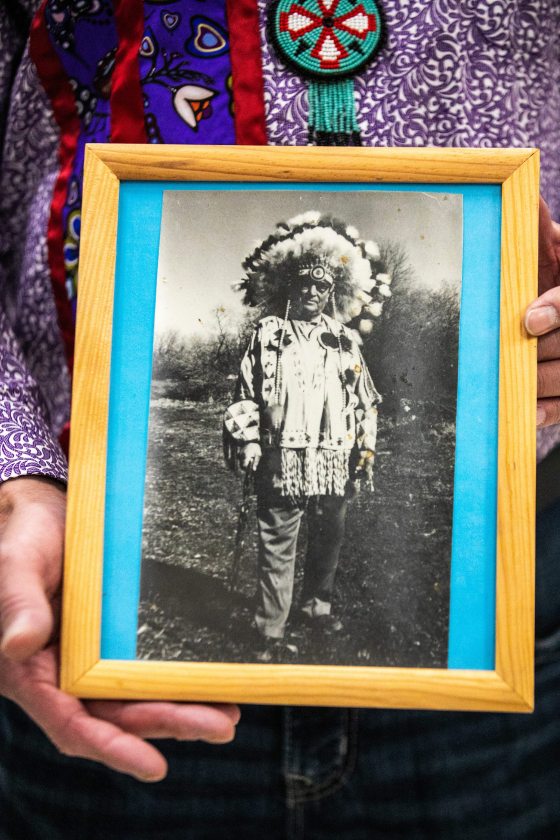
Randy Merrick holds a photo of his great-grandfather, Chief Frank Merrick, after the repatriation ceremony. (Mikaela MacKenzie / Free Press)
RECONCILI-ACTION OF THE WEEK
Every week I highlight an action, moment, or milestone forwarding reconciliation, illustrating how far Canada has come — and how far the country has yet to go.
This week’s reconciliaction is for the volunteers, leadership and everyone who donated to helping Santa arrive in 25 northern First Nations in Manitoba this week (many of them hit by wildfires this year) as the annual Santa Express initiative by Manitoba Keewatinowi Okimakanak (MKO) and Perimeter Aviation started this week. 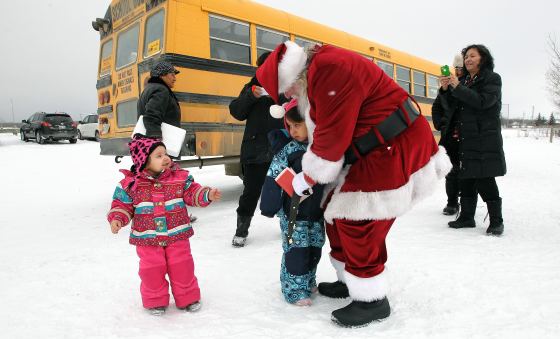
Kids get some goodbye hugs as Santa heads out to the helicopter after visiting the Black River Anishinabe School on the Little Black River First Nation during the Santa Express tour in December 2013. (Mike Deal / Free Press files)
For communities recovering from a brutal year of fires and evacuations, this will be a much happier season. That being said, Biidaajimowin: News From the Centre will be taking a short holiday hiatus until after January (my birthday!).
Miigwech and thanks to all for making the end of the first year of this newsletter such a resounding success! For everyone, and especially the readers of this newsletter, I hope you all have a good and loving time with your friends, family and relations and I will see you in the new year.
|